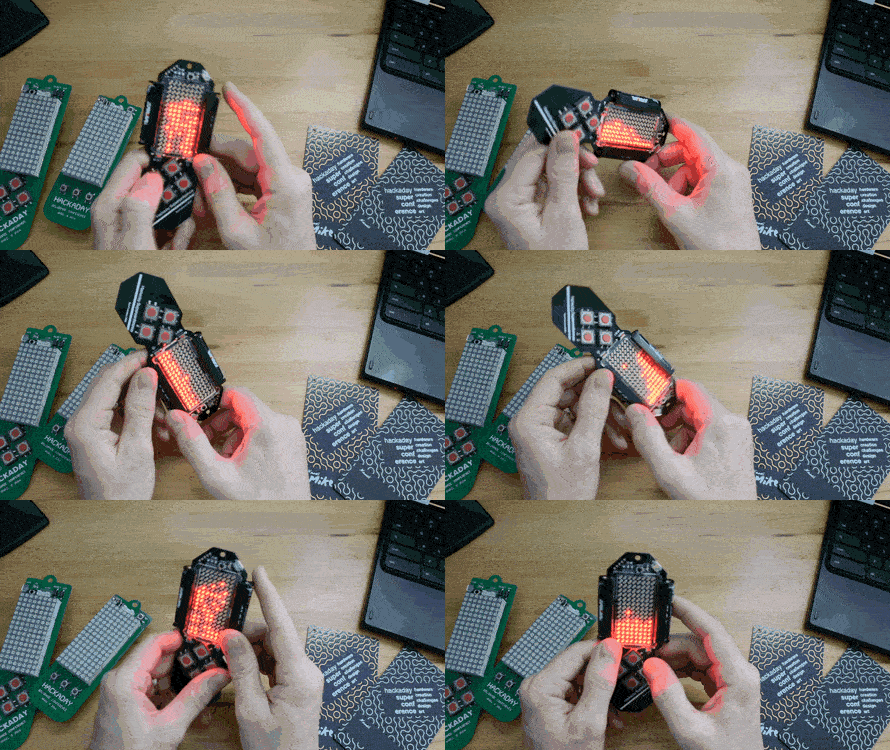
There is a lot of spectacle on display at Maker Faire. But to be honest, what I love seeing the most are well-executed builds pulled off by passionate hackers. Such is the case with [Debra Ansell]. She wasn’t exhibiting, just taking in all the sights like I was. But her bag was much better than my drab grey camera-equipment filled backpack; she build a handbag with an LED matrix and did it so well you will scratch your head trying to figure out if she bought it that way or not.
Gerrit and I walked right up and asked if she’d show it to us. We weren’t the only ones either. [Debra’s] bag started drawing a crowd as she pulled out her cellphone and sent “Hackaday” to the 10×15 matrix over Bluetooth. Check out our video interview below.
Hamvention was last weekend, and just like Hackaday’s expedition to Maker Faire, it was only fitting to find a bunch of Hackaday fans and take over a bar. This was in Dayton, Ohio, and you would think the nightlife for Hamvention would be severely lacking. Not so, as downtown Dayton is home to Proto BuildBar, a bar, arcade, and hackerspace all wrapped into one.
We’ve heard about Proto BuildBar a few years ago when it first opened. The idea is relatively simple; instead of having a hackerspace, with alcohol and video games on the side, Proto BuildBar is first and foremost a bar, with 3D printing services, a few workstations for soldering, and a few arcade games. It’s the perfect place for an impromptu meetup.
I caught up with Federico Musto, President and CEO of Arduino SRL, at the 2016 Bay Area Maker Faire. Their company is showing off several new boards being prepared for release as early as next month. In partnership with Nordic Semi and ST Microelectronics they have put together some very powerful offerings which we discuss in the video below.
The new boards are called Arduino Primo, Arduino Core, Arduino Alicepad, and Arduino Otto.
The first up is the Primo, a board built to adhere to the UNO form factor. This one is packing an interesting punch. The main micro is not an Atmel chip, but a Nordic nRF52832 ARM Cortex-M4F chip. Besides being a significantly fast CPU with floating-point support, the Nordic IC also has built-in Bluetooth LE and NFC capabilities, and the board has a PCB antenna built in.
On an UNO this is where the silicon would end. But on the Primo you get two more controllers: an ESP8266 and an STM32F103. The former is obvious, it brings WiFi to the party (including over-the-air programming). The STM32 chip is there to provide peripheral control and debugging. Debugging is an interesting development and is hard to come by in the Arduino-sphere. This will use the OpenOCD standard, with platformio.org as the recommended GUI.
Last weekend was Hamvention, the place you want to be on the third weekend in May. It is the world’s largest gathering of amateur radio enthusiasts, and an exceedingly large flea market containing all sorts of electronica.
The booths of Hamvention include a few notable Open Hardware folk, but for the most part, you’re looking a few big booths from Yaesu, an entire section dedicated to everything ARRL, and a few pop-ups from the usual suspects. Rigol was there, showing off their test equipment and selling the DS1052E oscilloscope for far more than it’s worth. The Rigol Zed is a much better buy, anyway.
As with any gathering of hams, antennas are everywhere. The largest by far was the tower at right. With a little more equipment, this antenna could do a moon bounce. It’s a shame the moon was full this weekend, and everyone went to bed early.
Giant antennas and an amateur radio trade show notwithstanding, the biggest draw is the flea market. You’re looking at about two football fields worth of parking spaces, filled with cars, tents, and collapsible tables and the strangest electronic devices you’ve ever seen. What was that like? Read on below.
This has got to be the ultimate name-dropping post. I’m tempted just to make a list. Or perhaps it should be like Jeopardy, I’ll list the products or companies and you guess who was there. I am of course talking about the Hackaday Bay Area Maker Faire Meetup last Saturday which started off as a steady stream of Faire-weary exhibitors and suddenly the place was packed to the gills. Luckily we have some photographic evidence of the awesome.
Peter Jansen seen on the right
If you do something three times you can start saying “always”, right? We always host a meetup on the Saturday night of Bay Area Maker Faire at O’Neill’s Irish Pub in San Mateo. It’s our kind of atmosphere: just enough room to set up hacks you tote along with you, they have Guinness, Lagunitas, and a few in-betweens on tap, you can bring in food from the various eateries that border the bar, and the staff is beyond awesome.
Despite my threat to call-out everyone by name, I’ll keep it to a minimum. It was most excellent meeting Peter Jansen who created the Open Source Science Tricorder, fourth place winner of the Hackaday Prize in 2014. I was glad to see Windell Oskay of Evil Mad Scientist Laboratories there since both Windell and Peter are Ph.D. Physicists. Of course it ended up they are able to converse with regular people too.
Eric Schlaepfer (left) and Caleb Kraft (right) with Monster 6502
Amp Hour Elite: Karl Bowers, Tony Long, Alan Yates, Jeff Keyzer
In the back Erick Schlaepfer was showing off his MOnSter6502 — check out the interview I did with him about it the day before. Astute readers will recognize who he’s showing that to: Hackaday Editor Emeritus Caleb Kraft stopped by on his way to the MAKE staff party. Somehow, although we shared a beer, neither of us thought of taking a picture together — perpetuating the mythos that Caleb is the Tyler Durden to my Tyler Durden. Incidentally, if anyone knows Chuck Palahniuk (or if he reads Hackaday which would be killer) we’d love to have him speak at SuperCon. Email me.
Also on the ‘didn’t get pictures of’ list is Anouk Wipprecht who stopped by later in the evening. I love her work and it was really great to meet her. Oops, and I’m not supposed to be dropping names. Paul Stoffregen (talking to Gerrit Coetzee and me in the bottom left corner of the image at the top of this post). Okay, enough of that.
There seemed to be a critical mass of Amp Hour elites on the scene. I grabbed this image from Chris Gammell’s Twitter. He snapped a still of Tony Long, Alan Yates, and Jeff Keyzer who have all been on the show (or hosted it). Karl Bowers, host of The Spark Gap podcast, photobombs on the left.
This barely brushes the tip of the iceberg. But I figure you get tired of hearing me prattle on. If you attended I’d love to see the photos you snapped, please link them in the comments below. And of course, if you do still want to play name-that-geek-celeb the comments are the place for it.
Thanks to Rich Hogben for taking all of these great photos and posting them up on Hackaday.io. I’d also like to thank Supplyframe for picking up everyone’s first round of drinks that night. Maker Faire has ended, but this evening will always have a special place in my heart. We look forward to seeing everyone there next year!
Hamvention was last weekend in Dayton, Ohio. Last weekend was also the Bay Area Maker Faire, and if you want tens of thousands of people who actually make stuff there’s really only one place to be. Bonus: you can also check out the US Air Force Museum at Wright-Patterson AFB. The ‘Space’ hangar was closed, so that’ll be another trip next year.
The biggest draw for Hamvention is the swap meet. Every year, thousands of cars pull up, set up a few tables and tents, and hock their wares. Everything from radios from the 1920s to computers from the 1980s can be found at the swap meet. This post is not about the swap meet; I still have several hundred pictures to go through, organize, label, and upload. Instead, this post is about the booths of Hamvention. Everything imaginable could be found at Hamvention, from the usual ARRL folks, to the preppers selling expired MREs, and even a few heros of Open Hardware.
I made a bee line for one booth in particular at this year’s Bay Area Maker Faire; our friend [Eric Schlaepfer] had his MOnSter 6502 on display. If you missed it last week, the unveiling of a 6502 built from discrete transistors lit the Internet afire. At that point, the board was not fully operational but [Eric’s] perseverance paid off because it had no problem whatsoever blinking out verification code at his booth.
I interviewed [Eric] in the video below about the design process. It’s not surprising to hear that he was initially trying to prove that this couldn’t be done. Unable to do so, there was nothing left to do but devote almost six-months of his free time to completing the design, layout, and assembly.
Unpopulated PCB
resistor fix
What I’m most impressed about (besides just pulling it off in the first place) is the level of perfection [Eric] achieved in his design. He has virtually no errors whatsoever. In the video you’ll hear him discuss an issue with pull-up/pull-down components which did smoke some of the transistors. The solution is an in-line resistor on each of the replacement transistors. This was difficult to photograph but you can make out the soldering trick above where the 3-pin MOSFET is propped up with it’s pair of legs on the board, and the single leg in the air. The added resistor to fix the issue connects that airborne leg to its PCB pad. Other than this, there was no other routing to correct. Incredible.
The huge schematic binder includes a centerfold — literally. One of the most difficult pieces of the puzzle was working out the decode ROM. What folds out of this binder doesn’t even look like a schematic at first glance, but take a closer look (warning, 8 MB image). Every component in that grid was placed manually.
I had been expecting to see some tube-based goodness from [Eric] this year. That’s because I loved his work on Flappy Bird on a green CRT in 2014, and Battlezone on a tube with a hand-wound yoke last year. But I’m glad he stepped away from the tubes and created this marvelous specimen of engineering.