Op Amp Contest: A Slice Of The ’70s

The 1970s was a great time to be an electronics hobbyist, as a whole new world of analogue integrated circuits was coming down in price while new devices would appear to tempt the would-be constructor. Magazines and project books were full of simple circuits to do all manner of fun things, including many synthesizers and sound generators.

We’re reminded of those days by [Burkhard Kainka]’s triggered sound generator, which couples an op-amp timer to another op-amp phase shift oscillator to produce a sound described as “the unwilling meowing of a cat, which does not want to be disturbed“. Yes, we did make things like this back in the day.

The timer is triggered by a few millivolts on its input, which can come from a bit of mains hum or a flash of light to an LED operating as a photodiode. This provides enough DC voltage to the input of the phase shift oscillator to start oscillation, and in turn the oscillator drives a piezo speaker. It’s a fun little project, it shows that a microcontroller isn’t always needed to make something work, and maybe those of you without the experience of a 1970s childhood can learn a little bit of analogue magic from it. Need to know op-amps better? Read our primer!

A High Precision ADC That You Can Understand!

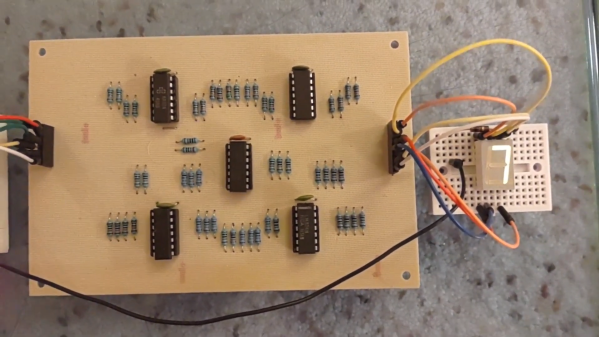
In a world where an analogue to digital converter is all too often an integrated peripheral buried inside a microcontroller, it’s easy to forget how simple these devices can be when built from first principles. An entry in our Op-Amp Challenge from [NNNI] demonstrates this perfectly, it’s a high resolution multi-slope ADC for instrumentation purposes, constructed using a mixture of op-amps, logic chips, and a Raspberry Pi Pico. Best of all, it’s easy to understand, so there’s little of that analogue mystique to worry about.

This type of ADC measures an analogue value by counting how long it takes to charge a capacitor to that voltage. A simple version that measures charge time has a few drawbacks, so this project goes from single slope to multi slope by measuring both charge and discharge times compared to the voltage. Pay attention to component matching and reference stability, and such a design can offer a very high resolution measurement.

The value in this project lies not only in the design itself, but also in the extremely comprehensive description of its operation, which should teach most readers a thing or two. That curvy-line PCB is rather nice, too. We used single slope ADCs to read analogue joysticks back in the day, but we certainly learned something here. Want to see another? This isn’t the first dual slope ADC we’ve seen.

Congratulations Low-Power Winners

Congratulations to the winners of the 2023 Hackaday.io Low Power Contest! We challenged you to show us how much you could do with how little, and you did not disappoint. Our judges have put their heads together, and thanks to Digi-Key, our contest sponsor, the top three entries will be taking home a $150 gift certificate for yet more hacking supplies.

We saw a great diversity of ideas here, all on the low-power theme. So without further ado…

The Prize Winners

[Christoph]’s Ultra Low Power RF-Sensor arose out of necessity. Having just repaired a shower drain, he couldn’t be sure that it wouldn’t start leaking again at some point in the future, but couldn’t go ripping up the floor under the shower tray every week to check. He needed a remote moisture sensor that would do the job for a long time with no intervention.

This superb solution combines an Atmel ATmega328P, an HDC1080 humidity sensor, a 433 MHz radio transmitter, and an RTC to keep power consumption super-low when everything else is shut down. Idling at 600 nA total most of the time, taking a reading every 15 minutes, this device should last for 12 years, and it’s been installed and running for five so far, so we’d say that it’s already proven itself very worthy of taking home the prize here.

[BleakyTex]’s Compact, low-power Geiger counter is absolutely the lowest power Geiger counter we’ve ever seen and maybe also the cutest. With the ambitious goal of running up to two years on two tiny LR44 batteries and a proven runtime of about six months by now, this is the radiation detector you can take with you every day, should you need to. The key is a custom HV section that’s designed for efficiency and the screen – even today, it’s still hard to beat the low power consumption of the humble LCD screen. All this, and it still makes those satisfying clicks when it’s enabled. [BleakyTex] says he might make a kit from this, and we absolutely hope he does!

[mircemk]’s Microwatt Pulse Motor took one of our suggestions in the announcement of the contest and ran with it. This eight-pole handmade electric motor doesn’t actually do anything other than spin, but it does that when hooked up to a literal potato. Pulling around 40 mA at 600 mV, it can easily run on solar power with enough power left over to charge up a battery for when the sun doesn’t shine. All of this is made with extremely simple circuitry and parts scavenged from old relays with a sewing needle held up by a magnet for the bearing. This is pure ingenuity and a sweet low-power demo.

Continue reading “Congratulations Low-Power Winners”

The 2023 Hackaday Prize Is Ten, First Challenge Is Educational

If you were anywhere near Hackaday over the weekend, you certainly noticed that we launched the tenth annual Hackaday Prize! In celebration of the milestone, we picked from our favorite challenges of years past and came up with four of our favorite, and even one new one just to keep you on your toes. But the first challenge round is running right now, so get your hacking motors turning.

Re-engineering Education

The first challenge this year showcases educational projects, but broadly construed. Hackers tend to learn best by doing. In the Re-engineering Education challenge, we want you to help give others a chance to learn new skills. Whether you’re building a DIY radio kit, a breadboard-it-yourself computer, or even a demonstrator robot arm, if it helps pass on your hard-earned skills, we want you to enter it here.

It’s fresh on my mind because we were just playing with one this weekend, but [deshipu]’s Fluffbug robot project is a great inspiration for non-traditional education. What better way to discover the intricacies of four-legged walking machine gaits than to have one to play with on your desktop? It’s not going to take over the world, but if you can make it walk, you’ve learned something.

More obviously educational is [Joan Horvath]’s Hacker Calculus, an entry in last year’s Prize. The connections between a function’s height, and the area or volume that it integrates up to can be awfully abstract. Printing out 3D models of the resulting shapes can really help to bring the point home. Or maybe you could really drive home the speed of a comet in its orbit with a physical model? They’ve got you covered, but also ideas for generating your own plastic math toys.

When we think educational computer builds, the amazing reproduction of the WDC-1 “Working Digital Computer” by [Michael Gardi] springs instantly to mind, but perhaps it goes too far down the rabbit hole. Just another rung up on the complexity ladder gets you the Blinking Computer by [Tony Robinson]. Or if you want to figure out how an almost-commercial Z80 computer works from the ground up, consider the Baffa 2.

So what skills do you have that you want to teach other hackers? Can you embody that in a project?

All the Challenges

If you don’t have education in your sights, have a look at the rest of the 2023 Hackaday Prize Challenge rounds. We’re sure you’ll find something you like.

To enter, simply set up a project on Hackaday.io. When the challenge is running, you’ll be able to enter. Full rules over at the 2023 Hackaday Prize landing page.

Challenge Date The Details
Re-engineering Education March 25 – April 25 Educational projects of all stripes welcome. If the goal is to teach, enter it here.
Assistive Tech April 25 – May 30 The Assistive Tech challenge calls for projects that help people with disabilities to learn, work, move around, and simply live their lives to the fullest.
Green Hacks May 30 – July 4 Help reduce our impact on the planet. Do more with less, or help clean up the mess.
Gearing Up July 4 – August 8 Hackers build their own tools. What have you made that makes your making easier? Share it with us.
Wildcard August 8 – September 12 This is where anything goes. The wildcard challenge lets your projects speak for themselves.

Continue reading “The 2023 Hackaday Prize Is Ten, First Challenge Is Educational”

Low-Power Challenge: Making An Analog Clock Into A Calendar With A 50-Year Life

You have to be pretty ambitious to modify a clock to run for 50 years on a single battery. You also should probably be pretty young if you think you’re going to verify your power estimates, at least in person. According to [Josh EJ], this modified quartz analog clock, which ticks off the date rather than the time, is one of those “The March of Time” projects that’s intended to terrify incentivize you by showing how much of the year is left.

Making a regular clock movement slow down so that what normally takes an hour takes a month without making any mechanical changes requires some clever hacks. [Josh] decided to use an Arduino to send digital pulses to the quartz movement to advance the minute hand, rather than let it run free. Two pulses a day would be perfect for making a 30-day month fit into a 60-minute hour, but that only works for four months out of the year. [Josh]’s solution was to mark the first 28 even-numbered minutes, cram 29, 30, and 31 into the last four minutes of the hour, and sort the details out in code.

As for the low-power mods, there’s some cool wizardry involved with that, like flashing the Arduino Pro Mini with a new bootloader that reduces the clock speed to 1 MHz. This allows the microcontroller and RTC module to run from the clock movement’s 1.5 V AA battery. [Josh] estimates a current draw of about 6 μA per day, which works out to about 50 years from a single cell. That’s to be taken with a huge grain of salt, of course, but we expect the battery will last a long, long time.

[Josh] built this clock as part of the Low-Power Challenge contest, which wrapped up this week. We’re looking forward to the results of the contest — good luck to all the entrants!

Low Power Challenge: Keep Plants Green And Clean With E-Paper Smart Tags

There are plenty of reasons to devote oneself to the care of houseplants — after all, a room full of bright, glossy-leaved plants can be a joy to behold, and that’s not even one of the more tangible benefits they bring. But as any green thumb knows, there’s a fine line between a healthy, vibrant plant and one that’s soon to give up the ghost.

If your thumb tends less toward green and more toward the brown and crusty side of things, something like [Jon]’s Smart Plant system might be just the thing for you. These low-power plant tags are built around increasingly ubiquitous e-Paper displays, like the kind you might find in a retail shelf price tag system. The current version of [Jon]’s tags uses a Waveshare 2.9″ tricolor display and a PCB with capacitive probes that stick into the plant’s soil. An ESP32-S lives on the top section of the PCB, along with a 1,000 mAh LiPo pack that’s charged off USB-C. The design includes an optional solar panel for keeping the battery topped off, which may or may not help depending on the plant’s place in your personal jungle.

In addition to the soil moisture sensor, the Smart Tag has an ambient temperature and humidity sensor and a light sensor — everything to keep your plant happy. The power-hungry sensors are only powered on when the Smart Tag pops out of deep sleep; this gives and estimated five to six weeks runtime between charges, without solar charging of course. The e-Paper display shows custom graphics of the plant’s current environmental state, and the same data is also available via Home Assistant thanks to the ESPHome firmware.

These are nice-looking plant tags that can really pull a lot of weight in keeping plants healthy. Check out the other offerings in our Low Power Challenge Contest, and maybe get an entry together yourself.

Hackaday.io Low-Power Challenge Begins Today

How low can you go? The 2023 Hackaday.io Low-Power Challenge is about doing the most with the least juice – bang for the power-budget buck, if you get our drift. And with three $150 gift certificates from Digi-Key on the line, you’ll be able to keep your projects going forever. The Challenge runs until March 21st, but with low-power, the devil is often in the details, so get started today!

More and more projects need to run on their own power, and more often than not, that means getting by without access to a wall plug. This contest is to encourage your designs that run on solar, small batteries, and generally energy harvested from wherever you can get it. But the power generation mechanism is taking the back seat here – we want to see what you can do with a few good electrons. Surprise us with your maximum minimalism!

Continue reading “Hackaday.io Low-Power Challenge Begins Today”