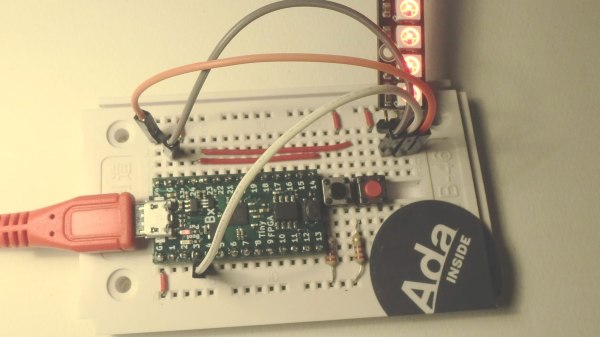
The blog post describes how to use the Community edition of the GNAT Ada compiler to set up the development environment, before implementing a simple example project that controls a strip of WS28212b RGB LED modules. There are two push buttons changing the animation and brightness of the lights.
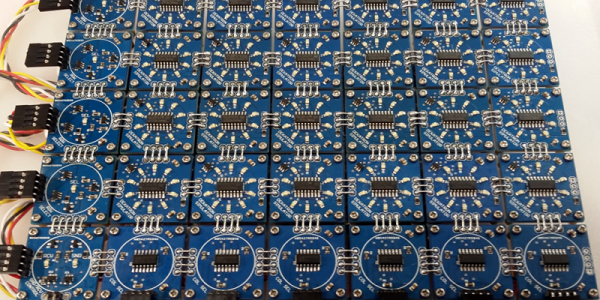
One of the things that always attracts our eye in old movies is how many kinds of displays you see on old gear both real and imaginary. Really old stuff usually had meters or circular recorders. But slightly newer movies often had some kind of exotic digital display with Nixes or Numitron tubes. One of the really exotic display devices was a Dekatron. While these are pretty rare, you can make a stand-in using modern LEDs and [Dave] did just that in an entry into our square inch competition.
These were gas-filled tubes with ten positions. You had to reset the tube and then the tube would visibly count pulses providing a visual indicator from zero to nine. Depending on the tube configuration, you could use them to count or to act as a divider. Those with neon fill looked sort of orange, although there were argon-based ones that had a purple glow. You can see what an older version of the board looks like in the video below or skip to the second video if you want to see the real ones in action.
No, we’re not talking about spooky feats of General Relativity. But you should know that the Return of the Square Inch Project just got its deadline extended.
If you missed the call the first time around, our favorite user-contributed contest on Hackaday.io is up and running again. Hackaday.io tossed in some good money for prizes, and folks started thinking about what functionality they could cram inside a 25.4 mm x 25.4 mm square. But while one constraint can help bring out creativity, adding a tight deadline to a tight squeeze caused a number of our entrants to ask for an extension.
If you’re working on the Square Inch Project, you’ve got until October 1st to get your boards ready. Breathe a quick sigh of relief and then get back to soldering! We’re looking forward to seeing all the great entries.
At Hackaday, we’re constantly impressed by the skill and technique that goes into soldering up some homebrew creations. We’re not just talking about hand-soldering 80-pin QFNs without a stencil, either: there are people building charlieplexed LED arrays out of bare copper wire, and using Kynar wire for mechanical stability. There are some very, very talented people out there, and they all work in the medium of wire, heat, and flux.
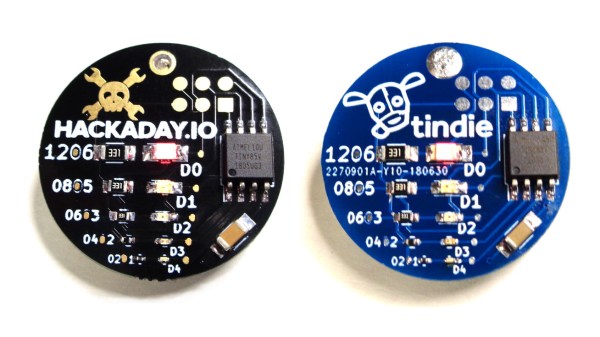
The kit in question was an SMD Challenge Kit put together my MakersBox, and consisted of a small PCB, an SOIC-8 ATtiny, and a LED and resistor for 1206, 0805, 0603, 0402, and 0201 sizes. The contest is done in rounds. Six challengers compete at a time, and everyone is given 35 minutes to complete the kit.
We’ve seen — and participated in — soldering challenges before, and each one has a slightly unique twist to make it that much more interesting. For example, at this summer’s Toorcamp, the soldering challenge was to simply drink a beer before moving to the next size of parts. You would solder the 1206 LED and resistor sober, drink a beer, solder the 0805, drink a beer, and keep plugging away until you get to the 01005 parts. Yes, people were able to do it.
Of course, being DEF CON and all, we were trying to be a bit more formal, and drinking before noon is uncouth. The rules for this Soldering Challenge award points on five categories: the total time taken, if the components are actually soldered down, a ‘functionality’ test, the orientation of the parts, and the quality of the solder joints.
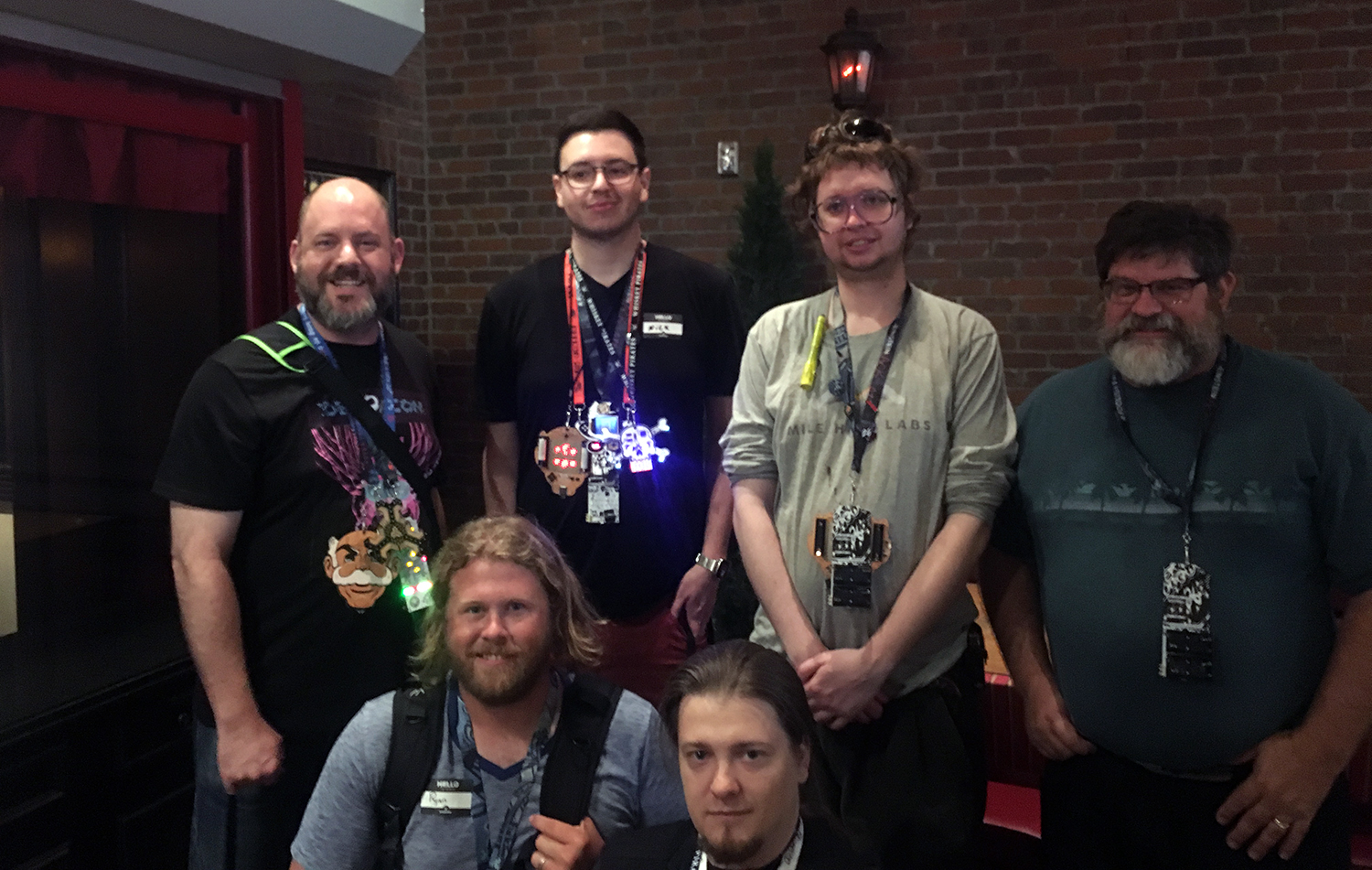
The winners of the soldering challenge, at the Hackaday Breakfast Meetup at DEF CON 26
So, with those rules in place, who won the Soldering Challenge at this year’s DEF CON? Out of a total 25 points, the top scorers are:
[True] – 23 pts
[Rushan] – 19 pts
[Ryan] – 18 pts
[Beardbyte] – 18 pts
[Casey] – 18 pts
[Bob] – 18 pts
[Nick] – 18 pts
[JEGEVA] – 18 pts
The Soldering Challenge had an incredible turnout, and the entire Soldering Skills Village was packed to the gills with folks eager to pick up an iron. The results were phenomenal!
We’d like to extend a note of thanks to [Bunny], the Hardware Hacking Village, the Soldering Skills Village, and MakersBox for making this happening. It was truly a magical experience, and now that competitive soldering is a thing, we’re going to be doing this a few more times. How do you think this could be improved? Leave a note in the comments.
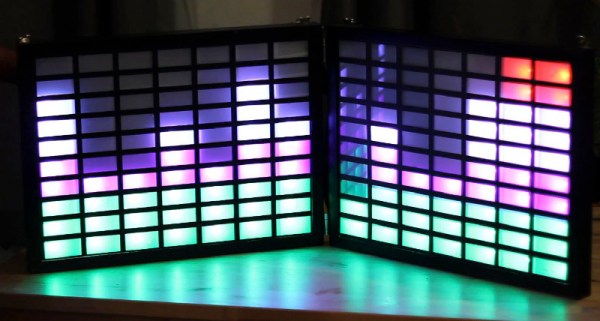
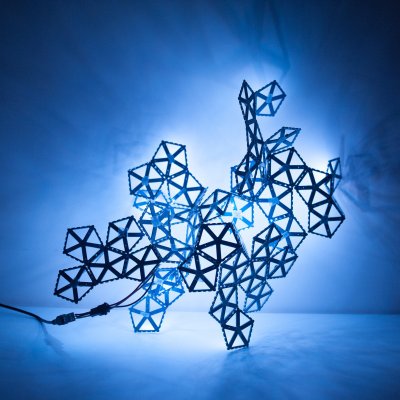
You can plug in a Raspberry Pi, and you can blink a LED. You can visualize data, and now there’s a contest on Hackaday.io to show off your skills. Right now, we’re opening up the Visualize It With Pi contest on Hackaday.io. The challenge? Visualize data with LED strips and panels. Is that ‘data’ actually just a video of Never Gonna Give You Up? We’ll find out soon enough.
The goal of this contest is to combine a Raspberry Pi and its immense processing power and the blinky goodness of LED strips and panels to visualize and interpret data in novel and artistic ways. We’re looking for animation. clarity, and flamboyant flickering. Want some ideas? Check out the World of Light or the American Constitution Candle. We’re looking for the most blinky you can do with a Pi, and yes, there will be prizes.
Prizes
BlinkyTile Explorers Kit
Prizes for the best blinky include, of course, more blinky. The best visualizations from a directly connected sensor, data from an Internet Source, and data from an esoteric data source will each receive some Blinkytape. This is a strip of WS2812b LEDs with an ATMega32u4 embedded on the end. Plug a USB power supply into the Blinkytape, and you get a strip of LEDs in whatever color you want with the ability to push animation frames to the chip on the strip. The Grand Prize winner for this contest will also receive Blinkytile Explorers Kit, a Serpentine LED strip, a LED ring, and two meters of ultra thin LED strip.
Let’s Do This!
The requirements for the contest are simple: just use a Raspberry Pi to drive LED strips or panels, post it as a new project on Hackaday.io, and submit the project to the contest. We’re looking for a full description, source, schematics, and photos and videos of the finished version of the project — do everything you can to show off your work! The contest is open right now, and ends at 08:00 Pacific on October 1st. We know you like to blink those LEDs, so get crackin’.
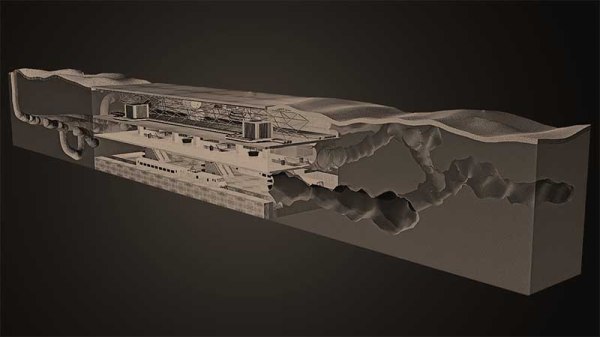
We all love reading about creative problem-solving work done by competitors in past DARPA robotic challenges. Some of us even have ambition to join the fray and compete first-hand instead of just reading about them after the fact. If this describes you, step on up to the DARPA Subterranean Challenge.
Following up on past challenges to build autonomous vehicles and humanoid robots, DARPA now wants to focus collective brainpower solving problems encountered by robots working underground. There will be two competition tracks: the Systems Track is what we’ve come to expect, where teams build both the hardware and software of robots tackling the competition course. But there will also be a Virtual Track, opening up the challenge to those without resources to build big expensive physical robots. Competitors on the virtual track will run their competition course in the Gazebo robot simulation environment. This is similar to the NASA Space Robotics Challenge, where algorithms competed to run a virtual robot through tasks in a simulated Mars base. The virtual environment makes the competition accessible for people without machine shops or big budgets. The winner of NASA SRC was, in fact, a one-person team.
Back on the topic of the upcoming DARPA challenge: each track will involve three sub-domains. Each of these have civilian applications in exploration, infrastructure maintenance, and disaster relief as well as the obvious military applications.
Man-made tunnel systems
Urban underground
Natural cave networks
There will be a preliminary circuit competition for each, spaced roughly six months apart, to help teams get warmed up one environment at a time. But for the final event in Fall of 2021, the challenge course will integrate all three types.
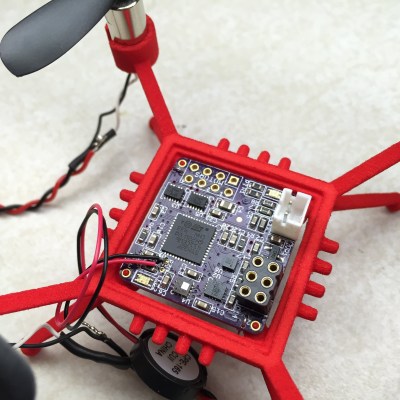
Want to play a game? Your challenge is to do something incredible with a printed circuit board that measures no more than one inch by one inch. It’s The Return of the One Square Inch Project and it’s going to be amazing!
We can’t believe that it’s been three years! The original One Square Inch Project was a contest dreamt up by Hackaday.io user [alpha_ninja] back in 2015, and we thought it was such a great idea that we ponied up some prizes. The entries were, frankly, the best we’ve ever seen. So we’re doing it again!
Last time around, the size constraint focused the minds and brought out the creativity in some of the best and brightest of Hackaday.io. What functionality or simply amusement can you pack into a square PCB that’s just a tad over 25 mm on a side? We’d like to see.
We’ll be featuring entries throughout the contest. We think geek ‘cred is the best reward but if you want something more to sweeten the pot here you go:
It’s been three years, and parts have gotten cheaper, smaller, and more capable. What’s newly feasible in a square inch that wasn’t way back in 2015? Show us what you got.