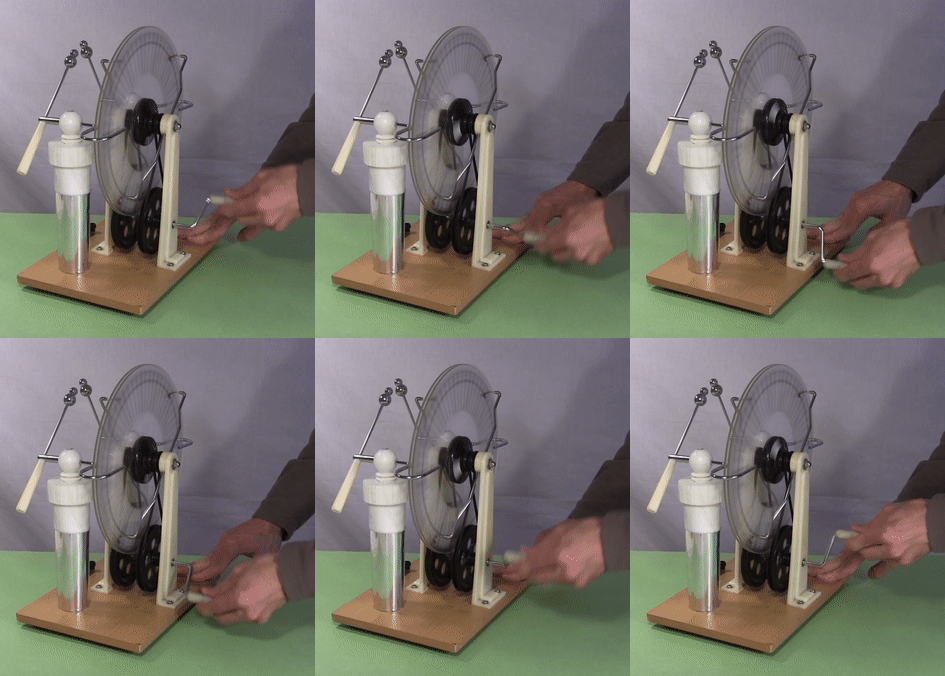
In the comments to our recent article about Wimshurst machines, we saw that some hackers had never heard of them, reminding us that we all have different backgrounds and much to share. Well here’s one I’m guessing even fewer will have heard of. It’s never even shown up in a single Hackaday article, something that was also pointed out in a comment to that Wimshurst article. It is the Lord Kelvin’s Water Dropper aka Lord Kelvin’s Thunderstorm, invented in the 1860s by William Thomson, 1st Baron Kelvin, the same fellow for whom the Kelvin temperature scale is named. It’s a device that produces a high voltage and sparks from falling drops of water.
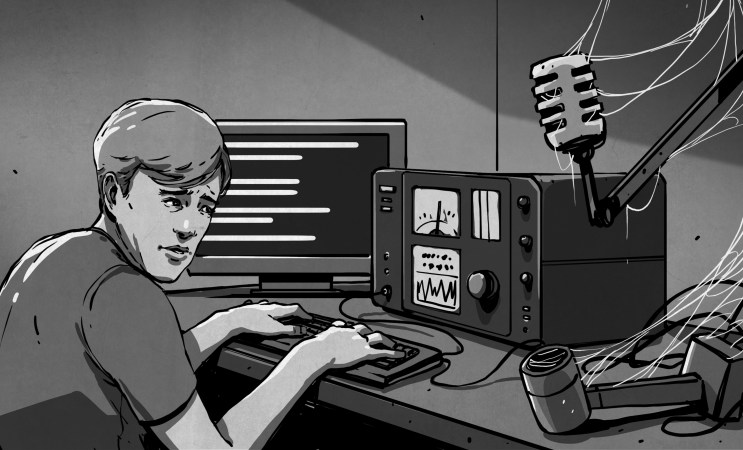
In a recent article, I lamented my distaste for carrying on the classic amateur radio conversation — calling CQ, having someone from far away or around the block call back, exchange call signs and signal reports and perhaps a few pleasantries. I think the idle chit-chat is a big turn-off to a lot of folks who would otherwise be interested in the World’s Greatest Hobby™, but thankfully there are plenty of ways for the mic-shy to get on the air. So as a public service I’d like to go over some of the many digital modes amateur radio offers as a way to avoid talking while still communicating.
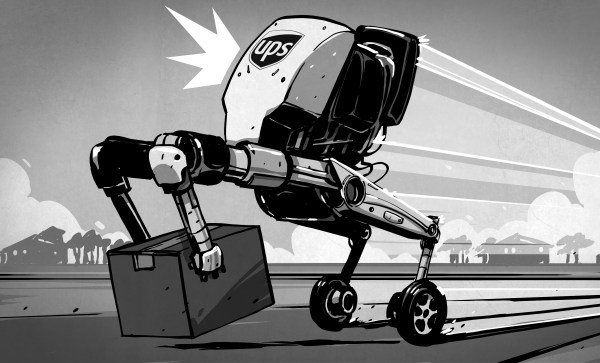
You’ve no doubt by now seen Boston Dynamics latest “we’re living in the future” robotic creation, dubbed Handle. [Mike Szczys] recently covered the more-or-less-official company unveiling of Handle, the hybrid bipedal-wheeled robot that can handle smooth or rugged terrain and can even jump when it has to, all while remaining balanced and apparently handling up to 100 pounds of cargo with its arms. It’s absolutely sci-fi.
[Mike] closed his post with a quip about seeing “Handle wheeling down the street placing smile-adorned boxes on each stoop.” I’ve recently written about autonomous delivery, covering both autonomous freight as the ‘killer app’ for self-driving vehicles and the security issues posed by autonomous delivery. Now I want to look at where anthropoid robots might fit in the supply chain, and how likely it’ll be to see something like Handle taking over the last hundred feet from delivery truck to your door.
It is so often the case with a particular technological advance, that it will be invented almost simultaneously by more than one engineer or scientist. People seem to like a convenient tale of a single inventor, so one such person is remembered while the work of all the others who trod the same path is more obscure. Sometimes the name we are familiar with simply managed to reach a patent office first, maybe they were the inventor whose side won their war, or even they could have been a better self-publicist.
When there are close competitors for the crown of inventor then you might just have heard of them, after all they will often feature in the story that grows up around the invention. But what about someone whose work happened decades before the unrelated engineer who replicated it and who the world knows as the inventor? They are simply forgotten, waiting in an archive for someone to perhaps discover them and set the record straight.
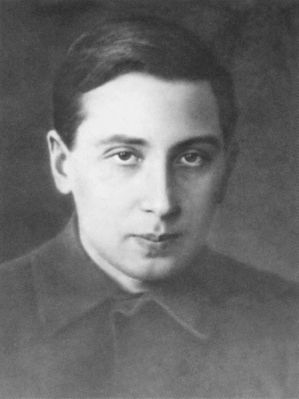
[Oleg Losev] (Public domain)Meet [Oleg Losev]. He created the first practical light-emitting diodes and the first semiconductor amplifiers in 1920s Russia, and published his results. Yet the world has never heard of him and knows the work of unrelated American scientists in the period after the Second World War as the inventors of those technologies. His misfortune was to born in the wrong time and place, and to be the victim of some of the early twentieth century’s more turbulent history.
[Oleg Losev] was born in 1903, the son of a retired Russian Imperial Army officer. After the Russian Revolution he was denied the chance of a university education, so worked as a technician first at the Nizhny Novgorod Radio laboratory, and later at the Central Radio Laboratory in Leningrad. There despite his relatively lowly position he was able to pursue his research interest in semiconductors, and to make his discoveries.
My buddy Harold recently landed a new job at a great technology company. It came at a perfect time for him, having just been laid off from the corporate behemoth where he’d toiled away as an anonymous cog for 19 years. But the day before he was to start, the new company’s HR folks sent him some last-minute documents to sign. One was a broad and vaguely worded non-compete agreement which essentially said he was barred from working in any related industry for a year after leaving the company.
Harold was tempted not to sign, but eventually relented because one needs to put food on the table. Thankfully he’s now thriving at the new company, but his experience got me thinking about all the complications hackers face with the day jobs that so many of us need to maintain. Non-competes and non-disclosures are bad enough, but there’s one agreement that can really foul things up for a hacker: the Intellectual Property Agreement.
The Wimshurst machine is one of the oldest and best known electrostatic machines, consisting of its iconic two counter rotating disks and two Leyden jars. Most often you see someone hand cranking it, producing sparks, though we’ve seen it used for much more, including for powering a smoke precipitator for cleaning up smoke and even for powering a laser.
It works through an interesting sequence of events. Most explanations attempt to cram it all into one picture, requiring some major mental gymnastics to visualize. This often means people give up, resigned to assume these work through some mythical mechanics that defy a mortal’s ability to understand.
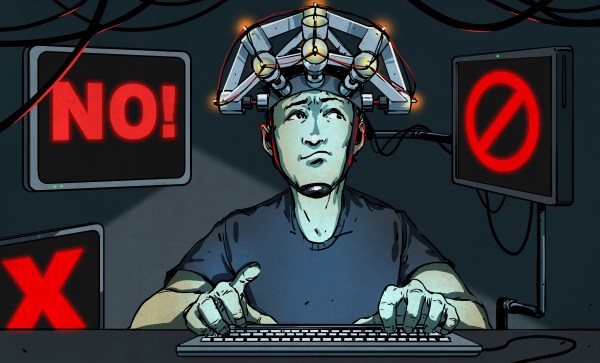
My phone can now understand me but it’s still an idiot when it comes to understanding what I want. We have both the hardware capacity and the software capacity to solve this right now. What we lack is the social capacity.
We are currently in a dumb state of personal automation. I have Google Now enabled on my phone. Every single month Google Now reminds me of bills coming due that I have already paid. It doesn’t see me pay them, it just sees the email I received and the due date. A creature of habit, I pay my bills on the last day of the month even though that may be weeks early. This is the easiest thing in the world for a computer to learn. But it’s an open loop system and so no learning can happen.
Earlier this month [Cameron Coward] wrote an outstanding pair or articles on AI research that helped shed some light on this problem. The correct term for this level of personal automation is “weak AI”. What I want is Artificial General Intelligence (AGI) on a personal level. But that’s not going to happen, and I am the problem. Here’s why.