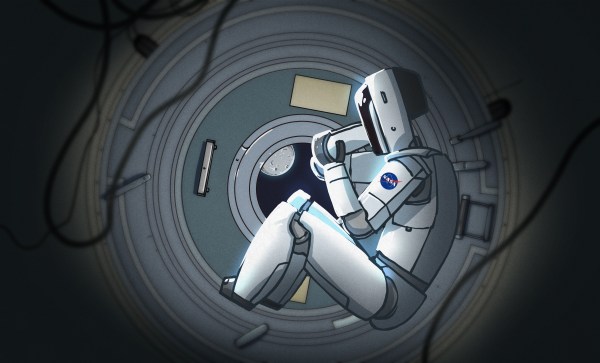
NASA Sets Eyes On Deep Space With Admin Shuffle

Since the Apollo 17 crew returned from the Moon in 1972, human spaceflight has been limited to low Earth orbit (LEO). Whether they were aboard Skylab, Mir, the Space Shuttle, a Soyuz capsule, or the International Space Station, no crew has traveled more than 600 kilometers (372 miles) or so from the Earth’s surface in nearly 50 years. Representatives of the world’s space organizations would say they have been using Earth orbit as a testing ground for the technology that will be needed for more distant missions, but those critical of our seemingly stagnated progress into the solar system would say we’ve simply been stuck.

Many have argued that the International Space Station has consumed an inordinate amount of NASA’s time and budget, making it all but impossible for the agency to formulate concrete plans for crewed missions beyond Earth orbit. The Orion and SLS programs are years behind schedule, and the flagship deep space excursions that would have utilized them, such as the much-touted Asteroid Redirect Mission, never materialized. The cracks are even starting to form in the Artemis program, which appears increasingly unlikely to meet its original goal of returning astronauts to the Moon’s surface by 2024.

But with the recent announcement that NASA will be splitting the current Human Exploration and Operations Mission Directorate into two distinct groups, the agency may finally have the administrative capacity it needs to juggle their existing LEO interests and deep space aspirations. With construction of the ISS essentially complete, and the commercial spaceflight market finally coming together, the reorganization will allow NASA to start shifting the focus of their efforts to more distant frontiers such as the Moon and Mars.

Continue reading “NASA Sets Eyes On Deep Space With Admin Shuffle”

The Coming Copper Shortage: Aluminium Or Carbon Nanotubes To The Rescue?

The use of aluminium in wiring is unlikely to bring a smile to the face of anyone who has had to deal with it in a 1960s, or early 1970s-era house. The causes behind the fires and other accidents were myriad, including failure to deal with the higher thermal expansion of aluminium, the electrically insulating nature of aluminium oxide, and the general brittleness of aluminium when twisted.

Yet while copper is superior to aluminium in terms of electrical conductivity and ease of installation, copper prices have skyrocketed since the 1970s, and are on the verge of taking off to the moon. A big part of the reason is the increased use of copper in everything from electronics and electrical motors to generators, driven by large-scale deployment of wind turbines and electrical vehicles.

As the world moves to massively expand the use of electrical cars and installation of wind turbines, copper demand is predicted to outstrip current copper supply. With aluminium likely to make a big return as a result, it’s worth taking a look at modern-day aluminium-based wiring, including copper-clad aluminium and the use of carbon-based replacements. Continue reading “The Coming Copper Shortage: Aluminium Or Carbon Nanotubes To The Rescue?”

101 Uses For An Everready — Flashlight History

For some reason, I’m always interested in why things are called what they are. For example, I’ve been compelled in the past to research what Absorbine Senior is. Not that it is important, but Absorbine Junior is a smaller size of horse liniment, so you don’t have to buy a drum of ordinary Absorbine just to rub down your sore thumb. So it isn’t a mystery that I would find myself musing over why we call a flashlight a flashlight.

You don’t think of a flashlight as flashing, under normal circumstances, at least. Turns out the answer lies in the history of the device, its poor beginnings, and our willingness to treat imperfect components as though they were much better than they are. That last point, by the way, still has ramifications today, so even if you aren’t a fan of flashlight history, keep reading.

Portable Lighting

Ever since people learned to use fire, there’s been a desire for portable lighting. Torches, candles, and even oil lamps have all had their place. But burning things for light in small cramped spaces leaves a lot to be desired. It isn’t surprising that people quickly turned to electricity when that seemed to be feasible.

Continue reading “101 Uses For An Everready — Flashlight History”

Gopher, The Competing Standard To WWW In The ’90s Is Still Worth Checking Out

The 30th anniversary of the World Wide Web passed earlier this year. Naturally, this milestone was met with truckloads of nerdy fanfare and pining for those simpler times. In three decades, the Web has evolved from a promising niche experiment to being an irreplaceable component of global discourse. For all its many faults, the Web has become all but essential for billions around the world, and isn’t going anywhere soon.

As the mainstream media lauded the immense success for the Web, another Internet information system also celebrated thirty years – Gopher. A forgotten heavyweight of the early Internet, the popularity of Gopher plummeted during the late 90s, and nearly disappeared entirely. Thankfully, like its plucky namesake, Gopher continued to tunnel across the Internet well into the 21st century, supported by a passionate community and with an increasing number of servers coming online.

Continue reading “Gopher, The Competing Standard To WWW In The ’90s Is Still Worth Checking Out”

Satellite image of hurrican Dorian

Hurricane Hunting From Outer Space

If you live in the right part of the world, you spend a lot of the year worried about hurricanes or — technically — tropical cyclones. These storms carry an amazing amount of power and can change your life. However, we are relatively spoiled these days compared to the past. It is hard to imagine, but there was a time when a hurricane’s arrival was something of a mystery. Sure, ships would report what they encountered, but finding exact data about a hurricane was a bit hit or miss. We often talk about space technology making life better. Weather forecasting — especially for tropical storms — is one place where money spent in space has made life much better on Earth.

The lack of data about storms can be fatal. The Great Galveston hurricane of 1900 took around 12,000 lives. It might have had a better outcome, but forecasters missed where the storm was heading, announcing that it would go from Cuba to Florida which was just totally wrong. Not that a forecaster couldn’t make a mistake today, but with aircraft and satellite coverage, you’d know very quickly that the prediction was wrong and you’d sound the alarm. In truth, the prediction models have become very good over the years, so the chances of this happening today are virtually nil in any event. But being able to precisely locate and track storms helps reduce the impact of the storm and also feeds data into the models that makes them even more accurate for the future.

Continue reading “Hurricane Hunting From Outer Space”

The Astronomical Promises Of The Fisher Space Pen

We’ve all heard of the Fisher Space Pen. Heck, there’s even an episode of Seinfeld that focuses on this fountain of ink, which is supposed to be ready for action no matter what you throw at it. The legend of the Fisher Space Pen says that it can and will write from any angle, in extreme temperatures, underwater, and most importantly, in zero gravity. While this technology is a definite prerequisite for astronauts in space, it has a long list of practical Earthbound applications as well (though it would be nice if it also wrote on any substrate).

You’ve probably heard the main myth of the Fisher Space Pen, which is that NASA spent millions to develop it, followed quickly by the accompanying joke that the Russian cosmonauts simply used pencils. The truth is, NASA had already tried pencils and decided that graphite particles were too much of an issue because they would potentially clog the instruments, like bags of ruffled potato chips and unsecured ant farms.

A Space-Worthy Instrument Indeed

Usually, it’s government agencies that advance technology, and then it trickles down to the consumer market at some point. But NASA didn’t develop the Space Pen. No government agency did. Paul Fisher of the Fisher Pen Company privately spent most of the 1960s working on a pressurized pen that didn’t require gravity in the hopes of getting NASA’s attention and business. It worked, and NASA motivated him to keep going until he was successful.

An original Fisher Space Pen AG-7 atop the Apollo 11 flight plan.
The pen that went to the moon. Image via Sebastien Billard

Then they tested the hell out of it in all possible positions, exposed it to extreme temperatures between -50 °F and 400 °F (-45 °C to 204 °C), and wrote legible laundry lists in atmospheres ranging from pure oxygen to a total vacuum. So, how does this marvel of engineering work?

The Fisher Space Pen’s ink cartridge is pressurized to 45 PSI with nitrogen, which keeps oxygen out in the same manner as potato chip bags. Inside is a particularly viscous, gel-like ink that turns to liquid when it meets up with friction from the precision-fit tungsten carbide ballpoint.

Between the viscosity and the precision fit of the ballpoint, the pen shouldn’t ever leak, but as you’ll see in the video below, (spoiler alert!) snapping an original Space Pen cartridge results in a quick flood of thick ooze as the ink is forced out by the nitrogen.

Continue reading “The Astronomical Promises Of The Fisher Space Pen”

Roll-on/roll-off vessel docking

RORO Vessels: Driving Cars Across The Ocean

YouTube does a pretty good job of making itself a target for criticism, but one thing you can say about their algorithms: when they work, they really work. Case in point, the other day I found a suggestion in my feed for a very recent video about salvaging a shipwreck. I can’t begin to guess what combination of view history and metadata Google mined to come to the conclusion that I’d be interested in this video, but they hit the nail on the head.

But more importantly, their algorithmic assessment of my interests must have been a goldmine to them — or it could have been if I didn’t have a minefield of ad blockers protecting me — because I fell down a rabbit hole that led me to a bunch of interesting videos. As it turns out, the shipwreck in that first video was of a cargo ship that was carrying thousands of brand-new automobiles, which were all destroyed in the fire and subsequent capsizing of a “roll-on/roll-off” (RORO) vessel off the coast of Georgia (the state, not the country) in 2019.

Thus began my journey into RORO vessels, on which automobiles and other bulky cargo are transported around the world. And while my personal assessment of the interests of Hackaday readers probably is not as finely tuned as Google’s algos, I figured there’s a better than decent chance that people might enjoy tagging along too.

Continue reading “RORO Vessels: Driving Cars Across The Ocean”