As the world waits for COVID-19 vaccines, some pharmaceutical companies stand armed and ready with an exciting improvement: better vials to hold the doses. Vials haven’t changed much in the last 100 years, but in 2011, Corning decided to do something about that. They started developing an alternative glass that is able to resist damage and prevent cracks. It’s called Valor glass, and it’s amazingly strong stuff. Think Gorilla glass for the medical industry.
Traditionally, pharmaceutical vials have been made from borosilicate glass, which is the same laboratory-safe material as Corning’s Pyrex. Borosilicate glass gets its strength from the addition of boron. Although borosilicate glass is pretty tough, it comes with some issues. Any type of glass is only as strong as its flaws, and borosilicate glasses are prone to some particularly strength-limiting flaws. Pharmaceutical glass must stand up to extreme temperatures, from the high heat of the vial-making process to the bitterly cold freeze-drying process and storing temperature required by the fragile viral RNA of some COVID-19 vaccines. Let’s take a look at how Valor glass vials tackle these challenges.
Circuit simulations are great because you can experiment with circuits and make changes with almost no effort. In Circuit VR, we look at circuits using a simulator to do experiments without having to heat up a soldering iron or turn on a bench supply. This time, we are going to take a bite of a big topic: op amps.
The op amp — short for operational amplifier — is a packaged differential amplifier. The ideal op amp — which we can’t get — has infinite gain and infinite input impedance. While we can’t get that in real life, modern devices are good enough that we can pretend like it is true most of the time.
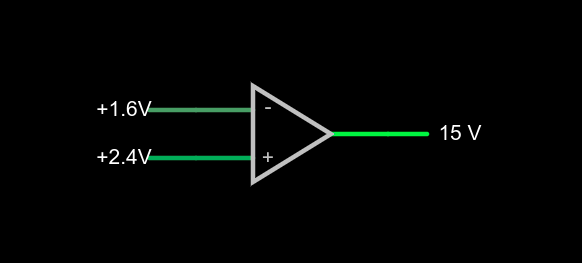
a very simple op amp circuit with some detail omitted
If you open this circuit in the Falstad simulator, you’ll see two sliders to the right where you can tweak the input voltage. If you make the voltages the same, the output will be zero volts. You might think that a difference amplifier would take inputs of 1.6V and 2.4V and either produce 0.8V or -0.8V, but that’s not true. Try it. Depending on which input you set to 2.4V, you’ll get either 15V or -15V on the output. That’s the infinite gain. Any positive or negative output voltage will quickly “hit the rail” or the supply voltage which, in this case, is +/-15V.
Practical Concerns
The biggest omitted detail in the schematic symbol above is that there’s no power supply here, but you can guess that it is +/- 15V. Op amps usually have two supplies, a positive and a negative and while they don’t have to be the same magnitude, they often are. Some op amps are specifically made to work with a single-ended supply so their negative supply can connect to ground. Of course, that presupposes that you don’t need a negative voltage output.
The amount of time it takes the output to switch is the slew rate and you’ll usually find this number on the device datasheet. Obviously, for high-speed applications, a fast slew rate is important, particularly if you want to use the circuit as a comparator as we are here.
Other practical problems arise because the op amp isn’t really perfect. A real op amp would not hit the 15V rail exactly. It will get close depending on how much current you draw from the output. The higher the current, the further away from the rails you get. Op amps will also have some offset that will prevent it from hitting zero when the inputs are equal, although on modern devices that can be very low. Some older devices or those used in high-precision designs will have a terminal to allow you to trim the zero point exactly using an external resistor.
Op Amps Can Provide Steady Voltage Under Variable Load
Rather than dig through a lot of math, you can deal with nearly all op amp circuits if you remember two simple rules:
The inputs of the op amp don’t connect to anything internally.
The output mysteriously will do what it can to make the inputs equal, as far as it is physically possible.
1x amplifier
That second rule will make more sense in a minute, but we already see it in action. Set the simulator so the – input (the inverting input) is at 0V and the noninverting input (+) is at 4V. The output should be 15V. The output is trying to make the inverting input match the noninverting one, but it can’t because there is no connection. The output would like to provide an infinite amount of voltage, but it can only go up to the rail which is 15V.
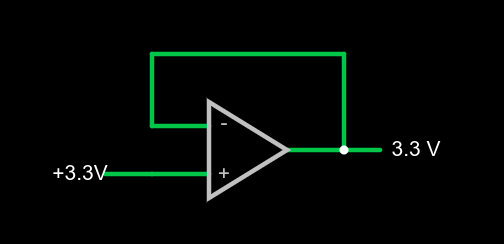
We can exploit this to make a pretty good x1 amplifier by simply shorting the output to the – terminal. Remember, our rules say the input terminals appear to not connect to anything, so it can’t hurt. Now the amplifier will output whatever voltage we put into it:
You might wonder why this would be interesting. Well, we will learn how to increase the gain, but you actually see this circuit often enough because the input impedance is very high (infinite in theory, but not practice). And the output impedance is very low which means you can draw more current without disturbing the output voltage much.
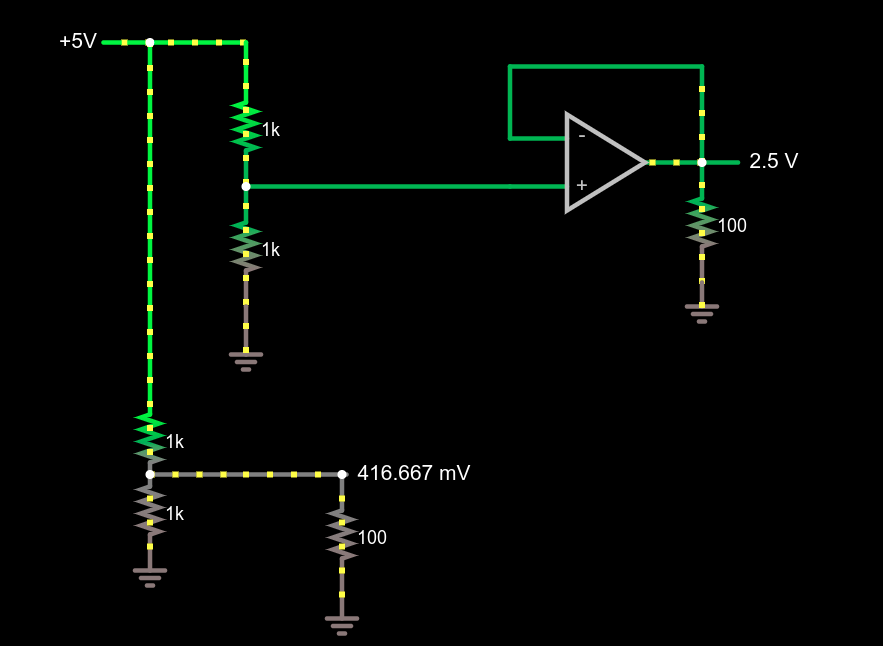
Comparing voltage divider performance with and without a 1x amplifier
This circuit demonstrates the power of a 1x amplifier. Both voltage dividers produce 2.5V with no load. However, with a 100 ohm load at the output, the voltage divider can only provide around 400mV. You’d have to account for the loading in the voltage divider design and if the load was variable, it wouldn’t be possible to pick a single resistor that worked in all cases. However, the top divider feeds the high impedance input of the op amp which then provides a “stiff” 2.5V to whatever load you provide. As an example, try changing the load resistors from 100 ohms to different values. The bottom load voltage will swing wildly, but the top one will stay at 2.5V.
Don’t forget there are practical limits that won’t hold up in real life. For example, you could set the load resistance to 0.1 ohms. The simulator will dutifully show the op amp sourcing 25A of current through the load. Your garden-variety op amp won’t be able to do that, nor are you likely to have the power supply to support it if it did.
What’s Being Amplified?
This is an amplifier even though the voltage stayed the same. You are amplifying current and, thus, power. Disconnect the bottom voltage divider (just delete the long wire) and you’ll see that the 5V supply is providing 12.5 mW of power. The output power is 62.5 mW and, of course, varies with the load resistor.
Notice how this circuit fits the second rule, though. When the input changes, the op amp makes its output equal because that’s what makes the + and – terminals stay at the same voltage.
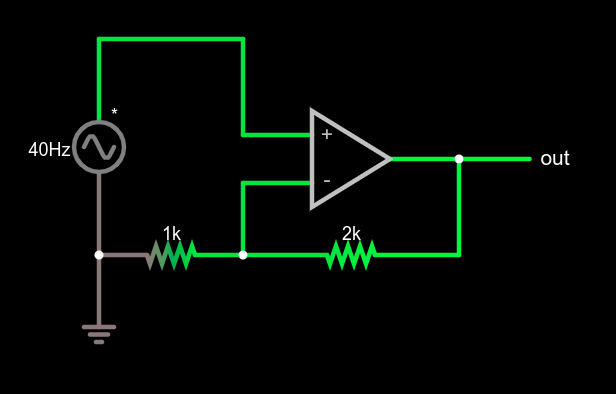
Of course, we usually want a higher voltage when we amplify. We can do that by building a voltage divider in the feedback loop. If we put a 1:2 voltage divider in the loop, the output will have to double to match the input and, as long as that’s physically possible, that’s what it will do. Obviously, if you put in 12V it won’t be able to produce 24V on a 15V supply, so be reasonable.
Non-inverting amplifier example
This type of configuration is called a non-inverting amplifier because, unlike an inverting amplifier, an increase in the input voltage causes an increase in the output voltage and a decrease in input causes the output to follow.
Note that the feedback voltage divider isn’t drawn like a divider, but that’s just moving symbols on paper. It is still a voltage divider just like in the earlier example. Can you figure the voltage gain of the stage? The voltage divider ratio is 1:3 and, sure enough, a 5V peak on input turns into a 15V peak on the output, so the gain is 3. Try changing the divider to different ratios.
What’s Next?
While it isn’t mathematically rigorous, thinking of the op amp as a machine that makes its inputs equal is surprisingly effective. It certainly made the analysis of these simple circuits, the comparator, the buffer amplifier, and a general non-inverting amplifier simple.
There are, of course, many other types of amplifiers, as well as other reasons to use op amps such as oscillators, filters, and other even more exotic circuits. We’ll talk about some of them next time and the idea of a virtual ground, which is another helpful analysis rule of thumb.
The National Institute Of Standards and Technology was founded on March 3, 1901 as the National Bureau of Standards, taking on its current moniker in 1988. The organisation is charged by the government with ensuring the uniformity of weights and measures across the United States, and generally helping out industry, academia and other users wherever some kind of overarching standard is required.
One of the primary jobs of NIST is the production and sale of Standard Reference Materials, or SRMs. These cover a huge variety of applications, from steel samples to concrete and geological materials like clay. However, there are also edible SRMS, too. Yes, you can purchase yourself a jar of NIST Standard Peanut Butter, though you might find the price uncompetitive with the varieties at your local supermarket. Let’s dive into why these “standard” foods exist, and see what’s available from the shelves of our favourite national standards institute. Continue reading “The Mouth-Watering World Of NIST Standard Foods”→
Solar power is a great source of renewable energy, but has always had its limitations. At best, there’s only 1,000 Watts/m2 available at the Earth’s surface on a sunny day, and the limited efficiency of solar panels cuts this down further. It’s such a low amount that solar panels on passenger cars have been limited to menial tasks such as battery tending and running low-power ventilation fans.
However, where some might see an impossibility, others see opportunity. The World Solar Challenge is a competition that has aimed to show the true potential of solar powered transport. Now 30 years since its inception, what used to be impossible is in fact achieved by multiple teams in under one tenth of the original time. To keep competitors on their toes, the rules have been evolving over time, always pushing the boundaries of what’s possible simply with sunlight. This isn’t mainstream transportation; this is an engineering challenge. How far can you go in a solar car?
Back before COVID-19, I was walking through the airport towards the gate when suddenly I remembered a document I wanted to read on the flight but had forgotten to bring along. No worry, I paused for a bit on the concourse, reached into my pocket and proceeded to download the document from the Internet. Once comfortably seated on the plane, I relaxed and began reading. Afterwards, I did a little programming in C on a shareware program I was developing.
Today this would be an ordinary if not boring recollection, except for one thing: this happened in the 1990s, and what I pulled out of my pocket was a fully functional MS-DOS computer:
Introducing the HP-200LX, the first real palmtop computer. I used one of these daily up until the mid-2000s, and still have an operational one in my desk drawer. Let’s step back in time and see how this powerful pocket computer began its life. Continue reading “The First Real Palmtop”→
This new pen cost $12.50, which is about $180 today. For many people, the improved experience that the ballpoint promised over the fountain pen was well worth the price. You might laugh, but if you’ve ever used a fountain pen, you can understand the need for something more rugged and portable.
Ballpoint pens are everywhere these days, especially cheap ones. They’re so ubiquitous that we don’t have to carry one around or really think about them at all. Unless you’re into pens, you’ve probably never marveled at the sheer abundance of long-lasting, affordable, permanent writing instruments that are around today. Before the ballpoint, pens were a messy nuisance.
A Revolutionary Pen
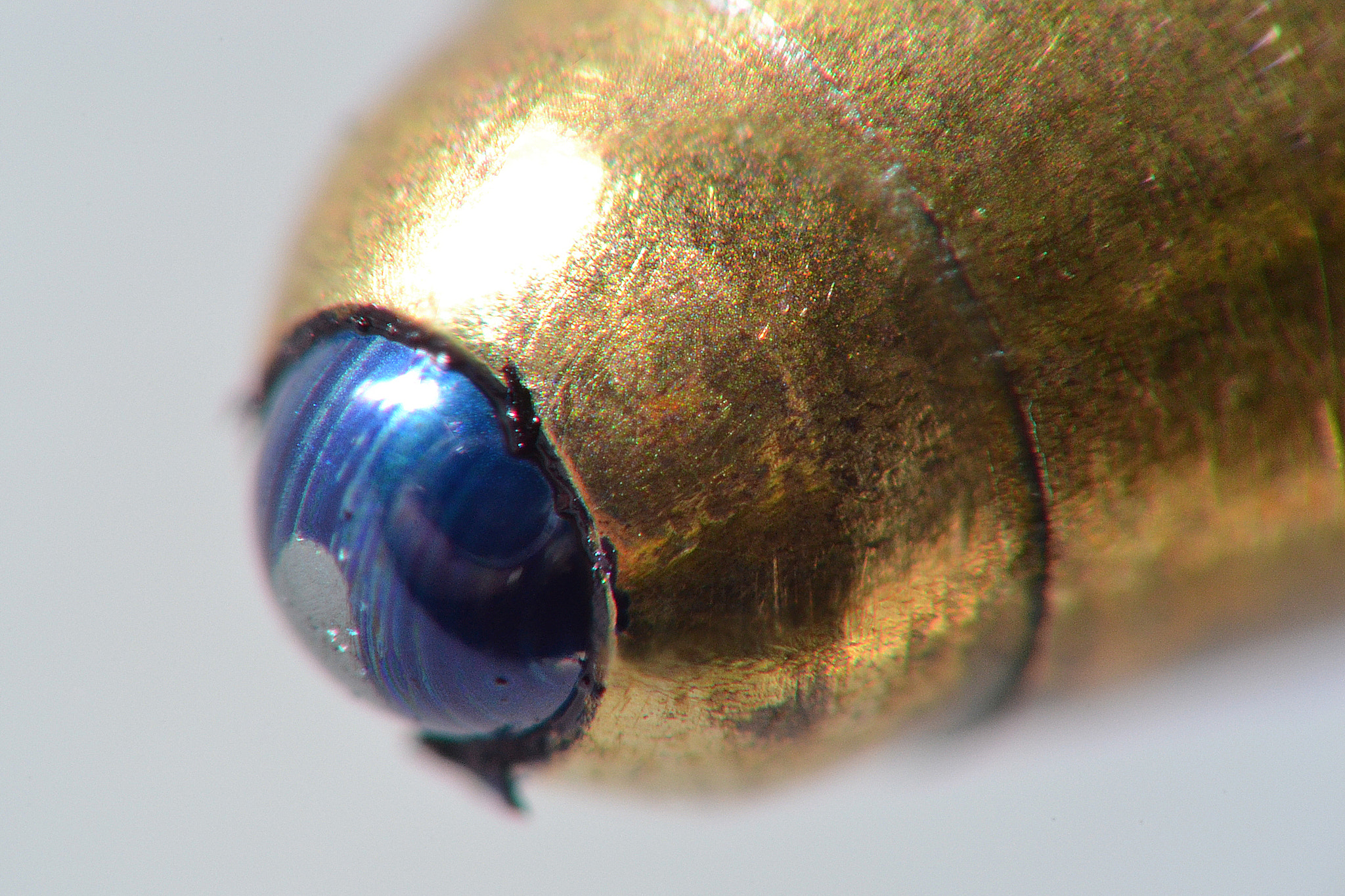
A ballpoint, up close and personal. Image via Wikipedia
Fountain pens use gravity and capillary action to evenly feed ink from a cartridge or reservoir down into the metal nib. The nib is split in two tines and allows ink to flow forth when pressed against paper. It’s not that fountain pens are that delicate. It’s just that they’re only about one step above dipping a nib or a feather directly into ink.
There’s no denying that fountain pens are classy, but you’re playing with fire if you put one in your pocket. They can be a bit messy on a good day, and the cheap ones are prone to leaking ink. No matter how nice of a fountain pen you have, it has to be refilled fairly frequently, either by drawing ink up from a bottle into the pen’s bladder or inserting a new cartridge. And you’re better off using it as often as possible, since a dormant fountain pen will get clogged with dried ink.
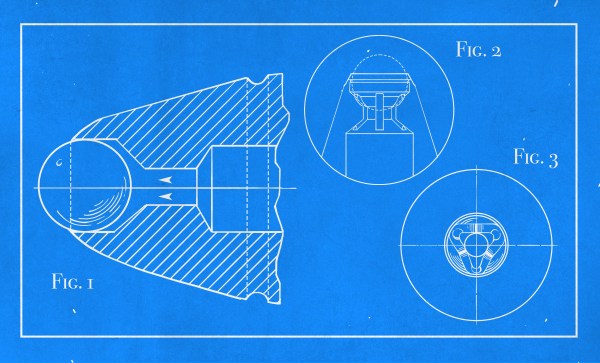
Early ballpoint pens were modeled after fountain pens, aesthetically speaking. They had metal bodies and refillable reservoirs that only needed a top-up every couple of years, compared to once a week or so for fountain pens. Instead of a nib, ballpoints have a tiny ball bearing made of steel, brass, or tungsten carbide. These pens rely on gravity to bathe the ball in ink, which allows it to glide around in the socket like a tiny roll-on deodorant.







 Back before COVID-19, I was walking through the airport towards the gate when suddenly I remembered a document I wanted to read on the flight but had forgotten to bring along. No worry, I paused for a bit on the concourse, reached into my pocket and proceeded to download the document from the Internet. Once comfortably seated on the plane, I relaxed and began reading. Afterwards, I did a little programming in C on a shareware program I was developing.