Who invented the automobile? The answer depends a little bit on your definition of the word. The first practical gas-powered carriage was built by Karl Benz, who later merged his company with Daimler Motor Group to form Mercedez-Benz.
Karl Benz was a design visionary whose first fascinations were with locomotives and bicycles. His 1886 Benz Patent Motorwagen was the first automobile to generate its own power, which was made with a two-stroke engine and transmitted to the rear axle by a pair of chains. He didn’t think it was ready for the road, and he was mostly right.
Bertha Benz, Karl’s wife and business partner, believed in her husband’s invention. She had been there since the beginning, and provided much of the funding for it along the way. If she hadn’t taken it out for a secret, illegal joyride, the Motorwagen may have never left the garage.
Over the past decades, additive manufacturing (AM, also known as 3D printing) has become increasingly common in manufacturing processes. While immensely helpful in the prototyping of new products by allowing for rapid turn-around times between design and testing, these days additive manufacturing is used more and more often in the production of everything from small production runs of custom enclosures to hard to machine components for rocket engines.
The obvious advantage of additive manufacturing is that they use generic equipment and common materials as input, without requiring expensive molds as in the case of injection molding, or extensive, wasteful machining of raw materials on a lathe, mill, and similar equipment. All of the manufacturing gets reduced to a 3D model as input, one or more input materials, and the actual device that converts the 3D model into a physical component with very limited waste.
In the nuclear power industry, these benefits haven’t gone unnoticed, which has led to 3D printed parts being developed for everything from keeping existing plants running to streamlining spent fuel reprocessing and even the printing of entire nuclear reactors.
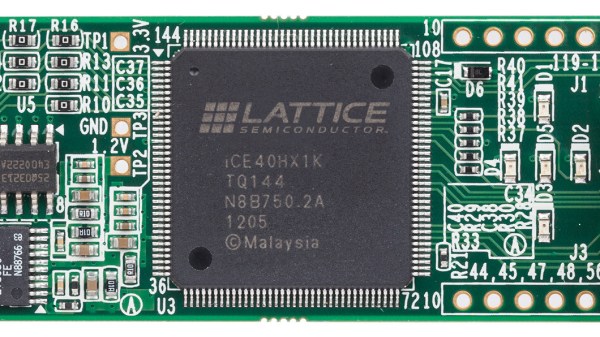
Yesterday we reported that Lattice Semiconductor had inserted a clause that restricted the reverse engineering of bitstreams produced by their FPGA toolchains. Although not explicitly stated, it’s assumed that this was directed toward several projects over the past five years that have created fully open source toolchains by reverse engineering the bitstream protocols of the Lattice ICE40 and ECP5 FPGA architectures. Late yesterday Lattice made an announcement reversing course.
To the open source community, thank-you for pointing out a new bitstream usage restriction in the Lattice Propel license. We are excited about the community’s engagement with Lattice devices and our intent is to not hinder the creation of innovative open source FPGA tools.
It’s refreshing then to see this announcement from Lattice Semiconductor. Even more so is the unexpected turn of speed with which they have done so, within a couple of days of it being discovered by the open-source community. We report depressingly often on boneheaded legal moves from corporations intent on curbing open source uses of their products. This announcement from Lattice removes what was an admonition opposing open source toolchains, can we hope that the company will continue yesterday’s gesture and build a more lasting relationship with the open source community?
The underlying point to this story is that in the world of electronics there has long been an understanding that hardware hackers drive product innovation which will later lead to more sales. Texas Instruments would for years supply samples of exotic semiconductors to impecunious students for one example, and maybe you have a base-model Rigol oscilloscope with a tacitly-approved software hack that gives it an extra 50MHz of bandwidth for another.
We can only congratulate Lattice on their recognition that open source use of their products is beneficial for them, and wish that some of the other companies triggering similar stories would see the world in the same way. Try interacting more with your open source fans; they know and love your hardware more than the average user and embracing that could mean a windfall for you down the road.
The topic of reverse engineering is highly contentious at best when it comes to software and hardware development. Ever since the configuration protocol (bitstream) for Lattice Semiconductor’s iCE40 FPGAs was published in 2015 through reverse engineering efforts, there has been a silent war between proponents of open bitstream protocols and FPGA manufacturers, with the Lattice ECP5’s bitstream format having been largely reverse-engineered at this point.
Update: About eight hours after this article was published, Lattice Semiconductor issued a statement retracting the EULA language that banned bitstream reverse engineering. Please check out Hackaday’s article about this reversal.
Most recently, it appears that Lattice has fired a fresh shot across the bow of the open source projects. A recently discovered addition to the Propel SDK, which contains tools to program and debug Lattice devices, specifically references bitstream reverse engineering. When logged in with an account on the company’s website the user must agree to the Lattice Propel License Agreement for Lattice Propel 1.0 prior to download. That document includes the following language:
In particular, no right is granted hereunder […] (3) for reverse engineering a bitstream format or other signaling protocol of any Lattice Semiconductor Corporation programmable logic device.
While watching a video about old radios from the 1920s, a phone jack popped up. The host mentioned that phone jacks are super old and he wondered what was their origin. I always assumed they had something to do with the telephone system, and that’s right, but I had no idea how old they really are and how they’ve evolved. Turns out the venerable plug goes back to at least 1878.
Keep in mind, I’m talking about the good old fashioned 1/4″ phone jack with two wires. Over time, the jack and plug have spawned different versions with more wires and — particularly — smaller dimensions. The headphone jack that many smartphone makers are dropping is a direct descendant of that old phone jack. But a mono cable like you would see connecting an electric guitar or another mono source would be right at home connected to a 1900s switchboard. Let’s take a look at the origins of a design that’s almost 150 years old and still in use.
Long ago, before smartphones were ubiquitous and children in restaurants were quieted with awful games on iPads, there was a beautiful moment. A moment in which the end user could purchase, at a bargain price, an x86 computer in a compact, portable shell. In 2007, the netbook was born, and took the world by storm – only to suddenly vanish a few years later. What exactly was it that made netbooks so great, and where did they go?
A Beautiful Combination
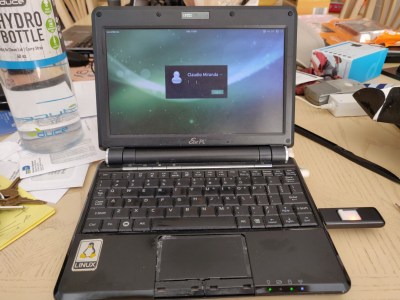
An Asus EEE PC shown here running Linux. You could run anything on them! Because they were real, full-fat computers. No locked down chipsets or BIOS. Just good, clean, x86 fun.
The first machine to kick off the craze was the Asus EEE PC 701, inspired by the One Laptop Per Child project. Packing a 700Mhz Celeron processor, a small 7″ LCD screen, and a 4 GB SSD, it was available with Linux or Windows XP installed from the factory. With this model, Asus seemed to find a market that Toshiba never quite hit with their Libretto machines a decade earlier. The advent of the wireless network and an ever-more exciting Internet suddenly made a tiny, toteable laptop attractive, whereas previously it would have just been a painful machine to do work on. The name “netbook” was no accident, highlighting the popular use case — a lightweight, portable machine that’s perfect for web browsing and casual tasks.
But the netbook was more than the sum of its parts. Battery life was in excess of 3 hours, and the CPU was a full-fat x86 processor. This wasn’t a machine that required users to run special cut-down software or compromise on usage. Anything you could run on an average, low-spec PC, you could run on this, too. USB and VGA out were available, along with WiFi, so presentations were easy and getting files on and off was a cinch. It bears remembering, too, that back in the Windows XP days, it was easy to share files across a network without clicking through 7 different permissions tabs and typing in your password 19 times.
We’re now several months into the global response to the COVID-19 pandemic, with most parts of the world falling somewhere on the lockdown/social distancing/opening up path.
It’s fair to say now that while the medical emergency has not passed, the level of knowledge about it has changed significantly. When communities were fighting to slow the initial spead, the focus was on solving the problem of medical protection gear and other equipment shortages at all costs with some interesting yet possibly hazardous solutions. Now the focus has moved towards protecting the general public when they do need to venture out, and as society learns to get life moving again with safety measures in place.
So, we all need masks of some sort. What type to do you need? Is one type better than another? And how do we all get them when everyone suddenly needs what was once a somewhat niche item?