We are truly living in the golden age of media streaming. From the Roku to the Chromecast, there is no shortage of cheap devices to fling your audio and video anywhere you please. Some services and devices may try to get you locked in a bit more than we’d like (Amazon, we’re looking at you), but on the whole if you’ve got media files on your network that you want to enjoy throughout the whole house, there’s a product out there to get it done.
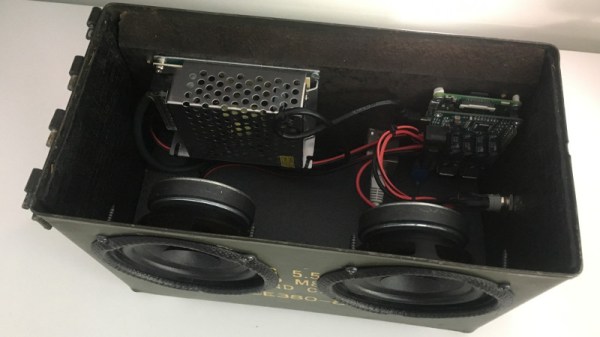
But why buy an easy to use and polished commercial product when you can hack together your own for twice the price and labor over it for hours? While you’re at it, why not build the whole thing into a surplus ammo can? This the line of logic that brought [Zwaffel] to his latest project, and it makes perfect sense to us.
It should come as no surprise that a military ammo can has quite a bit more space inside than is strictly required for the Raspberry Pi 3 [Zwaffel] based his project on. But it does make for a very comfortable wiring arrangement, and offers plenty of breathing room for the monstrous 60 watt power supply he has pumping into his HiFiBerry AMP+ and speakers.
On the software side the Pi is running Max2Play, a Linux distro designed specifically for streaming audio and video remotely. [Zwaffel] says that with this setup he is able to listen to music on his Squeezebox server as well as watch movies via Kodi.
While none are quite as battle-hardened as this, we have seen several other Raspberry Pi Squeezebox clients over the years if you’re looking for more inspiration.