FAA Bans Drones For More Than Six Million People

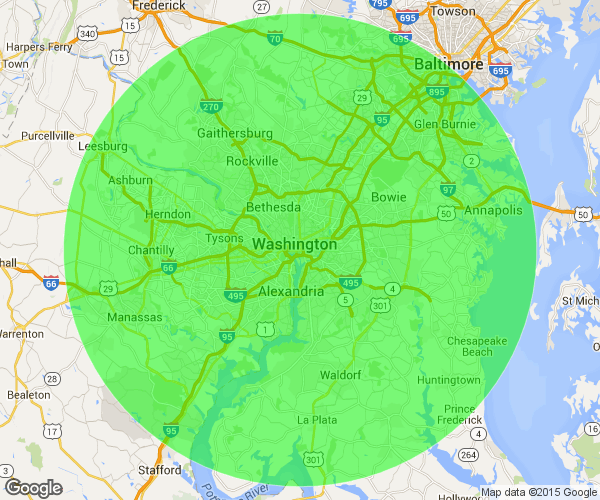
In recent weeks, the FAA has solicited input from hobbyists and companies in the ‘drone’ industry, produced rules and regulations, and set up a registration system for all the quadcopters and flying toys being gifted over the holiday season. Whether or not the FAA is allowed to do this is a question being left to the courts, but for now, the FAA has assuredly killed a hobby for more than six million people. The FAA has introduced an updated Temporary Flight Restriction (TFR) for a 30-mile radius around Washington, DC.

staticmap
The 30-mile TFR area

Previously, there had been a blanket ban on drones, UAS, and model aircraft within a 15-mile radius of a point inside Reagan National Airport. This point covered the District of Columbia proper, and the suburbs of Bethesda, College Park, and Alexandria – basically, everything inside the beltway, and a mile or two beyond. The new flight restriction for drones covers a vastly larger area – all of the DC metro area, Annapolis, half of Baltimore, and all of northern Virginia. This area encompasses a population of more than six million people.

The DC metro area has, since 9/11, become some of the most complex airspace in the entire country. There are several military bases, Aberdeen proving grounds, the US Naval academy, and of course the White House, Capitol building, and the Pentagon. Even commercial airliners are subject to some very interesting regulations. For the same reason general aviation shuts down in southern California every time the president visits LA, you simply can’t fly model aircraft within the beltway; it’s a security measure, and until now, flying clubs in the DC area have dealt with these restrictions.

The new TFR has effectively shuttered more than a dozen flying clubs associated with the Academy of Model Aeronautics. DCRC, a club with a field in the middle of some farmland in Maryland, has closed down until further notice. The Capital Area Soaring Association has also closed because of the TFR.

Although called a Temporary Flight Restriction, this is a rule that will be around for a while. The FAA says this restriction is here for good.

Drone Registration Is Just FAA Making You Read Their “EULA”

Over the last few weeks we’ve waded through the debate of Drone restrictions as the FAA announced, solicited comments, and finally put in place a registration system for Unmanned Aerial Systems (UAS). Having now had a week to look at the regulation, and longer to consider the philosophy behind it, I don’t think this is a bad thing. I think the FAA’s move is an early effort to get people to pay attention to what they’re doing.

The broad picture looks to me like a company trying to get users to actually read an End User Licensing Agreement. I’m going to put the blame for this firmly on Apple. They are the poster children for the unreadable EULA. Every time there is an update, you’re asked to read the document on your smartphone. You scroll down a bit and think it’s not that long, until you discover that it’s actually 47 pages. Nobody reads this, and years of indoctrination have made the click-through of accepting an EULA into a pop-culture reference. In fact, this entire paragraph has been moot. I’d bet 99 out of 103 readers knew the reference before I started the explanation.

So, we have a population of tech adopters who have been cultivated to forego reading any kind of rules that go with a product. Then we have technological advancement and business interests that have brought UAS to the feet of the general public both with low costs, wide availability, and pop-culture appeal. What could possibly go wrong? Let’s jump into that, then cover some of the other issues people are concerned about, like the public availability of personal info on the drone registry.

Continue reading “Drone Registration Is Just FAA Making You Read Their “EULA””

Flying Planes With Squirrel Cages

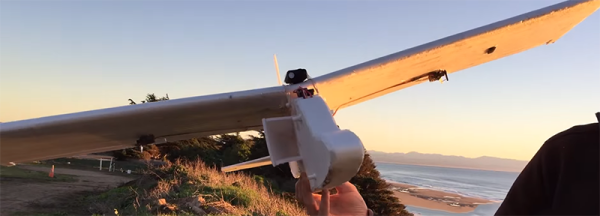
Fixed wing remote control planes are ridiculously overpowered. Whereas normal, manned fixed wing aircraft need to take into account things like density altitude, angle of attack, and weight limits, most RC aircraft can hover. This insane amount of power means there’s a lot of room for experimentation, especially in new and novel power plants. [Samm Sheperd] had an old squirrel cage fan taken from an electric wall heater and figured one man’s trash was an integral part of another man’s hobby and built a plane around this very unusual fan.

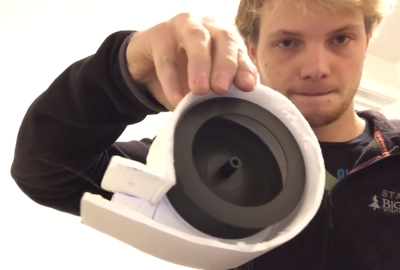
squirrel-cage-fan-wideThe only part of the squirrel cage fan [Samm] reused was the impeller. Every other part of this power plant was either constructed out of foam board, plywood, or in the case of the brushless motor turning the fan, stolen from the ubiquitous box of junk on every modeller’s workbench.


The design of the plane puts the blower fan directly under the wings, blasting the air backwards underneath the empennage. During testing, [Samm] found this blower pulled around 350W from the battery – exactly what it should draw if a properly sized propeller were attached to the motor. The thrust produced isn’t that great — only about 400g of thrust from an airframe that weights 863g. That’s very underpowered for an RC aircraft, but absurdly powerful for any manned flying machine.

Does the plane work? Of course it does. [Samm] took his plane for a few laps around the neighborhood and found the plane flies excellently. It is horrifically loud, but it is a great example of how much anyone can do with cheap RC planes constructed out of foam.

Continue reading “Flying Planes With Squirrel Cages”

You Need A Self-Righting Thrust-Vector Balloon Copter

Cornell University’s microcontroller class looks like a tremendous amount of fun. Not only do the students learn the nitty-gritty details of microcontroller programming, but the course culminates in a cool project. [Brian Ritchken] and [Jim Liu] made a thrust-vector controlled balloon blimp. They call this working?!?!

Three balloons provide just enough lift so that the blimp can climb or descend on motor power. Since the machine is symmetric, there’s no intrinsic idea of “forward” or “backward”. Instead, a ring of eight LEDs around the edge let you know which way the blimp thinks it’s pointing. Two controls on the remote rotate the pointing direction clockwise and counter-clockwise. The blimp does the math to figure out which motors to run faster or slower when you tell it to go forward or back.

The platform is stabilized by a feedback loop with an accelerometer on board, and seems capable of handling a fairly asymmetric weight distribution, as evidenced by their ballast dangling off the side — a climbing bag filled with ketchup packets that presumably weren’t just lifted from the dining halls.

It looks like [Brian] and [Jim] had a ton of fun building and flying this contraption. We’d love to see a distance-to-the-floor sensor added so that they could command it to hover at a given height, but that adds an extra level of complexity. They got this done in time and under budget, so kudos to them both. And in a world full of over-qualified quadcopters, it’s nice to see the humble blimp getting its time in the sun.

Yep, you heard right… this is yet another final project for a University course. Yesterday we saw a spinning POV globe, and the day before a voice-activated eye test. We want to see your final project too so please send in a link!

Camera Quadcopter Almost Hits Slalom Skiier

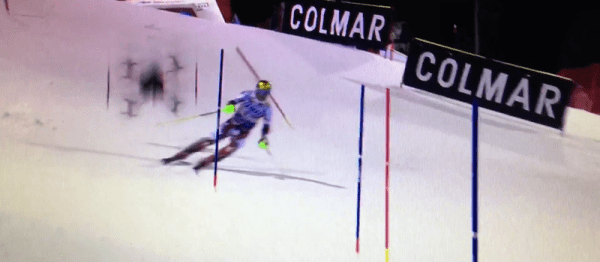
During the World Cup slalom skiing championship on Wednesday, ski champion [Marcel Hirscher] was nearly hit by an out-of-control camera drone, that crashed just behind him while filming during a run. Watch the (scary) video embedded after the break.

According to this article in Heise.de (Google Translate link), the pilot was accredited and allowed to fly the quad, but only over a corridor where no spectators were present. After the first couple of runs, apparently the pilot went off course and quite obviously lost control of the copter.

Continue reading “Camera Quadcopter Almost Hits Slalom Skiier”

Here’s The Reason The FAA’s Drone Registration System Doesn’t Make Sense

Last week, the US Department of Transportation and FAA released their rules governing drones, model aircraft, unmanned aerial systems, and quadcopters – a rose by any other name will be regulated as such. Now that the online registration system is up and running.

The requirements for registering yourself under the FAA’s UAS registration system are simple: if you fly a model aircraft, drone, control line model, or unmanned aerial system weighing more than 250g (0.55 lb), you are compelled under threat of civil and criminal penalties to register.

This is, by far, one of the simplest rules ever promulgated by the FAA, and looking at the full text shows how complicated this rule could have been. Representatives from the Academy of Model Aircraft, the Air Line Pilots Association, the Consumer Electronics Association weighed in on what types of aircraft should be registered, how they should be registered, and even how registration should be displayed.

Considerable attention was given to the weight limit; bird strikes are an issue in aviation, and unlike drones, bird strikes have actually brought down airliners. The FAA’s own wildlife strike report says, “species with body masses < 1 kilogram (2.2 lbs) are excluded from database,”. The Academy of Model Aircraft pushed to have the minimum weight requiring registration at two pounds, citing their Park Flyer program to define what a ‘toy’ is.

Rules considering the payload carrying ability of an unmanned aerial system were considered, the inherent difference between fixed wing and rotors or quadcopters was considered, and even the ability to drop toy bombs was used in the decision-making process that would eventually put all remotely piloted craft weighing over 250g under the FAA’s jurisdiction. We must at least give the FAA credit for doing what they said they would do: regulate drones in a way that anyone standing in line at a toy store could understand. While the FAA may have crafted one of the simplest rules in the history of the administration, this rule might not actually be legal.

Continue reading “Here’s The Reason The FAA’s Drone Registration System Doesn’t Make Sense”

Tokyo Police Aim To Catch Drones In A Net

A Japanese protester flew a quadcopter with a symbolic amount of soil from the contaminated Fukushima region onto the roof of the Prime Minister’s office in April. Although it was a gesture, it alerted the Tokyo police department to the potential need to be able to pull drones out of the air.

drone_in_netSimply shooting them down won’t do — think of the innocent bystanders on the ground subjected to a rain of quadcopter parts. The Tokyo police’s solution: catch them in a net, flown by another quadcopter, of course.

We can’t embed it here, but go click through to the video. It looks like the police are having a really good time. How long before we see drone-net sets under the Christmas tree, or quadcopter-tag leagues? We’re uncertain of how far the Battlebots in the Sky movement got.

We have no shortage of yahoos driving quadcopters in the States, of course. From interfering with fire-fighting aircraft to simply flying too close to commercial airplanes, people are doing things that they simply shouldn’t. We’ve been covering the US government’s response that finally culminated in the FAA making rules requiring medium-weight drones to be registered. Watch our front page for more on that next week. Fly safe, folks.

[via The Verge]