In the 125 years since Marconi made his first radio transmissions, the spectrum has been divvied up into ranges and bands, most of which are reserved for governments and large telecom companies. Amidst all of the corporate greed, the “little guys” managed to carve out their own small corner of the spectrum, with the help of organizations like the American Radio Relay League (ARRL). Since 1914, the ARRL has represented the interests of us amateur radio enthusiasts and helped to protect the bands set aside for amateur use. To actually take advantage of the wonderful opportunity to transmit on these bands, you need a license, issued by the FCC. The licenses really aren’t hard to get, and you should get one, but what if you don’t feel like taking a test? Or if you’re just too impatient?
Well, fear not because there’s some space on the radio spectrum for you, too.
Welcome to the wonderful world of (legal!) unlicensed radio experimentation, where anything goes. Okay, not anything but the possibilities are wide open. There are a few experimental radio bands, known as LowFER, MedFER, and HiFER where anyone is welcome to play around. And of the three, LowFER seems the most promising. Continue reading “The Low-Down On Long-Wave: Unlicensed Experimental Radio”→
We’re really excited to announce that Jeremy Fielding will give a keynote address at Hackaday Remoticon in November! Get your free ticket now!
The projects we in this community choose to tackle often take a lot to see to completion. Parts, tools, expertise, time; all are critical to getting projects from concept to reality. But how deep your parts bin is or how well-equipped your shop may be matters not a whit unless you’ve got the one thing that makes it all go: passion. Passion is what keeps a project rolling ahead paste the inevitable roadblocks and diversions; it’s what keeps us going back to the bench to try something new when we think we’ve tried it all.
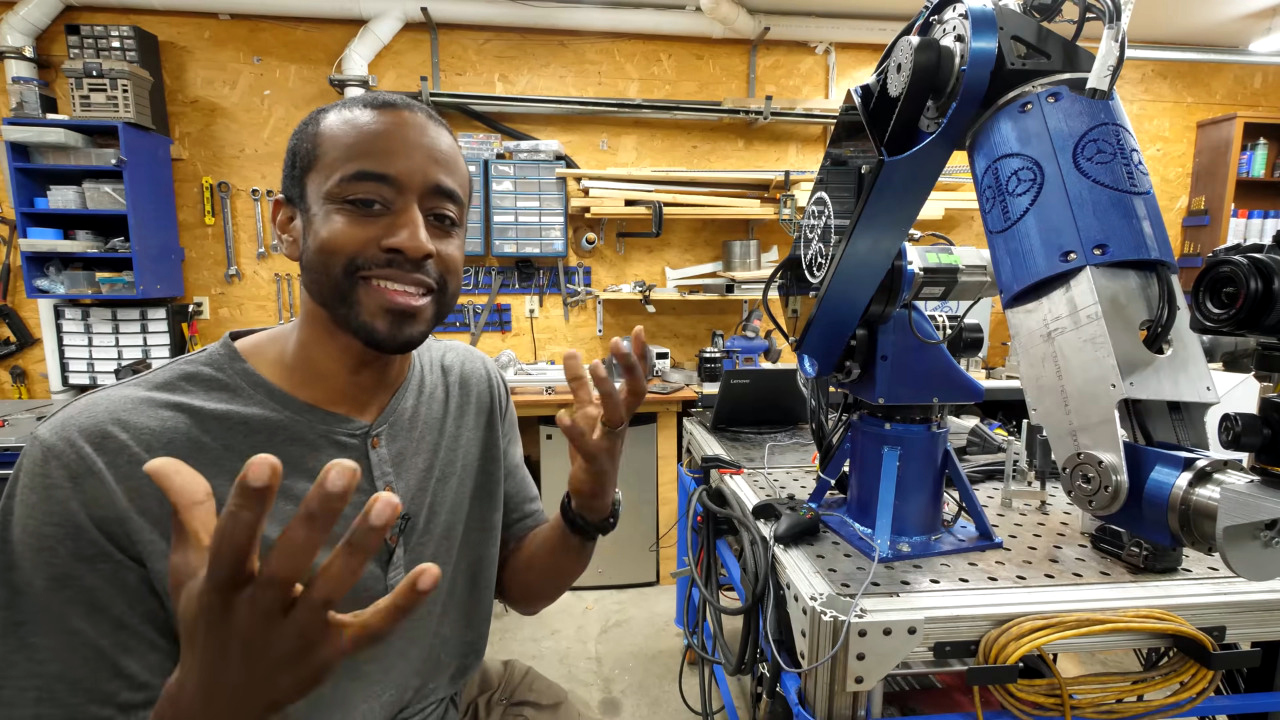
The passion to understand, to create, to innovate, is something that Jeremy Fielding clearly has. Anyone who has watched even a few of his YouTube videos knows how much he loves to make things move. His current project is a seven-axis industrial robot arm, and it’s a seriously impressive build that could easily be mistaken for a commercial product. What’s perhaps most impressive about this is that many of the skills needed to pull it off, like welding aluminum and machining, are skills that Jeremy has been teaching himself on the fly. Talk about passion!
For his keynote, Jeremy is going to focus on building hardware that moves. Most of us are reasonably good at putting together projects that flash a few lights or perhaps move a few small steppers or servos. But scaling that up, as Jeremy has done for his robot arm as well as other projects, introduces new challenges: what type of electric motor do I choose? How do I figure out the trade-offs between torque and speed? Do I even want to use electric motors — maybe pneumatics will be better? What are my control options? These questions can be just as daunting to the old hands as they are to beginners, and Jeremy is going to focus on how to handle these and other mechatronic challenges that crop up in our projects.
Aside from the (literal) nuts and bolts of mechanical engineering, there’s another place where Jeremy’s passion shines through: his passion for communicating what he has learned. His presentation style and enthusiasm are infectious, and we’re sure that’s going to come across in his keynote. Jeremy fancies himself a “contraption engineer,” which is both an apt and engaging way to look at what he does. Fellow contraption builders take note — you’re going to want to make sure you don’t miss this one!
Call for Proposals is Still Open!
We’re still on the hunt for great talks about hardware creation, so the Call for Proposals has been extended to October 20. And remember, get your tickets early — knowing how many people to expect really helps us with infrastructure planning so we can give everyone a quality experience.
When you’re standing at the gas station filling up your car, watching those digits on the pump flip by can be a sobering experience. Fuel prices, especially the price of gasoline, have always been keenly watched, so it’s hard to imagine a time when gasoline was a low-value waste product. But kerosene, sold mainly for lighting, was once king of the petroleum industry, at least before the automobile came along, to the extent that the gasoline produced while refining kerosene was simply dumped into streams to get rid of it.
The modern mind perhaps shudders at the thought of an environmental crime of that magnitude, and we can’t imagine how anyone would think that was a good solution to the problem. And yet we now face much the same problem, as the increasing electrification of the world’s fleet of motor vehicles pushes down gasoline demand. To understand why this is a problem, we’ll start off by taking a look at how crude oil is formed, and how decreasing demand for gasoline may actually cause problems that we should think about before we get too far down the road.
Burning fossil fuels releases carbon dioxide into the atmosphere. While most attempts to reduce greenhouse-gas emissions focus on reducing the amount of CO2 output, there are other alternatives. Carbon capture and sequestration has been an active area of research for quite some time. Being able to take carbon dioxide straight out of the air and store it in a stable manner would allow us to reduce levels in the atmosphere and could make a big difference when it comes to climate change.
A recent project by a company called Climeworks is claiming to be doing just that, and are running it as a subscription service. The company has just opened up its latest plant in Iceland, and hopes to literally suck greenhouses gases out of the air. Today, we’ll examine whether or not this technology is a viable tool in the fight against climate change.
On a dark night in 2006 I was bicycle commuting to my office, oblivious to the countless man made objects orbiting in the sky above me at thousands of miles per hour. My attention was instead focused on a northbound car speeding through a freeway underpass at dozens of miles per hour, oblivious to my southbound headlamp. The car swerved into the left turn lane to get to the freeway on-ramp. The problem? I was only a few feet from crossing the entrance to that very on-ramp! As the car rushed through their left turn I was presented with a split second decision: slow, and possibly stop in the middle of the on-ramp, or just go for it and hope for the best.
In Blue: Terrified cyclist. In Red: A speeding car careening around a corner without slowing down.
By law I had the right of way. But this was no time to start discussing right of way with the driver of the vehicle that threatened to turn me into a dark spot on the road. I followed my gut instinct, and my legs burned in compliance as I sped across that on-ramp entrance with all my might. The oncoming car missed my rear wheel by mere feet! What could have ended in disaster and possibly even death had resulted in a near miss.
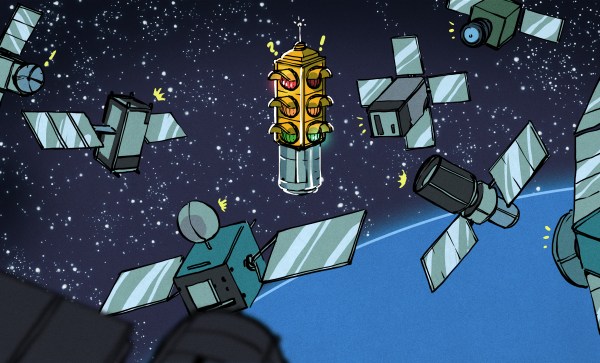
Terrestrial vehicles generally have laws and regulations that specify and enforce proper behavior. I had every right to expect the oncoming car be observant of their surroundings or to at least slow to a normal speed before making that turn. In contrast, traffic control in Earth orbit conjures up thoughts of bargain-crazed shoppers packed into a big box store on Black Friday.
So is spacecraft traffic in orbit really a free-for-all? If there were stringent rules, how can they be enforced? Before we explore the answers to those questions, let’s examine the problem we’re here to discuss: stuff in space running into other stuff in space.
Despite being present in everything that contains water, tritium is not an isotope that many people were that familiar with outside of select (geeky) channels, such as DEF CON with a tritium-containing badge, the always excellent NurdRage’s assembly of a tritium-based atomic battery, or the creation of a tritium-phosphor-based glow-in-the-dark tesseract cube.
Tritium is a hydrogen isotope that shares a lot of characteristics with its two siblings: 1H (protium) and 2H (deuterium), with the main distinction being that tritium (3H) is not a stable isotope, with a half-life of ~12.32 years that sees it decay into 3He. Most naturally occurring tritium on Earth originates from interactions between fast neutrons (>4.0 MeV) from cosmic radiation and atmospheric nitrogen.
Recently tritium has become a politically hot topic on account of the announced release of treated water at the Japanese Fukushima Daiichi nuclear plant. This has raised for many the question of just how much tritium is ‘too much’ and what we’re likely to notice from this treated — but still tritium-containing water — being released into the ocean.
It is my pleasure to announce that Keith Thorne has graciously agreed to deliver a keynote take at Hackaday Remoticon 2. Get your ticket now!
Keith is an astrophysicist and has worked on the Laser Interferometer Gravitational-Wave Observatory (LIGO) since 2008, literally looking for ripples in space-time that you know as gravitational waves. The effects of the phenomena are so subtle that detecting an event requires planet-scale sensors in the form of 4 km long interferometers placed in different parts of the United States whose readings can be compared against one another. A laser beam inside these interferometers bounces back and forth 300 times for a total travel distance of 1,200 km in which any interaction with gravitational waves will ever-so-slightly alter how the photons from the beam register.
The challenges of building, operating, and interpreting such a device are manifold. These interferometers are the highest precision devices ever devised, able to detect motion 1/10,000 of the diameter of a proton! To get there, the mirrors need to be cooled to 77 nano-Kelvins. Getting the most out of it is what Keith and the rest of the team specialize in. This has included things like hacking the Linux kernel to achieve a sufficient level of real-time digital control, and using “squeezed light” to improve detection sensitivity in frequencies where quantum mechanics is getting in the way. While the detectors were first run in 2015 & 2016, successfully observing three events, the work to better understand this phenomenon is ongoing and may include a third site in India, and a space-based detector in the future.
In getting to know Keith he mentioned that he is excited to speak to a conference packed with people who want to hear the gory technical details of this fantastic piece of hardware. I’m sure we’re all giddy to learn what he has to say. But if you’re someone who wants to work on a project like this, he tipped us off that there’s an active EE job posting for LIGO right now. Maybe you’ll end up doing the keynote at a future Hackaday conference.
Call for Proposals is Still Open!
We’re still on the hunt for great talks about hardware creation. True creativity is fed by a steady stream of inspiration. Be that inspiration by giving a talk about the kinds of things you’ve been working on!