All of us probably know what neutrons are, or have at least heard of them back in physics class. Yet these little bundles of quarks are much more than just filler inside an atom’s nucleus. In addition to being an essential part of making matter as stable as it (usually) is, free neutrons can be used in a variety of manners.
From breaking atoms apart (nuclear fission), to changing the composition of atoms by adding neutrons (transmutation), to the use of neutrons in detecting water and inspecting materials, neutrons are an essential tool in the sciences, as well as in medicine and industrial applications. This has meant a lot of development toward the goal of better neutron sources. While nuclear fission is an efficient way to get lots of neutrons, for most applications a more compact and less complicated approach is used, some of which use nuclear fusion instead.
In this article we’ll be taking a look at the many applications of neutron sources, and these neutron sources themselves.
People rightly marvel at modern surgical techniques that let surgeons leverage the power of robotics to repair the smallest structures in the human body through wounds that can be closed with a couple of stitches. Such techniques can even be applied remotely, linking surgeon and robot through a telesurgery link. It can be risky, but it’s often a patient’s only option.
NASA has arrived at a similar inflection point, except that their patient is the Mars InSight lander, and the surgical suite is currently about 58 million kilometers away. The lander’s self-digging “mole” probe needs a little help getting started, so they’re planning a high-stakes rescue attempt that would make the most seasoned telesurgeon blanch: they want to use the lander’s robotic arm to press down on the mole to help it get back on track.
But of course these smart speakers are listening all the time, at least locally. How else are they going to know that someone uttered one of their wake words, or something close enough? It would sure help a lot if we could change the wake word to something like ‘rutabaga’ or ‘supercalifragilistic’, but they probably have ASICs that are made to listen for a few specific words. On the Echo for example, your only choices are “Alexa”, “Amazon”, “Echo”, or “Computer”.
So how often are smart speakers listening when they shouldn’t? A team of researchers at Boston’s Northeastern University are conducting an ongoing study to determine just how bad the problem really is. They’ve set up an experiment to generate unexpected activation triggers and study them inside and out.
When it comes to creating a handling monster, the aim is to create a car that sticks to the road like glue, and is controllable when it does break loose. Having a car that handles predictably at the limit is a big help when you’re pushing hard on track, particularly for an inexperienced driver. And, whether you’re hitting the canyons on the weekend or trying to slash your laptimes, it’s always nice to have more grip. Through selecting the right parts and getting the set up right, it’s possible to hone your car’s cornering ability to make it a rewarding experience to drive fast and hard. Continue reading “How To Get Into Cars: Handling Mods”→
Of the many well-known names in science, few have been as reluctant to stick to one particular field as Freeman John Dyson. Born in the UK in 1923, he showed a great interest in mathematics and related fields even as a child. By the time he was 15 he had won a scholarship at Trinity College, in Cambridge, where he studied mathematics. Though the war forced him to work at the Air Force’s Operational Research Section (ORS), afterwards he would return to Trinity to get his BA in mathematics.
His subsequent career saw him teaching at universities in the UK and US, before eventually ending up at Cornell University, where he joined the Institute for Advanced Study at the invitation of its head, J. Robert Oppenheimer. Here he would meet up with such people as Richard Feynman with whom he would work on quantum electrodynamics.
Beyond mathematics and physics, Dyson would also express great interest in space exploration — with Dyson spheres being well-known — and genetics, both in the context of the first formation of life and in genetic manipulation to improve plants to deal with issues today. He also worked on the famous Project Orion, which used nuclear bombs for propulsion.
In this article we’ll take a look at these and other parts of Mr. Dyson’s legacy, as well as the influence of his works today.
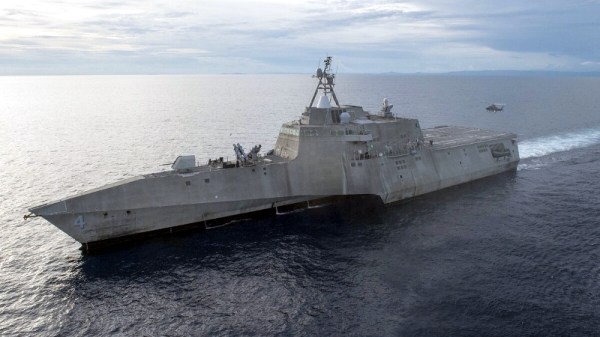
From the Age of Sail through to the Second World War, naval combat was done primarily in close quarters and with cannons. Naturally the technology improved quite a bit in those intervening centuries, but the idea was more or less the same: the ship with the most guns and most armor was usually the one that emerged victorious. Over the years warships became larger and heavier, a trend that culminated in the 1940s with the massive Bismarck, Iowa, and Yamato class battleships.
But by the close of WWII, the nature of naval combat had begun to change. Airplanes and submarines, vastly improved over their WWI counterparts, presented threats from above and below. A few years later, the advent of practical long-range guided missiles meant that adversaries no longer had to be within visual range to launch their attack. Going into the Cold War it became clear that to remain relevant, warships of the future would need to be smaller, faster, and smarter.
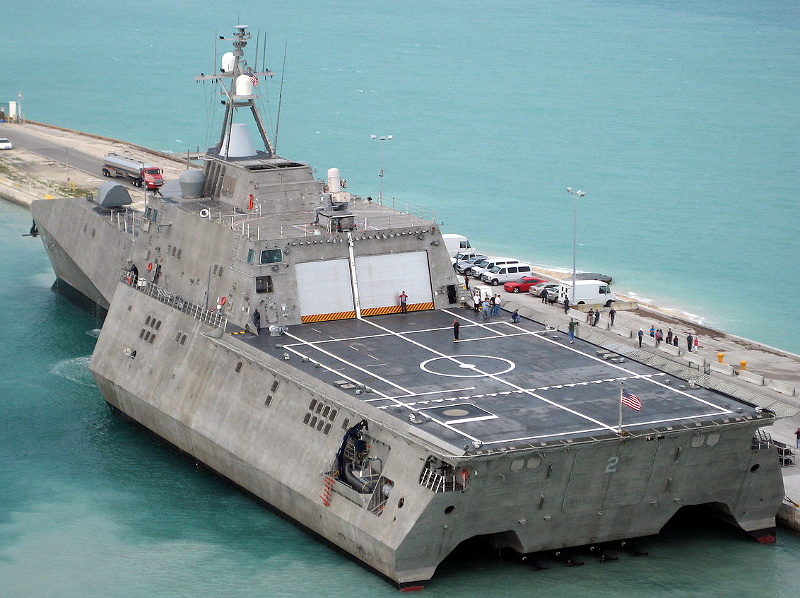
The aft flight deck of a modular LCS
It was this line of thinking that lead the US Navy to embark on the Littoral Combat Ship (LCS) program in the early 2000s. These ships would be more nimble than older warships, able to quickly dash through shallow coastal waters where adversaries couldn’t follow. Their primary armament would consist of guided missiles, with fast firing small-caliber guns being relegated to defensive duty. But most importantly, the core goal of the LCS program was to produce a modular warship.
Rather than being built for a single task, the LCS would be able to perform multiple roles thanks to so-called “mission modules” which could be quickly swapped out as needed. Instead of having to return to home port for a lengthy refit, an LCS could be reconfigured for various tasks at a commercial port closer to the combat area in a matter of hours.
A fleet of ships that could be switched between combat roles based on demand promised to make for a more dynamic Navy. If the changing geopolitical climate meant they needed more electronic reconnaissance vessels and fewer minesweepers, the Navy wouldn’t have to wait the better part of a decade to reshuffle their assets; the changeover could happen in a matter of weeks.
For some reason, of all the ships that have sailed the oceans, it’s the unlucky ones that capture our imagination. Few ships have been as unlucky as the RMS Titanic, sinking as she did on the night of April 15, 1912 after raking across an iceberg on her maiden voyage, and no ship has grabbed as much popular attention as she has.
During her brief life, Titanic was not only the most elegant ship afloat but also the most technologically advanced. She boasted the latest in propulsion and navigation technology and an innovation that had only recently available: a Marconi wireless room, used both for ship-to-shore and ship-to-ship communications.
The radio room of the Titanic landed on the ocean floor with the bow section of the great vessel. The 2.5-mile slow-motion free fall destroyed the structure of the room, but the gear survived relatively intact. And now, more than a century later, there’s an effort afoot to salvage that gear, with an eye toward perhaps restoring it to working condition. It’s a controversial plan, of course, but it is technologically intriguing, and it’s worth taking a look at what’s down there and why we should even bother after all these years.