One of the goals of programming languages back in the 1950s was to create a way to write assembly language concepts in an abstract, high-level manner. This would allow the same code to be used across the wildly different system architectures of that era and subsequent decades, requiring only a translator unit (compiler) that would transform the source code into the machine instructions for the target architecture.
Other languages, like BASIC, would use a runtime that provided an even more abstract view of the underlying hardware, yet at the cost of a lot of performance. Although the era of 8-bit home computers is long behind us, the topic of cross-platform development is still highly relevant today, whether one talks about desktop, embedded or server development. Or all of them at the same time.
Let’s take a look at the cross-platform landscape today, shall we?
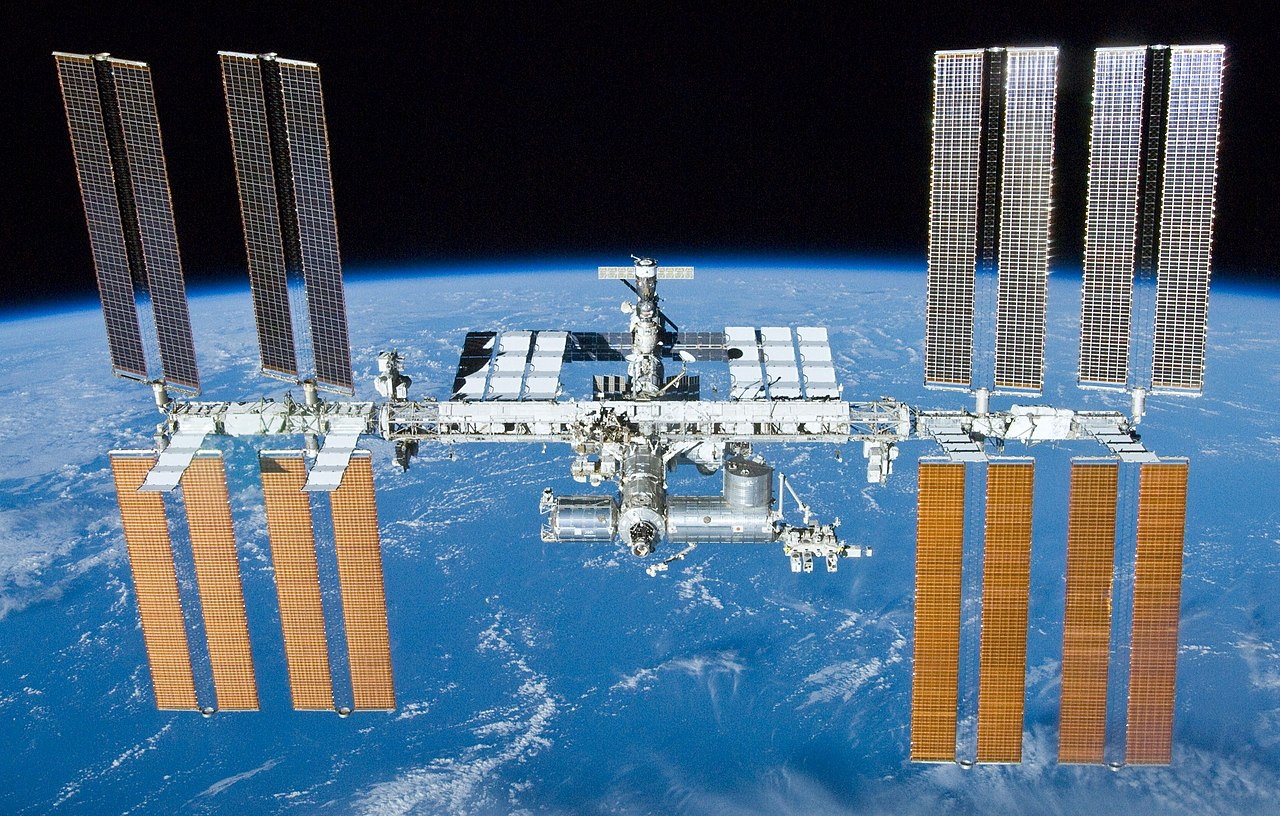
Aboard the International Space Station (ISS), humanity has managed to maintain an uninterrupted foothold in low Earth orbit for just shy of 20 years. There are people reading these words who have had the ISS orbiting overhead for their entire lives, the first generation born into a truly spacefaring civilization.
But as the saying goes, what goes up must eventually come down. The ISS is at too low of an altitude to remain in orbit indefinitely, and core modules of the structure are already operating years beyond their original design lifetimes. As difficult a decision as it might be for the countries involved, in the not too distant future the $150 billion orbiting outpost will have to be abandoned.
Naturally there’s some debate as to how far off that day is. NASA officially plans to support the Station until at least 2024, and an extension to 2028 or 2030 is considered very likely. Political tensions have made it difficult to get a similar commitment out of the Russian space agency, Roscosmos, but its expected they’ll continue crewing and maintaining their segment as long as NASA does the same. Afterwards, it’s possible Roscosmos will attempt to salvage some of their modules from the ISS so they can be used on a future station.
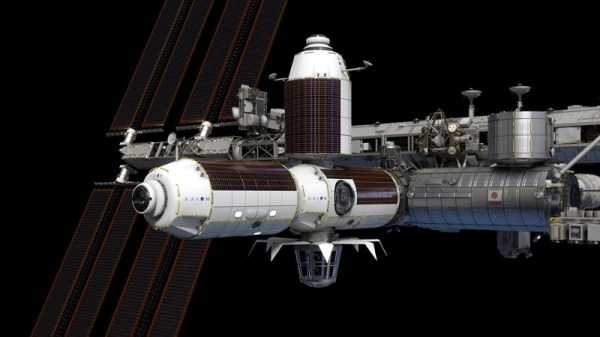
This close to retirement, any new ISS modules would need to be designed and launched on an exceptionally short timescale. With NASA’s efforts and budget currently focused on the Moon and beyond, the agency has recently turned to private industry for proposals on how they can get the most out of the time that’s left. Unfortunately several of the companies that were in the running to develop commercial Station modules have since backed out, but there’s at least one partner that still seems intent on following through: Axiom.
With management made up of former astronauts and space professionals, including NASA’s former ISS Manager Michael Suffredini and Administrator Charles Bolden, the company boasts a better than average understanding of what it takes to succeed in low Earth orbit. About a month ago, this operational experience helped secure Axiom’s selection by NASA to develop a new habitable module for the US side of the Station by 2024.
While the agreement technically only covers a single module, Axiom hasn’t been shy about their plans going forward. Once that first module is installed and operational, they plan on getting NASA approval to launch several new modules branching off of it. Ultimately, they hope that their “wing” of the International Space Station can be detached and become its own independent commercial station by the end of the decade.
There have been a few moments in the past few years, when a conspiracy theory is suddenly demonstrated to be based in fact. Once upon a time, it was an absurd suggestion that the NSA had data taps in AT&T buildings across the country. Just like Snowden’s revelations confirmed those conspiracy theories, a news in February confirmed some theories about Crypto AG, a Swiss cryptography vendor.
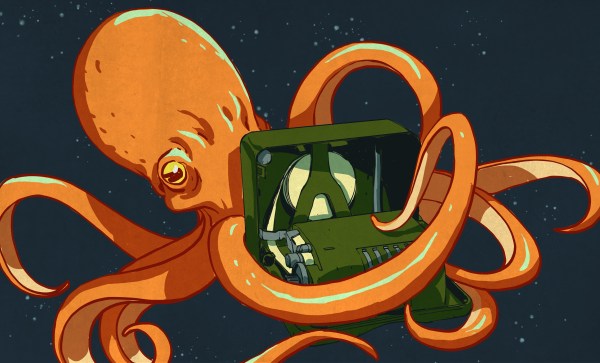
The whole story reads like a cold-war era spy thriller, and like many of those novels, it all starts with World War II. As a result of a family investment, Boris Hagelin found himself at the helm of Aktiebolaget Cryptograph, later renamed to Crypto AG (1952), a Swedish company that built and sold cipher machines that competed with the famous Enigma machine. At the start of the war, Hagelin decided that Sweden was not the place to be, and moved to the United States. This was a fortuitous move, as it allowed Hagelin to market his company’s C-38 cipher machine to the US military. That device was designated the M-209 by the army, and became the standard in-the-field encryption machine.
After the end of the Second World War the United States and the Soviet Union started working feverishly to perfect the rocket technology that the Germans developed for the V-2 program. This launched the Space Race, which thankfully for everyone involved, ended with boot prints on the Moon instead of craters in Moscow and DC. Since then, global tensions have eased considerably. Today people wait for rocket launches with excitement rather than fear.
That being said, it would be naive to think that the military isn’t still interested in pushing the state-of-the-art forward. Even in times of relative peace, there’s a need for defensive weapons and reconnaissance. Which is exactly why the Defense Advanced Research Projects Agency (DARPA) has been soliciting companies to develop a small and inexpensive launch vehicle that can put lightweight payloads into Earth orbit on very short notice. After all, you never know when a precisely placed spy satellite can make the difference between a simple misunderstanding and all-out nuclear war.
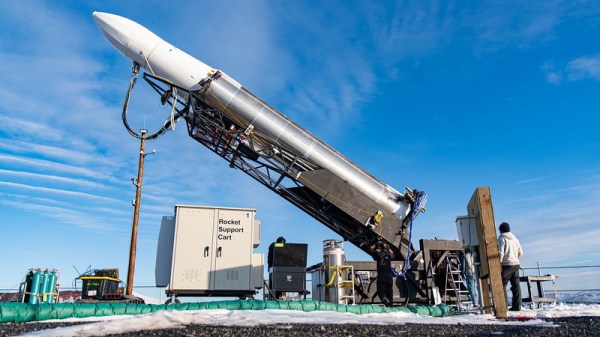
More than 50 companies originally took up DARPA’s “Launch Challenge”, but only a handful made it through to the final selection. Virgin Orbit entered their air-launched booster into the competition, but ended up dropping out of contention to focus on getting ready for commercial operations. Vector Launch entered their sleek 12 meter long rocket into the competition, but despite a successful sub-orbital test flight of the booster, the company ended up going bankrupt at the end of 2019. In the end, the field was whittled down to just a single competitor: a relatively unknown Silicon Valley company named Astra.
Should the company accomplish all of the goals outlined by DARPA, including launching two rockets in quick succession from different launch pads, Astra stands to win a total of $12 million; money which will no doubt help the company get their booster ready to enter commercial service. Rumored to be one of the cheapest orbital rockets ever built and small enough to fit inside of a shipping container, it should prove to be an interesting addition to the highly competitive “smallsat” launcher market.
We have all watched videos of concerts and events dating back to the 1950s, but probably never really wondered how this was done. After all, recording moving images on film had been done since the late 19th century. Surely this is how it continued to be done until the invention of CCD image sensors in the 1980s? Nope.
Although film was still commonly used into the 1980s, with movies and even entire television series such as Star Trek: The Next Generation being recorded on film, the main weakness of film is the need to move the physical film around. Imagine the live video feed from the Moon in 1969 if only film-based video recorders had been a thing.
A common sight in automobile-congested cities such as New York are parking meters lining the curbs next to parking spots. They’re an autonomous way for the city to charge for the space taken by cars parked along the sidewalk near high-traffic commercial areas, incentivizing people to wrap up their business and move their vehicle out of a costly or time-limited parking space.
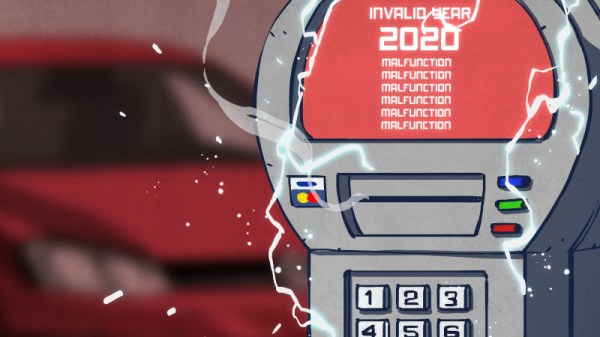
The parking meter is such a mundane device most people wouldn’t look at them twice, but on the inside it’s fascinating to see how they’re engineered, how that’s changed through the years, and how a software bug handicapped thousands of digital meters at the start of 2020.
Parking meters were originally commissioned in the 1930s by the government of Oklahoma City, due to the rapidly increasing number of automobiles, and therefore demand for parking space. Up until then, the city used patrolling policemen to regulate parking space, but they couldn’t keep up with the pace of the increased traffic and the lack of available parking space made business drop around downtown shops.
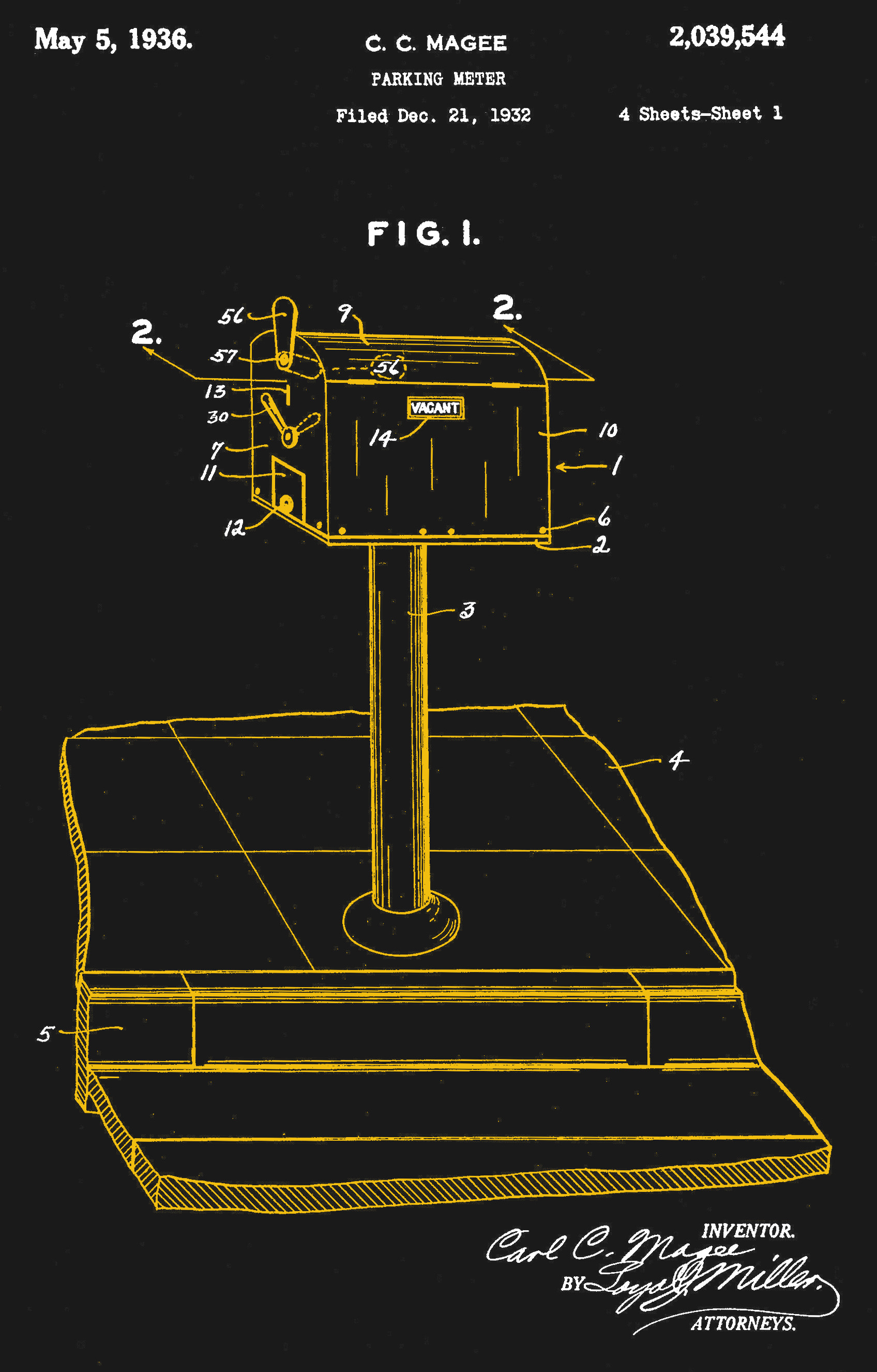
The first widely-adopted parking meter was dubbed “Black Maria”, a machine patented in 1935 by Carl C. Magee and Gerald Hale and first installed in the city in July of that year. This was a completely automated mechanical device made to solve the problem of regulating the time a driver can park their car in a given spot. It would take a nickel as payment, inserted into the mechanism by rotating a handle which also served to wind a clock spring. This clock would then tick down the remaining time the user could remain parked there, which could range from 15 minutes to an hour depending on the location.
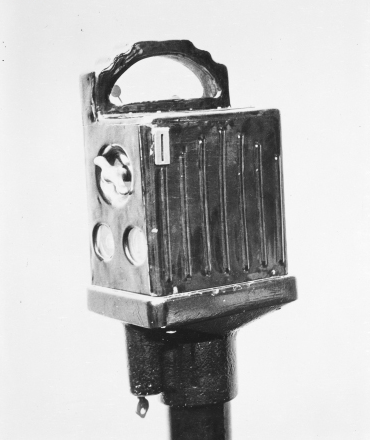
An early Black Maria design, circa 1933.
Within days store owners noticed a positive effect in their profits thanks to the increase in customers with the regulated parking. What’s more, the coins collected from the meters also generated revenue for the city, and so, parking meters started spreading throughout the city. And as decades went, the mechanics were improved upon. A window was added into which a patrolling officer could easily look to check if the right amount of money (or money at all) was inserted. Separate panels for the coins to be easily collected without risking damage to the rest of the internal clockwork were also added.
The evolution of parking meters eventually passed through meters that could take care of parking spaces on either side of it, halving the amount of necessary poles per sidewalk. Electronic models starting appearing in the 1990s and eventually connectivity added. With meters all hooked up to the same network, the symbiotic connection between the parking meter and your spot was severed. It didn’t matter where your car was parked anymore; you could simply take your printed ticket and put it on your dashboard to be legally parked. Further advancements led to numbers spots that can be paid from any kiosk in the city, or though a smartphone app. But those digital advancements don’t always translate into reliability…
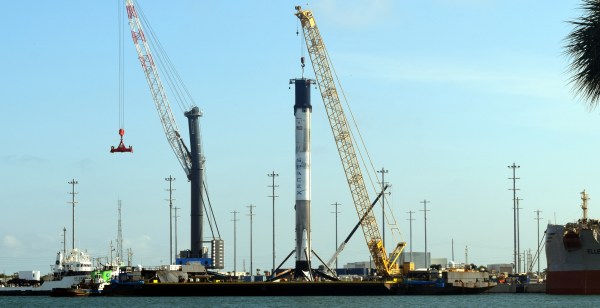
With the notable exception of the Space Shuttle, rockets and spacecraft have always been considered disposable. It’s a slow and expensive way to travel, akin to building a new airliner for every flight, but it was the easiest option. These vehicles have always represented the pinnacle of engineering and material science of their time, and just surviving the trip to space once was an incredible accomplishment. To have another go around would have been asking too much of the technology. Even looking back on the Space Shuttle program, there’s plenty of debate about whether or not the reusable design really paid off in the end.
So SpaceX’s ability to land, refurbish, and refly the first stage of their Falcon 9 booster is no small accomplishment. After demonstrating the idea was possible in 2017, the company made numerous changes to the latest iteration of the rocket with reusability in mind. Known as Block 5, this version of the Falcon 9 is designed to be more survivable and require minimal servicing between flights. The company says its cheaper and faster to reuse the Block 5 than it would be to build a new one for each flight, allowing the company to approach spaceflight more like commercial aviation.
Falcon 9 launch and landing streaks. (Source: SpaceX)
With a fleet of Block 5 boosters now in rotation, SpaceX has given them serial numbers not unlike an airplane’s tail number. It might not be the kind of thing the general public would normally be aware of, but these serial numbers have allowed a dedicated community of space aficionados to keep track of the missions each booster has flown.
Unfortunately the story of one of these rockets, officially referred to as “Cores” in SpaceX parlance, was recently cut short. Core B1056, returning from the Starlink 4 mission on February 17th, failed to land on the autonomous spaceport drone ship (ASDS) Of Course I Still LoveYou and splashed down in the ocean. It’s still unclear what condition the booster was in after its soft landing in the water, but when the recovery ships returned to port empty handed, there was no question as to the fate of B1056.
From a purely business standpoint, the failure of any of SpaceX’s boosters means lost time and revenue. But in some ways B1056 had established itself as the vanguard of the fleet, managing to either set or break a number of records in its relatively short life. The destruction of the most thoroughly flight proven Block 5 booster is a stark reminder that there’s very little about spaceflight that could be called routine.