Logic Noise: More CMOS Cowbell!

Logic Noise is an exploration of building raw synthesizers with CMOS logic chips. This session, we’ll tackle things like bells, gongs, cymbals and yes, cowbells that have a high degree of non-harmonically related content in them.

Metallic Sounds: The XOR

I use the term “Non-harmonic” in the sense that the frequencies that compose the sound aren’t even integer multiples of some fundamental pitch as is the case with a guitar string or even our square waves. To make these metallic sounds, we’re going to need to mess things up a little bit, and the logic function we’re introducing today to do it is the exclusive-or (XOR).

Continue reading “Logic Noise: More CMOS Cowbell!”

Open Hardware For Open Science – Interview With Charles Fracchia

Open Science has been a long-standing ideal for many researchers and practitioners around the world. It advocates the open sharing of scientific research, data, processes, and tools and encourages open collaboration. While not without challenges, this mode of scientific research has the potential to change the entire course of science, allowing for more rigorous peer-review and large-scale scientific projects, accelerating progress, and enabling otherwise unimaginable discoveries.

As with any great idea, there are a number of obstacles to such a thing going mainstream. The biggest one is certainly the existing incentive system that lies at the foundation of the academic world. A limited number of opportunities, relentless competition, and pressure to “publish or perish” usually end up incentivizing exactly the opposite – keeping results closed and doing everything to gain a competitive edge. Still, against all odds, a number of successful Open Science projects are out there in the wild, making profound impacts on their respective fields. HapMap Project, OpenWorm, Sloan Digital Sky Survey and Polymath Project are just a few to name. And the whole movement is just getting started.

While some of these challenges are universal, when it comes to Biology and Biomedical Engineering, the road to Open Science is paved with problems that will go beyond crafting proper incentives for researchers and academic institutions.

It will require building hardware.

Continue reading “Open Hardware For Open Science – Interview With Charles Fracchia”

Time For The Prize: Big Water

I inadvertently started a vigorous debate a few weeks ago with the Time for the Prize post about a shower feedback loop. That debate was on the effect of curbing household water since households make up a relatively small percentage of total use. I think we should be thinking of solutions for all parts of the problem and so this week we’ll be looking for ideas that can help conserve water in large-scale use cases. Primarily these are agricultural and industrial but if you know of others feel free to make your case.

According to the United States Department of Agriculture, about 80% of all ground and surface water is used in agriculture. I’m not particularly interested in hearing a debate on water rights and the like (there’s a rather interesting article here if you want more on that). The agriculture industry produces food, and employs a lot of people. The conflict is of course long growing season versus lack of water compounded by severe drought. Even if we could move our food production elsewhere it would be a monumental undertaking to also relocate the infrastructure supporting it. Of course we need to look to the future, but can we leverage our engineering prowess now to conserve the water that is being used right now?

Enter with an Idea

Write down your ideas for agricultural and industrial water conservation as a project on Hackaday.io. Tag the project 2015HackdayPrize. Do this by next Monday and you’re in the running for this week’s awesome prizes.

You aren’t necessarily committing yourself to finishing out the build. At this point we want to get the idea machine rolling. One good idea could spark the breakthrough that makes a real difference in the world.

This Week’s Prizes

time-for-prize-prizes-week-3

We’ll be picking three of the best ideas based on their potential to help alleviate a wide-ranging problem, the innovation shown by the concept, and its feasibility. First place will receive a DSLogic 16-channel Logic Analyzer. Second place will receive a an Adafruit Bluefruit Bluetooth Low Energy sniffer. Third place will receive a Hackaday robot head tee.


The 2015 Hackaday Prize is sponsored by:

Build A Phased-Array Radar In Your Garage That Sees Through Walls

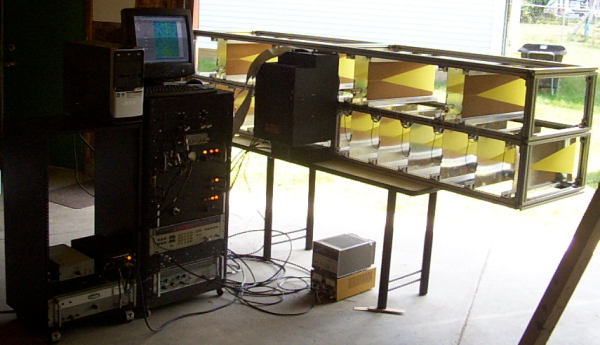
Until recently phased array radar has been very expensive, used only for military applications where the cost of survival weighs in the balance. With the advent of low-cost microwave devices and unconventional architecture phased array radar is now within the reach of the hobbyist and consumer electronics developer. In this post we will review the basics of phased-array radar and show examples of how to make low-cost short-range phased array radar systems — I built the one seen here in my garage! Sense more with more elements by making phase array your next radar project.

Phased array radar

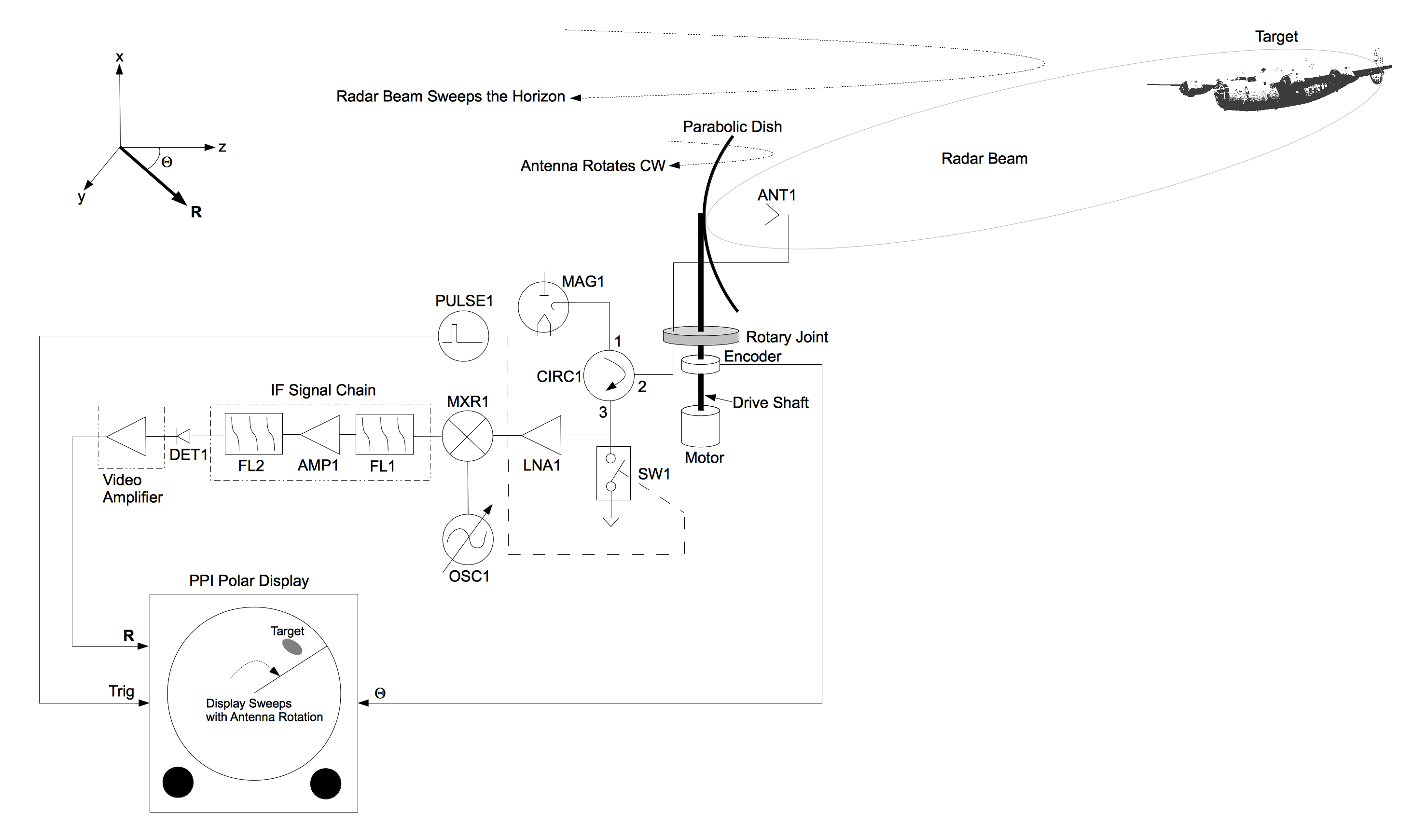
In a previous post the basics of radar were described where a typical radar system is made up of a large parabolic antenna that rotates. The microwave beam projected by this antenna is swept over the horizon as it rotates. Scattered pulses from targets are displayed on a polar display known as a Plan Position Indicator (PPI).

Block diagram of a conventional radar system using a parabolic dish.

In a phased array radar (PDF) system an array of antenna elements are used instead of the dish. These elements are phase-coherent, meaning they are all phase-referenced to the same transmitter and receiver. Each element is wired in series with a phase shifter that can be adjusted arbitrarily by the radar’s control system. A beam of microwave energy is focused by applying a phase rotation to each phase shifter. This beam can be directed anywhere within the array’s field of view. To scan the beam rotate the phases of the phase shifters accordingly. Like the rotating parabolic dish, a phased array can scan the horizon but without the use of moving parts.

Continue reading “Build A Phased-Array Radar In Your Garage That Sees Through Walls”

How To Build A Thermocouple Amplifier

A Thermocouple is a terrific way to measure temperature. The effects of temperature change on dissimilar metals produces a measurable voltage. But to make that measurement you need an amplifier circuit designed for the thermocouple being used.

Linear Technology LTC 1049 Low Power Zero-Drift Operational Amplifier with Internal Capacitors
Linear Technology LTC 1049 Low Power Zero-Drift Operational Amplifier
with Internal Capacitors

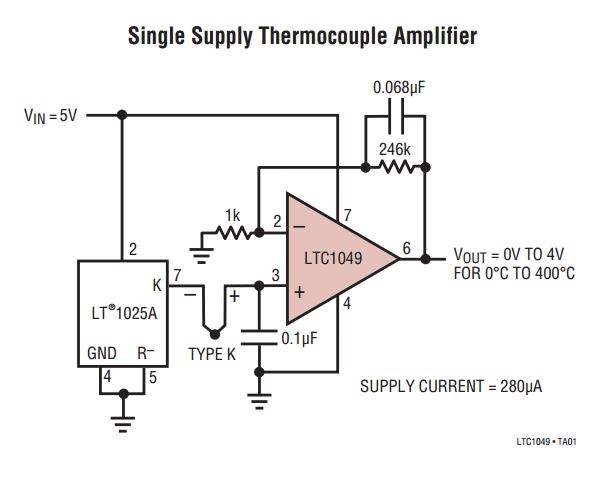
While researching “Zero Drift Amplifiers” as a follow-up to my video on Instrumentation Amplifiers I noticed the little schematic the front page of the LTC1049 datasheet which is shown here. I thought it was an ideal example of an analog application where some gain and some “gain helper” were needed to accomplish our useful little application of amplifying a thermocouple probe.

In the video I don’t really talk much about the thermocouples themselves other than the type I see most of the time which is type K. If you’re not already familiar with the construction of these probes you can find an informative write-up on thermocouples and the different types on the Wikipedia page and you might also want to check out the Analog Devices app note if you would like to know more. What I will cover is a reliable and precise way to read from these probes, seen in the video below and the remainder of the post after the break.

Continue reading “How To Build A Thermocouple Amplifier”

Time For The Prize: Aging In Place

Aging in Place is a growing issue facing the world. As the population begins to live longer, healthier lives we need to continue developing assistive technologies that will facilitate independence and safe living long into our twilight years. That is the topic of this week’s Time for the Prize. Enter your idea for Aging in Place by starting a project on Hackaday.io and tagging it 2015HackadayPrize. Do this by next Monday and you’re in the running for this week’s awesome prizes.

What is Aging in Place?

I use the “define:” search term on Google all the time and for Aging in Place it turns up the Center for Disease Control’s definition:

“the ability to live in one’s own home and community safely, independently, and comfortably, regardless of age, income, or ability level.”

I love this definition. How easy is it to get behind the concept of better quality of life for all as we age? Still not getting the thought process flowing? After listing the prizes I’ll illustrate a couple of projects that will give you a good idea of what people are working on.

This Week’s Prizes

aging-in-place-prizes

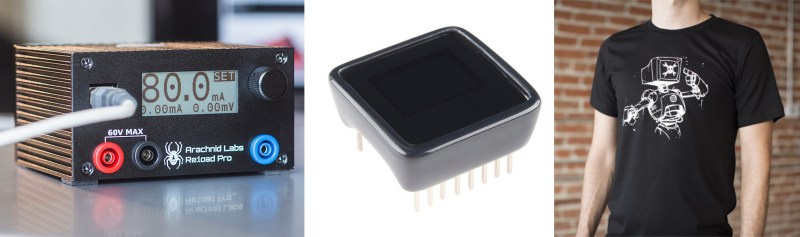
We’ll be picking three of the best ideas based on their potential to help alleviate a wide-ranging problem, the innovation shown by the concept, and its feasibility. First place will receive a RE:load Pro programmable constant current load. Second place will receive a Sparkfun Microview. Third place will receive a Hackaday CRT-android head tee.

 Hacks that Help

pill-reminderrx-timer-capsThe easiest examples I can think of relate to medicine. A lot of the time people can be independent and high-functioning as long as they take the right medicine at the right time. The simplest way to ensure this is to use technology that helps track medication schedules. Pill reminders can monitor a pill case, sending reminders to you if you miss your schedule, and alertimg family or caretakers if you don’t respond to the reminder.

We’ve also seen technology built right into the cap of the prescription bottle. These caps have a timer that resets to zero every time the bottle is opened. But anyone who has taken several medicines on different time schedules can tell you that this can still be very confusing. We wonder if anyone can prototype a system that would use computer vision to verify and log the pills each time you take them?

Of course the prescription reminders are just one of a multitude of low-hanging fruit. Safety is another aspect. Here’s an entry that seeks to give peace of mind that the stove is off for those dealing with Alzheimer’s or memory issues.

Now you see what we’re getting at. What ideas do you have that can move the goal of Aging in Place forward?


The 2015 Hackaday Prize is sponsored by:

Arduino SRL To Distributors: “We’re The REAL Arduino”

Arduino SRL (formerly known as Smart Projects SRL) sent out a letter to its distribution partners yesterday. If you’ve been following along with the Arduino vs Arduino story (we’ve previously published two installments), the content isn’t entirely surprising; it’s essentially a tactical move to reassure their distribution channels that Arduino SRL is the “One True Arduino”. That said, there’s still some new tidbits buried inside. You can skip down to read the full text below, but here’s our take.

The Business History of Arduino

arduino_vs_arduino_tnA quick summary of the legal situation. Arduino LLC was formed in April 2008 by the original five founders to provide a corporate entity behind the Arduino project. Smart Projects SRL, controlled by one of the founders, was tasked with the actual production of the boards. It turns out that Smart Projects had trademarked the Arduino brand in Italy in December 2008, before Arduino LLC got around to filing in April 2009 in the USA. But everyone was friends, right? As long as the licensing fees keep flowing.

Fast-forward to September 2014, when Arduino LLC filed a lawsuit in Italy against Smart Projects claiming that they had infringed LLC’s trademark and that they had recently stopped paying licensing fees on their use of the Arduino name. In October, Smart Projects filed with the USPTO to revoke Arduino LLC’s trademark. In late 2014, Smart Projects changed its company name to Arduino SRL (a “Società a responsabilità limitata” is one form of Italian limited-liability company) and hired a new CEO, [Federico Musto].  Around the same time, Arduino SRL opened up the website arduino.org (different from long-existing arduino.cc) but with nearly identical style. In January 2015, Arduino LLC filed a lawsuit in the US, claiming their right on the Arduino name.

The Gist of it

In short, Arduino LLC has been working on developing the Arduino platform, software, and community while Smart Projects / Arduino SRL was the major official producer of the hardware for most boards. Both are claiming to “be” Arduino, and going after each other in court. So it’s not strange that Arduino SRL would like to try to keep its hold on the distribution channels. Which brings us to their letter to distributors.

March 27 Letter
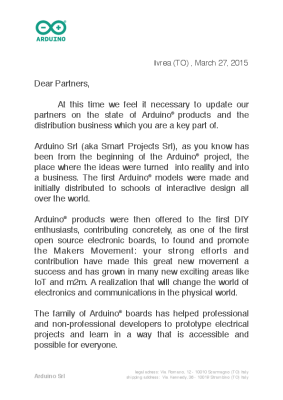
Arduino-Distributor-Update-0A good portion of the letter reads to be a very carefully worded defense of why Arduino SRL is the true Arduino:

“Arduino Srl (aka Smart Projects Srl), as you know has been from the  beginning of the Arduino® project, the place where the ideas were turned into reality and into a business.”

This is of course strictly true — Smart Projects was certainly the largest manufacturer of Arduino boards. But it sidesteps the issue at hand in the trademark suits: whether they were simply a licensed producer of the boards or whether they’re “Arduino”.

Similarly, in the questions section of the letter, they ask if there are actually two “Arduino” product manufacturers, and answer “not really”. Of course, that’s true. Arduino LLC doesn’t manufacture boards, but exists to license their trademark out to fund development.

The only real news in the letter is that Arduino SRL is replacing its old distribution and logistics company, Magyc Now, with a new one named CC Logistics. Both Magyc and CC Logistics are named as defendants in the US lawsuit filed by Arduino LLC, so it’s unlikely that this change is due to legal fallout.

What this Means

In conclusion, Arduino SRL’s letter to its distributors seems to essentially follow the line of reasoning in their trademark lawsuit in the US against Arduino LLC: since Arduino SRL is doing the manufacturing and using the Arduino name, they’re the true Arduino. Whether or not this will stand up in court, or whether Arduino LLC can make its case that SRL was simply a licensed manufacturer, remains to be seen.

We’ve embedded the contents of the letter after the break. You can also download the original PDF.

Continue reading “Arduino SRL To Distributors: “We’re The REAL Arduino””