Punycodes Explained

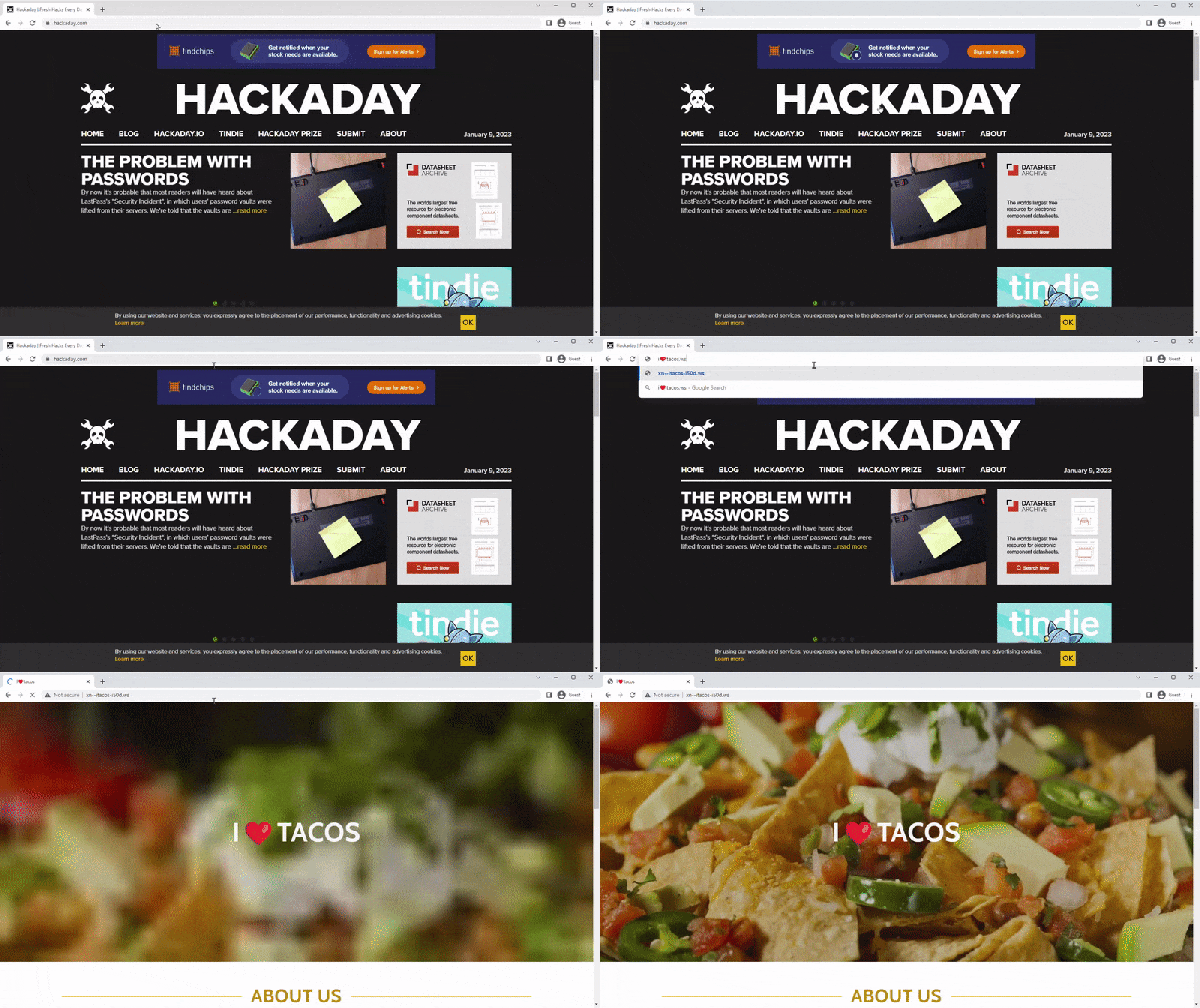
When you’re restricted to ASCII, how can you represent more complex things like emojis or non-Latin characters? One answer is Punycode, which is a way to represent Unicode characters in ASCII. However, while you could technically encode the raw bits of Unicode into characters, like Base64, there’s a snag. The Domain Name System (DNS) generally requires that hostnames are case-insensitive, so whether you type in HACKADAY.com, HackADay.com, or just hackaday.com, it all goes to the same place.

[A. Costello] at the University of California, Berkley proposed the idea of Punycode in RFC 3492 in March 2003. It outlines a simple algorithm where all regular ASCII characters are pulled out and stuck on one side with a separator in between, in this case, a hyphen. Then the Unicode characters are encoded and stuck on the end of the string.

First, the numeric codepoint and position in the string are multiplied together. Then the number is encoded as a Base-36 (a-z and 0-9) variable-length integer. For example, a greeting and the Greek for thanks, “Hey, ευχαριστώ” becomes “Hey, -mxahn5algcq2″. Similarly, the beautiful city of München becomes mnchen-3ya. Continue reading “Punycodes Explained”


Supercon 2022: All Aboard The SS MAPR With Sherry Chen

How do you figure out what is in a moving body of water over a mile wide? For those in charge of assessing the water quality of the Delaware river, this is a real problem. Collecting the data required to evaluate the water quality was expensive and time-consuming, taking over six years. Even then, the data was relatively sparse, with just a few water quality stations and only one surface sample for every six miles of river.

Sherry Chen, Quinn Wu, Vanessa Howell, Eunice Lee, Mia Mansour, and Frank Fan teamed up to create a solution, and the SS MAPR was the result. At Hackaday Supercon 2022, Sherry outlined the mission, why it was necessary, and their journey toward an autonomous robot boat. What follows is a fantastic guide and story of a massive project coming together. There are plans, evaluations, and tests for each component.

Sherry and the team first started by defining what was needed. It needed to be cheap, easy to use, and able to sample from various depths in a well-confined bounding box. It needed to run for four hours, be operated by a single person, and take ten samples across a 1-mile (2 km) section of the river. Some of the commercial solutions were evaluated, but they found none of them met the requirements, even ignoring their high costs. They selected a multi-hull style boat with off-the-shelf pontoons for stability and cost reasons.
Continue reading “Supercon 2022: All Aboard The SS MAPR With Sherry Chen”

All About USB-C: High-Speed Interfaces

One amazing thing about USB-C is its high-speed capabilities. The pinout gives you four high-speed differential pairs and a few more lower-speed pairs, which let you pump giant amounts of data through a connector smaller than a cent coin. Not all devices take advantage of this capability, and they’re not required to – USB-C is designed to be accessible for every portable device under the sun. When you have a device with high-speed needs exposed through USB-C, however, it’s glorious just how much USB-C can give you, and how well it can work.

The ability to get a high-speed interface out of USB-C is called an Alternate Mode, “altmode” for short. The three altmodes you can encounter nowadays are USB3, DisplayPort and Thunderbolt, there’s a few that have faded into obscurity like HDMI and VirtualLink, and some are up and coming like USB4. Most altmodes require digital USB-C communication, using a certain kind of messages over the PD channel. That said, not all of them do – the USB3 is the simplest one. Let’s go through what makes an altmode tick. Continue reading “All About USB-C: High-Speed Interfaces”

2022 FPV Contest: Congratulations To The Winners!

We wanted to see what the Hackaday crowd was up to in first-person view tech, and you didn’t disappoint! Commercial FPV quads have become cheap enough these days that everyone and their mom got one for Christmas, so it was fantastic to see the DIY spirit in these projects. Thanks to everyone who entered.

The Winners

None of the entries do the DIY quite as thoroughly as [JP Gleyzes]’s “poor man’s FPV journey”. This is actually three hacks in one, with DIY FPV goggles made from cheap optics and 3D printed additions, a USB joystick to PPM adapter to use arbitrary controllers with an RC transmitter, and even a fully DIY Bluetooth-based controller for a popular flight simulator. [JP] has done everything but build his own drone, and all the files are there for you to use, whether you’re goal is to do it on the cheap, or to do something new.

If you want to build your own drone from scratch, though, ESP32 Drone project has you covered. At least, mostly. This build isn’t entirely finished yet, and it’s definitely got some crash-testing still in its future, but the scope and accessibility of the project is what caught our eyes. The goal is to make a lightweight indoor quad around parts we can all get easily and cheaply, completely scratch-built. This drone is meant to be controlled by a smartphone, and the coolest parts for us are the ESP_Drone and ESPStream software that run on the drone and your phone respectively. Congrats to [Jon VB]! Now get that thing in the air.

And if you’re looking for a tidy little build, [Tobias]’s Mini FPV Speed Tank doesn’t disappoint. It’s a palm-sized mini tank, but this thing hauls, and looks like a ton of fun to drive around. It uses an absolutely tiny RP2040 module, an equally tiny receiver, and a nano FPV camera and transmitter to keep it compact. The 3D-printed frame and tracks are so nice that we’re not even complaining that the FPV rig is simply rubber-banded on top of the battery. This looks like a super fun build.

Each of these three projects have won a $150 Digi-Key shopping spree to help out with parts in this, or your next project. Thanks again to Digi-Key for sponsoring!

Continue reading “2022 FPV Contest: Congratulations To The Winners!”

Machining With Electricity Hack Chat

Join us on Wednesday, January 18 at noon Pacific for the Machining with Electricity Hack Chat with Daniel Herrington!

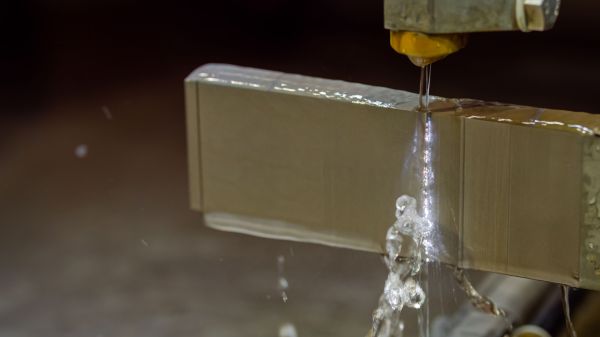
With few exceptions, metalworking has largely been about making chips, and finding something hard enough and tough enough to cut those chips has always been the challenge. Whether it’s high-speed steel, tungsten carbide, or even little chunks of rocks like garnet or diamond, cutting metal has always used a mechanical interaction between tool and stock, often with spectacular results.

But then, some bright bulb somewhere realized that electricity could be used to remove metal from a workpiece in a controlled fashion. Whether it’s using electric sparks to erode metal — electric discharge machining (EDM) — or using what amounts to electroplating in reverse — electrochemical machining (ECM) — electrical machining methods have made previously impossible operations commonplace.

join-hack-chatWhile the technology behind ExM isn’t really that popular in the hobby machine shop yet, a lot of the equipment needed and the methods to make it all work are conceivably DIY-able. But the first step toward that is understanding how it all works, and we’re lucky enough to have Daniel Herrington stop by the Hack Chat to help us out with that. Daniel is CEO and founder of Voxel Innovations, a company that’s on the cutting edge of electrochemical machining with its pulsed ECM technology. There’s a lot to unpack, so make sure you stop by so we can all get up to speed on what’s up with using electricity to do the machining.

Our Hack Chats are live community events in the Hackaday.io Hack Chat group messaging. This week we’ll be sitting down on Wednesday, January 18 at 12:00 PM Pacific time. If time zones have you tied up, we have a handy time zone converter.

Hackaday Links Column Banner

Hackaday Links: January 15, 2023

It looks like the Martian winter may have claimed another victim, with reports that Chinese ground controllers have lost contact with the Zhurong rover. The solar-powered rover was put into hibernation back in May 2022, thanks to a dust storm that kicked up a couple of months before the start of local winter. Controllers hoped that they would be able to reestablish contact with the machine once Spring rolled around in December, but the rover remains quiet. It may have suffered the same fate as Opportunity, which had its solar panels covered in dust after a planet-wide sandstorm and eventually gave up the ghost.

What’s worse, it seems like the Chinese are having trouble talking to the Tianwen-1 orbiter, too. There are reports that controllers can’t download data from the satellite, which is a pity because it could potentially be used to image the Zhurong landing site in Utopia Planitia to see what’s up. All this has to be taken with a grain of dust, of course, since the Chinese aren’t famously transparent with their space program. But here’s hoping that both the rover and the orbiter beat the odds and start doing science again soon.

Continue reading “Hackaday Links: January 15, 2023”

Too Many Pixels

Sometimes simpler is more impressive than complicated, and part of this is certainly due to Arthur C. Clarke’s third law: “Any sufficiently advanced technology is indistinguishable from magic.”. It’s counter-intuitive, though, that a high-tech project would seem any less amazing than a simpler one, but hear me out.

I first noticed this ages ago, when we were ripping out the blue laser diodes from Casio XJ-A130 laser projectors back when this was the only way to get a powerful blue laser diode. Casio had bought up the world’s supply of the 1.5 W Nichias, and was putting 24 of them in each projector, making them worth more dead than alive, if you know what I mean. Anyway, we were putting on a laser show, and the bright blue diode laser was just what we needed.

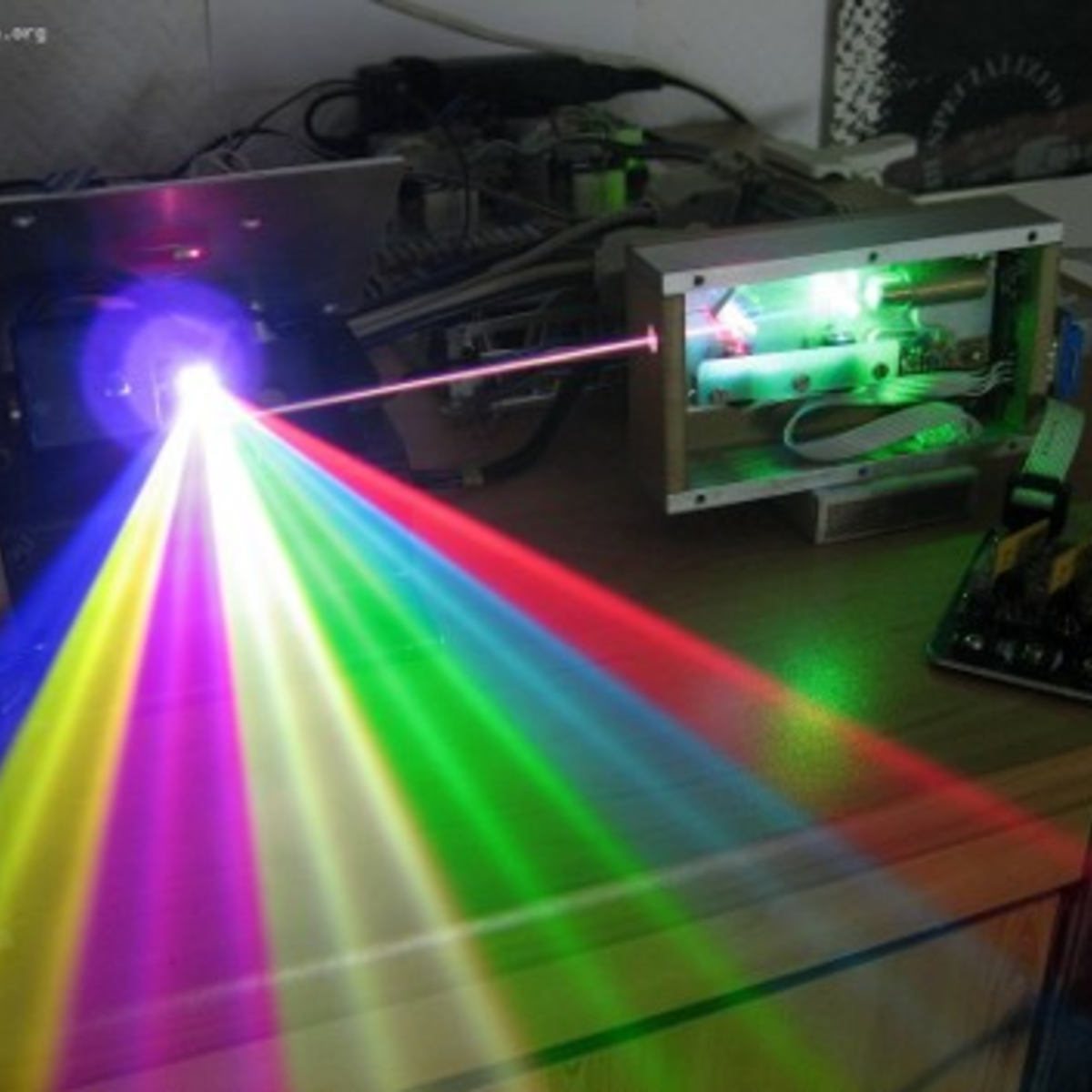
RGB Laser show
A sweeter setup than mine, but you get the idea. 

Color laser setups take three or more different lasers, combine the beams, and then bounce them off of mirrors attached to galvos. Steer the mirrors around, and you can project vector images. It’s pretty cool tech, and involves some serious fine-tuning, but the irony here is that we were tearing apart a device with 788,736 microscopic DLP mirrors to point the lasers through just two. And yet, a DIY laser show is significantly cooler than just putting up your powerpoint on the office wall.

The same thing goes for 2D plotting machines like the AxiDraw. The astonishing tech behind any old laser printer is mind-numbing. Possibly literally. Why else would we think that art drawn out by a pen in the hands of a stepper-powered robot is cooler than the output of a 1600 DPI unit coming from HP’s stable? I mean, instead of running an hours-long job to put ink on paper with a pen, my Laserjet puts out an image in ten seconds. But it’s just not as much fun.

So here we are, in an age where there’s so darn much magic all around us, in the form of sufficiently advanced technology, that comprehensible devices are actually more impressive. And my guess is that it’s partly because it’s not surprising when a device that’s already magic does something magical. I mean, that’s just what it’s supposed to do. Duh!

But when something beautiful emerges from a pair of mirrors epoxied to shafts on springs turned by copper coils, that’s real magic.