Hackaday Prize Worldwide: Workbench Projects Bengaluru

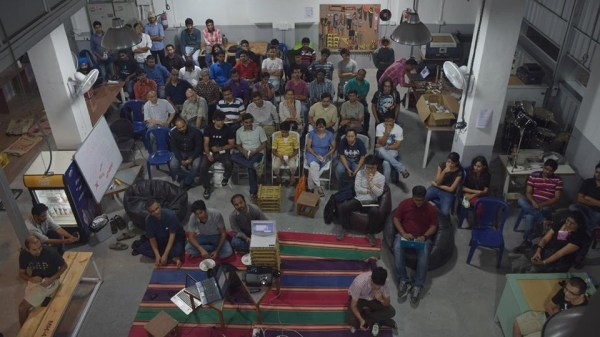
Bengaluru (formerly Bangalore) is a town full of awesome hackers. So when Workbench Projects, a local maker space there, asked if I’d like to come down and talk about the Hackaday Prize, I immediately set things in motion. We decided to arrange a “Bring-a-Hack” event, asking local makers to turn up with their hacks and give a talk or drop by and discuss ideas that matter. To reach out to a larger audience, we also partnered with IoT-BLR, a pretty large group of IoT enthusiasts in Bengaluru. 10,000 Startups (NASSCOM for Startups) helped ensure that all the hackers were well fed with sandwiches and cookies while Paper Boat chipped in with a cooler full of beverages.  A freak hail storm meant that we had to delay the start a bit. But that turned into a blessing of sorts, as it allowed those already at the space to check out the hacks that had been set up at demo tables and generally network with each other.
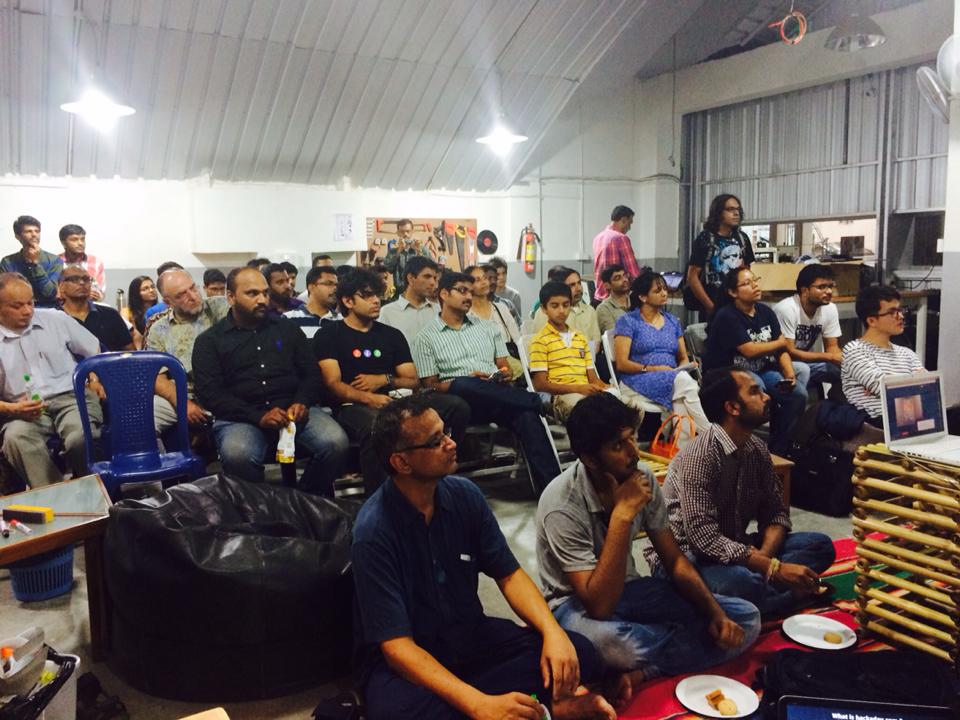
almost 100 Hackers turned up

[Anupama], who set up Workbench Projects with [Pavan], set the ball rolling by telling us about how it all started off a year ago. She and [Pavan] had ideas buzzing in their heads, but no means to prototype them. “You can either continue cribbing about the lack of maker spaces, or jump right in and start one on your own”.

We then had [Pavan] tell us about the various “studios” that they have set up. He was also excited to announce their addition to the world-wide MIT FabLab network. Their space is located right under the escalator that goes to the Halasuru Metro Station. The use of that space, which would other wise have been wasted and empty, itself is brilliant.

I stepped up and talked about the Hackaday Prize and our call to makers this year to “Build something that matters”. I showed off last years winners, this years prizes and gave out other details asking the assembled hackers to jump in and submit their hacks to the Hackaday Prize. Next up we had [Nihal], who founded IoT-BLR and talked to us about their projects, events and initiatives. IoT-BLR is the 3rd largest IoT-focused Meetup community in the world.

With that done, we opened up the floor for the assembled hackers to come forth and talk about their hacks. First up was [Anmol Agrawal] who showed off his earthquake early warning system which was prototyped using Littlebits, PubNub and Ruby.

I was glad that at short notice, my friend [Mohammed Khasim], who works at Linnaro, agreed to drop by to talk about and show off the modular phone being developed by Google as part of Project Ara.

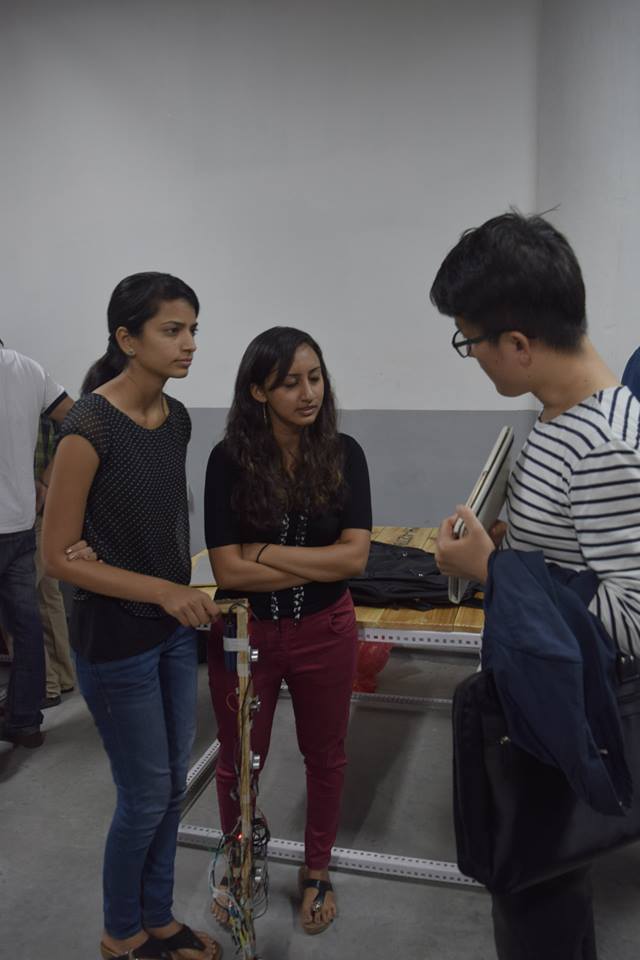
Intelligent cane for blind

The all-girls team of [Kruti], [Chitra] and [Archana] showed off their intelligent cane for the blind. Five ultrasonic ping sensors, one light sensor and a camera are all hooked up to a Raspberry Pi running off a battery pack. The cane communicates with a paired smart phone and the app provides audio cues. There’s also a pager motor for haptic feedback.

[Rahul] and his team showed up with what looked like the Iron-Man Arc Reactor on a T-shirt. It turned out to be an HID device that could be used to send key presses back to a paired computer. Their next iteration was less flashy and unobtrusive. They are now working on using this to provide safety for school kids by allowing them to send alerts in case of an emergency.
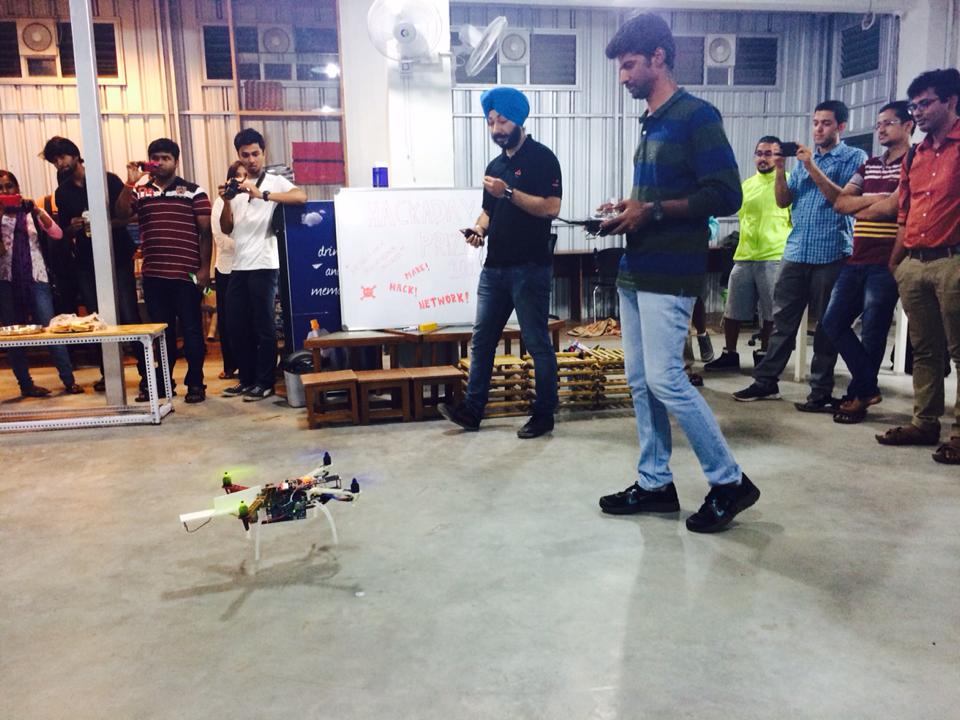
 

Drone demo, for collision avoidance

[Chetan] and his team from EdgeVerve showed off the work they are doing with putting various sensors on drones – CO2, temperature, humidity, multi-spectral camera –  to enable them to be used for some real world applications. They have also integrated collision avoidance using cheap ultrasonic sensors and a ballistic parachute which deploys during an emergency.

The IoT-BLR connected cars project team talked about their project to tap into on-board diagnostics on vehicles and use the various sensor data to control pollution.
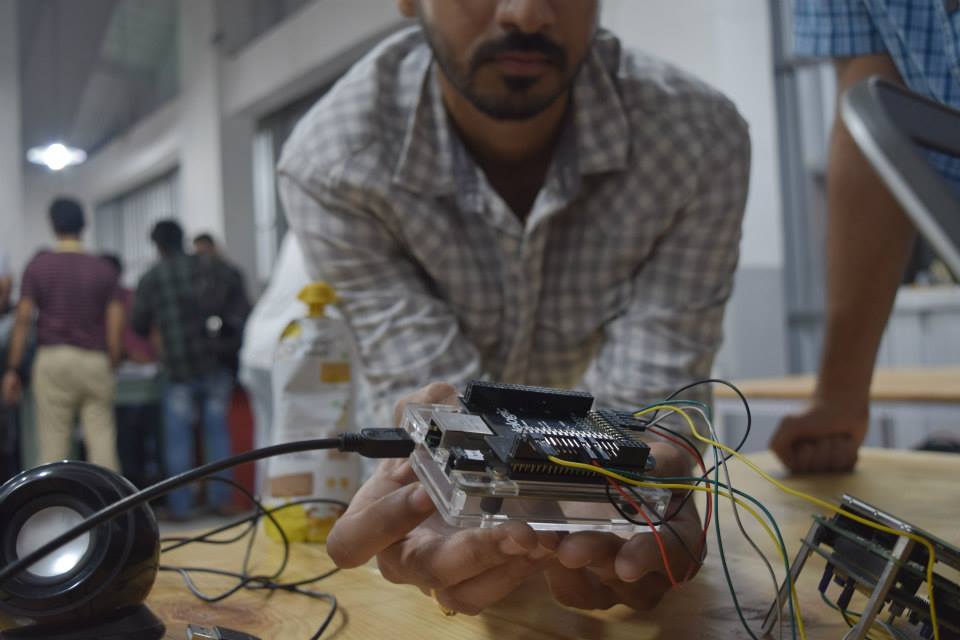
Kumar Abhishek's BeagleLogic

[Kumar Abhishek] came down just in time to show us his BeagleLogic. I had written about this project on the blog earlier, and it was nice to be able to see it in action.

There were some more projects up for display. [Osho Bajpai] had a demo of his “Smart Driving alert system”  which detects if driver is falling sleep and wakes him up. [Sanju Mathew] demo’ed his prosthetic arm while [Supreet Joshi] showed off his “Smart Robotic Arm”  which replicates the movements of a human arm using a smart glove. On display was also a remote controlled skate board driven by a BLDC motor controlled via the ESC. It was also interesting to see a bunch of school kids wheel in their chopper-inspired bicycle which is still work in progress. Those kids are learning a lot in the process such as ergonomics and welding. [Abdul] showed off a couple of devices he is working on to help harness tidal energy from coastal areas. The team from WiSense showed off some network connected environmental sensors. One measures soil moisture and temperature and transmits data  via text message over GSM. This is aimed for use by Farmers and alerts them to water their farms at the right time. Another sensor worked as a tank level detector and controlled flow rate to prevent over flow.

By this time, it was quite late in the evening, so folks spent the next hour looking up the various projects, talking and getting selfies taken using the OpenSelfie photobooth that I had set up. [Rishi Bhatnagar] from Workbench Projects, who set the whole event in motion, managed to archive the evening’s proceedings and you can watch the (long) video after the break.

Here’s another photo album from the event.

Continue reading “Hackaday Prize Worldwide: Workbench Projects Bengaluru” →
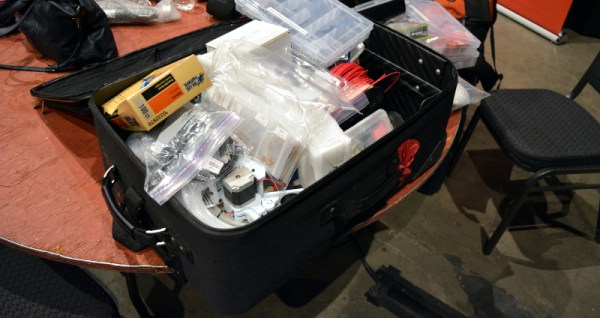
[Kenji Larsen] Shows Off The Ultimate Hacking Kit

If you roll into a hardware hackathon empty-handed, you’re going to be at a disadvantage compared to those who bring equipment with which they’re already familiar. Pray that you never roll into one where [Kenji Larsen] is your competitor. Luckily, this weekend he came out to mentor for Hackaday’s hardware hacking village at the TechCrunch Disrupt hackathon and not as a competitor. In this video he shows off the huge rollerbag which he calls his “Hack Pack”. I’d say there’s a 50/50 chance his travel setup is better than your home lab.

Where do I begin (seriously, watch the video)? Perhaps best to note is how organized he is. For instance, the large plastic bag containing his battery-operated and plug-in Dremels also has conveniently sized stock like acrylic and metal. There are compartment boxes full of sensors, others contain things like passives, batteries, battery chargers, hundreds of Moteino modules, handfuls of BeagleBones Black, breakout and dev boards of every flavor. He has all the necessary tools like hemostat, x-acto blade, steel ruler, and magnifying glasses. There’s even a 3D printer in the bag — a Printrbot Simple which [Chris Gammell] played with all weekend err… learned to use as part of his role as a mentor.

We had a ton of hardware along with us, but time and again [Kenji] was there for the save on some of the less-common needs. He’s a expert when it comes to fabrication techniques and it showed. We also give him mad points for staying up overnight for all 20-hours of the build session. Thank you so much [Kenji], I think I speak for every one of the hardware hackers when I say you helped bring the event to the next level of exhilarating and exhausting fun. Please direct your own thanks, stories, and well-wishes, and follows to [Kenji’s] hacker profile.

If you weren’t able to make it to NYC this weekend, you definitely missed out. We’ll be telling the story of that all week. Those on the West Coast will have a chance next weekend at Hackaday Prize Worldwide: LA. The workshop is sold out but socializing on Saturday, and a Sunday free-build are both still available for RSVPs.

Logic Noise: Taming The Wild Shift Register

One of the best things about DIY synth building is that you can create devices that just don’t exist in the commercial marketplace. In this session, we’ll build a looper / sequencer the likes of which you may have never seen. And it’s groovy. Today we’ll also get back a little closer to the soul of the series. In this session, nothing is analog — this is pure Logic Noise.

The shift register is the centerpiece chip this session, and a great device in its own right. We’ve got a lot of ground to cover, so watch the teaser video and then let’s get going.

Continue reading “Logic Noise: Taming The Wild Shift Register” →

Vintage Computer Festival Europa 16.0: The Hackaday Report

The 16th annual Vintage Computer Festival Europa (VCFe) is still ongoing this weekend in Munich, and of course Hackaday had to swing by. If you’re anywhere in Germany, you’ve still got until Sunday at 16:30 to check it out.

DSCF7896The theme for this year’s festival is “The East is Red Colorful” and that means vintage computers from the other side of the Iron Curtain. Here in (West) Germany, that naturally means a good representation of computers from the former Democratic Republic of Germany (DDR), but Czechoslovakia, Yugoslavia, and of course Russia were also in the house. There was far too much going on to cover it all, but here’s a few of the projects and computers that caught our eye.

Continue reading “Vintage Computer Festival Europa 16.0: The Hackaday Report” →

Try Not To Fall Off The Backwards Brain Bike

[Destin] of SmarterEveryDay fame has a challenge for your brain : a bicycle where the handlebars turn the front wheel in the opposite direction of a typical bike (YouTube link). For example, turning the handlebars left turns the wheel right and vice versa. He warns you it’s harder than it looks.

The hack that pulls this off is a simple one compared to bike hacks we’ve previously covered. Gears on the head tube make this possible. It was built by his welder friends who challenged him to ride it. He couldn’t at first; determined to overwrite his brain’s memory of bike riding, he practiced until he finally succeeded. It took him eight months. When it was time to ride an old-fashioned bike, it only took him about twenty minutes to “un-learn” the Backwards Brain Bike. [Destin’s] biking illustrates neuroplasticity, memory, and learning in a fun way (fun for us; no doubt frustrating for him).

As a testament to the sponge-like brains of youth, [Destin’s] son learned to ride the Backwards Brain Bike in only two weeks.

Continue reading “Try Not To Fall Off The Backwards Brain Bike” →

Thursday Drink-Up In The City

Hackaday is headed to New York this week. Grab your projects and catch up with us for a tasty beverage. We’ll be hanging out at the Antler Beer & Wine Dispensary on Thursday night starting at about 7. Be part of Hackaday’s first ever social event in NYC!

This is the pre-game for our Hackathon which starts on Saturday afternoon. So far we have eight of the Hackaday crew confirmed for evening: [Brian Benchoff], [Adam Fabio], [Bil Herd], [Sophi Kravitz], [Aleksandar Bradic], [Matt Berggren], [Jasmine Brackett], and [Rob Vincent]. But hey, it wouldn’t be any fun without you there too! We want to pack the place with hardware hackers so grab your friends and RSVP using the link at the top.

This is part of our 2015 Hackaday Prize Worldwide tour. Start your entry now by hammering out a few quick ideas about a future build and we can gab about it on Thursday. See you soon!


The 2015 Hackaday Prize is sponsored by:

Logic Noise: Sequencing In Silicon

In this session of Logic Noise, we’ll combine a bunch of the modules we’ve made so far into an autonomous machine noise box. OK, at least we’ll start to sequence some of these sounds.

A sequencer is at the heart of any drum box and the centerpiece of any “serious” modular synthesizer. Why? Because you just can’t tweak all those knobs and play notes and dance around at the same time. Or at least we can’t. So you gotta automate. Previously we did it with switches. This time we do it with logic pulses.

Continue reading “Logic Noise: Sequencing In Silicon” →