
The World’s First Agricultural Right To Repair Law

Long time readers will know that occasionally we mix up our usual subject matter with a dash of farm equipment. Usually the yellow and green variants that come from John Deere, as the agricultural manufacturer has become the poster child for all that is wrong in the fight for the right to repair. An old Deere is worth more than a nearly new one in many places, because for several years now their models have had all their parts locked down by DRM technologies such that only their own fitters can replace them. Now after a long legal fight involving many parties, the repair and parts company iFixit sound justifiably pleased as they announce the world’s first agricultural right to repair law being passed in the US state of Colorado. (Nitter)

This may sound like a small victory, and it will no doubt be followed by further rearguard actions from the industry as similar laws are tabled in other states. But in fact as we read it, with this law in place the game is de facto up for the tractor makers. Once they are required to release any access codes for the Coloradans those same codes will by extension be available to any other farmers, and though we’re guessing they won’t do this, they would be best advised to give up on the whole DRM idea and concentrate instead on making better tractors to fix their by-now-damaged brands.

It’s exciting news for everybody as it proves that right-to-repair legislation is possible, however since this applies only to agricultural machinery the battle is by no means over. Only when all machines and devices have the same protection can we truly be said to have achieved the right to repair.

We’ve reported on this story for a long time, here’s a previous piece of legislation tried in another state.
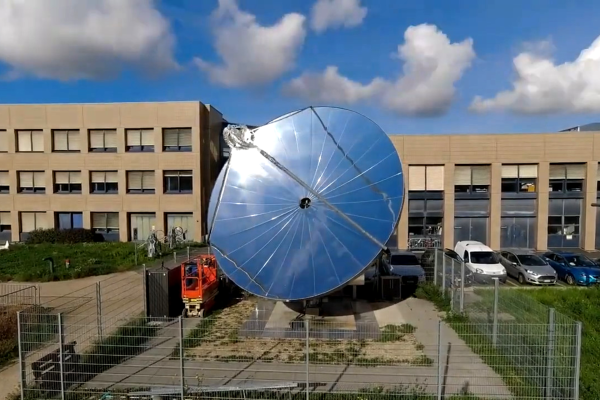

Making Hydrogen With Solar Energy, With Oxygen And Heat A Bonus

Hydrogen is a useful gas. Whether you want to float an airship, fuel a truck, or heat an industrial process, hydrogen can do the job. However, producing it is currently a fraught issue. While it can be produced cleanly using renewable energy, it’s often much cheaper to split it out of hydrocarbon fuels using processes that generate significant pollution.

There are methods to generate hydrogen more efficiently, though, in a clean and sustainable process. that also produces useful heat and oxygen as byproducts. The key to the process? Concentrated sunshine.
Continue reading “Making Hydrogen With Solar Energy, With Oxygen And Heat A Bonus”

Smoke Some Weeds: Lasers Could Make Herbicide Obsolete

We’ve all tangled with unwelcome plant life at one point or another. Whether crabgrass infested your lawn, or you were put on weeding duty in your grandfather’s rose patch, you’ll know they’re a pain to remove, and a pain to prevent. For farmers, just imagine the same problem, but scaled up to cover thousands of acres.

Dealing with weeds typically involves harsh chemicals or excessive manual labor. Lasers could prove to be a new tool in the fight against this scourge, however, as covered by the BBC.

Continue reading “Smoke Some Weeds: Lasers Could Make Herbicide Obsolete”

A black and white image of the Sun and Earth with a series of lines radiating out from the sun and bisecting rings circumscribed around it. On the Earth are three dots with the text "Active Server" on one exposed to the Sun and two dots representing "Inactive Server"s on the dark side.

Solar Protocol Envisions A Solar-Powered Web

The transition to low carbon energy is an important part of mitigating climate change, and the faster we can manage, the better. One project looking at how we could reduce the energy requirements of the web to more quickly adopt renewable energy is Solar Protocol.

Instead of routing requests to the fastest server when a user pulls up a website, Solar Protocol routes the request to the server currently generating the greatest amount of solar power. Once a user is on a website, the experience is energy-responsive. Website style and image resolution can range based on the power left in the active server’s batteries, including an image free low power mode.

Another benefit to the project’s energy efficiency approach is a focus on only the essential parts of a page and not any of the tracking or other privacy-endangering superfluous features present on many other websites. They go into much more depth in the Solar Protocol Manifesto. As a community project, Solar Protocol is still looking for more stewards since the network can go down if an insufficient number of servers are generating electricity.

For more details on the project that inspired Solar Protocol, check out this low-tech website.

There’s Cash In Them Old Solar Panels

The first solar panels may have rolled out of Bell Labs in the 1950s, with major press around their inconsistent and patchy adoption in the decades that followed, but despite the fanfare they were not been able to compete on a price per kilowatt compared to other methods of power generation until much more recently. Since then the amount of solar farms has increased exponentially, and while generating energy from the sun is much cleaner than most other methods of energy production and contributes no greenhouse gasses in the process there are some concerns with disposal of solar panels as they reach the end of their 30-year lifespan. Some companies are planning on making money on recycling these old modules rather than letting them be landfilled. Continue reading “There’s Cash In Them Old Solar Panels”

Using Old Coal Mines As Cheap Sources Of Geothermal Heat

For as much old coal mines are a blight upon the face of the Earth, they may have at least one potential positive side-effect. Where the coal mine consists out of tunnels that were drilled deep into the soil, these tend to get flooded by groundwater after the pumps that keep them dry are turned off. Depending on the surrounding rock, this water tends to get not only contaminated, but also warmed up. As the BBC explains in a recent video as a follow-up to a 2021 article, when the water is pumped up for decontamination, it can be run through a heat exchanger in order to provide heat for homes and businesses. Continue reading “Using Old Coal Mines As Cheap Sources Of Geothermal Heat”

A red Tesla Model 3 converted into a pickup truck with a black lumber rack extending over the roof of the cab sits in a grey garage. A black and silver charging robot is approaching its charging port from the right side attached to a black cable. The charging bot is mostly a series of tubes attached to a wheeled platform and the charging connector itself is attached to a linear actuator to insert the charging device.

Truckla Gets An Open Source Charging Buddy

More than three years have passed since Tesla announced its Cybertruck, and while not a one has been delivered, the first Tesla truck, Truckla, has kept on truckin’. [Simone Giertz] just posted an update of what Truckla has been up to since it was built.

[Giertz] and friend’s DIT (do-it-together) truck was something of an internet sensation when it was revealed several months before the official Tesla Cybertruck. As with many of our own projects, while it was technically done, it still had some rough edges that kept it from being truly finished, like a lack of proper waterproofing or a tailgate that didn’t fold.

Deciding enough was enough, [Giertz] brought Truckla to [Marcos Ramirez] and [Ross Huber] to fix the waterproofing and broken tailgate while she went to [Viam Labs] to build Chargla, an Open Source charging bot for Truckla. The charging bot uses a linear actuator on a rover platform to dock with the charging port and is guided by a computer vision system. Two Raspberry Pis power handle the processing for the operation. We’re anxious to see what’s next in [Giertz]’s quest of “picking up the broken promises of the car world.”

If you want to see some more EV charger hacks, check out this Arduino-Based charger and the J1772 Hydra.

Continue reading “Truckla Gets An Open Source Charging Buddy”