Hackaday Berlin: The Badge, Workshops, And Lightning Talks

Hackaday Berlin is just under two weeks away, and we’ve got news times three! If you don’t already have tickets, there are still a few left, so grab them while they’re hot. We’ll be rolling out the final full schedule soon, but definitely plan on attending a pre-party Friday night the 24th, followed by a solid 14-hour day of hacking, talks, and music on Saturday the 25th, and then a mellow Bring-a-Hack brunch with impromptu demos, workshops, and whatever else on Sunday from 10:30 until 14:00.

The Badge Round Two

Many Europeans weren’t able to make the flight to Supercon, so here’s your chance to get hands on Voja Antonic’s superb down-to-the-metal computer trainer-slash-retrocomputer on this side of the Atlantic. It’s been re-skinned for Berlin, with a couple hardware tweaks because nobody can leave a board revision alone, but it’s 100% compatible with the badge that took Supercon 2022 by storm.

If you want to read more about it, you should. We loved it, and so did the crowd. One of the coolest badge hardware hacks was a “punchcard” reader, but there was also a lot of work on the software side as well, and we got pull requests for most of the cool demos. If you’re coming, and if you’d like to start your badge hacking a bit early, you could start your research now.

We’ll have a Badge Hacking Ceremony Saturday night, so you can show off whatever you made. It’s lots of fun. Continue reading “Hackaday Berlin: The Badge, Workshops, And Lightning Talks”

Supercon 2022: Irak Mayer Builds Self-Sustainable Outdoor IoT Devices

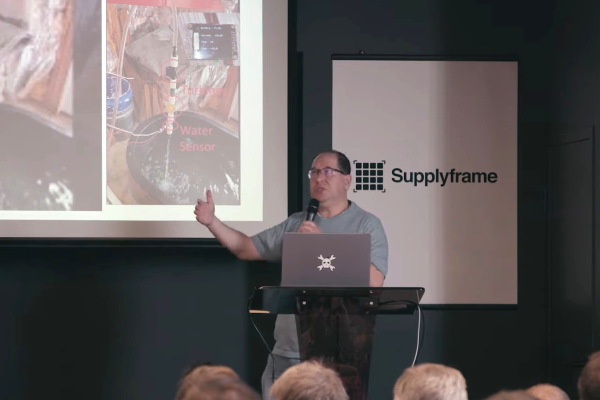
[Irak Mayer] has been exploring IoT applications for use with remote monitoring of irrigation control systems. As you would expect, the biggest challenges for moving data from the middle of a field to the home or office are with connectivity and power. Obviously, the further away from urbanization you get, the sparser both these aspects become, and the greater the challenge.

[Irak] solves his connectivity problem by assuming there is some WiFi network within range, building a system around the Blues Wireless WiFi note card. Substituting their cellular card would be an option for applications out of WiFi range, but presumably without changing too much on the system and software side of things. Leveraging the Adafruit FeatherWing INA219, which is a bidirectional current sensor with an I2C interface, for both the power generation and system consumption measurements. For control, [Irak] is using an Adafruit ESP32 board, but says little more about the hardware. On the software side, [Irak] is using the Blues Wireless NoteHub for the initial connection, which then routes the collected data onto the Adafruit IoT platform for collation purposes. The final part of the hardware is a LiPo battery which is on standby to soak up any excess power available from the energy harvesting. This is monitored by an LC709203f battery fuel gauge.

Continue reading “Supercon 2022: Irak Mayer Builds Self-Sustainable Outdoor IoT Devices”

Hackaday Links Column Banner

Hackaday Links: March 12, 2023

With a long history of nearly universal hate for their products, you’d think printer manufacturers would by now have found ways to back off from the policies that only seem to keep aggravating customers. But rather than make it a financially wiser decision to throw out a printer and buy a new one than to buy new ink cartridges or toners, manufacturers keep coming up with new and devious ways to piss customers off. Case in point: Hewlett-Packard now seems to be bricking printers with third-party ink cartridges. Reports from users say that a new error message has popped up on screens of printers with non-HP cartridges installed warning that further use of the printer has been blocked. Previously, printers just warned about potential quality issues from non-HP consumables, but now they’re essentially bricked until you cough up the money for legit HP cartridges. Users who have contacted HP support say that they were told the change occurred because of a recent firmware update sent to the printer, so that’s comforting.

Continue reading “Hackaday Links: March 12, 2023”

Computers For Fun

The last couple years have seen an incredible flourishing of the cyberdeck scene, and probably for about as many reasons as there are individual ’deck designs. Some people get really into the prop-making, some into scrapping old tech or reusing a particularly appealing case, and others simply into the customization possibilities. That’s awesome, and they’re all different motivations for making a computer that’s truly your own.

But I really like the motivation and sentiment behind [Andreas Eriksen]’s PotatoP. (Assuming that his real motivation isn’t all the bad potato puns.) This is a small microcomputer that’s built on a commonly available microcontroller, so it’s not a particularly powerful beast – hence the “potato”. But what makes up for that in my mind is that it’s running a rudimentary bare-metal OS of his own writing. It’s like he’s taken the cyberdeck’s DIY aesthetic into the software as well.

What I like most about the spirit of the project is the idea of a long-term project that’s also a constant companion. Once you get past a terminal and an interpreter – [Andreas] is using LISP for both – everything else consists of small projects that you can check off one by one, that maybe don’t take forever, and that are limited in complexity by the hardware you’re working on. A simple text editor, some graphics primitives, maybe a sound subsystem. A way to read and write files in flash. I don’t love LISP personally, but I love that it brings interactivity and independence from an external compiler, making the it possible to develop the system on the system, pulling itself up by its own bootstraps.

Pretty soon, you could have something capable, and completely DIY. But it doesn’t need to be done all at once either. With a light enough computer, and a good basic foundation, you could keep it in your backpack and play “OS development” whenever you’ve got the free time. A DIY play OS for a sandbox computing platform: what more could a nerd want?

Hackaday Podcast 209: HDMI Tempest, Norm Upscaled, Seeing Electrons, And When The Radios Go Silent

It was one of those weeks, where Elliot and Dan found a bounty of interesting hacks to choose from for the podcast, making it hard to pick. But pick we did, and we found so many deep and important questions. What good is a leaky HDMI cable? Good for falling down a TEMPEST-like rabbit hole, that’s what. Why would you use a ton of clay to make a car? Because it’s cool, that’s why. What does an electron look like? A little like a wiggling wire, but mostly it looks like a standing wave… of waves.

Is artificial intelligence going to take over all the code and start suing us for copyright violations? Maybe yes, maybe no, but we’re definitely in a strange, new world. And when all our media is on demand, what is the spectrum that broadcasters currently use going to be good for?

It’s not all heavy questions, of course; we found a lot of fun hacks, like an extreme drill press makeover, a couple of low-power cyberdecks, the return of Norm Abram in glorious AI-generated HD, getting up close and personal with flip dot displays, and a sled that lets you go uphill as easily as going downhill.

Check out the links below if you want to follow along, and as always, tell us what you think about this episode in the comments!

Download your own personal copy!

Continue reading “Hackaday Podcast 209: HDMI Tempest, Norm Upscaled, Seeing Electrons, And When The Radios Go Silent”

Hacker Hotel 2023 Had A Very Cool Badge

One effect of the global pandemic was that there were relatively few events in our sphere for a couple of years. This and that other by-product of COVID-19, the chip shortage, meant that over the past year we’ve been treated to several event badges that should have appeared in 2020 or 2021, but didn’t due to those cancelled events. We were lucky enough to receive probably the last of these delayed badges in mid February, as we made the journey to the central part of the Netherlands to Hacker Hotel 2023.

A Puzzle, A 4-Bit Computer, And An Artwork

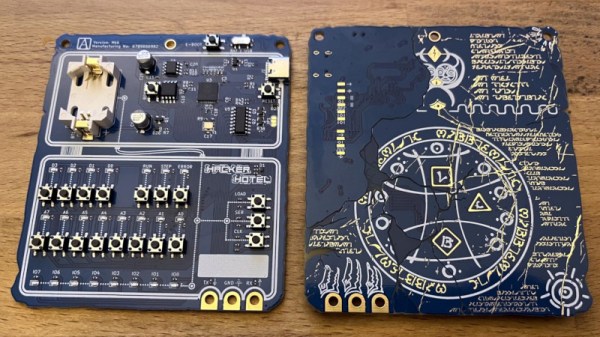
The badge takes the form of a rectangular PCB with all parts on the top side. The brains of the operation is an RP2040, and it’s powered by a CR2032 coin cell in a holder.  It’s divided into two parts, the top third which carries the circuitry and the lower two thirds of which as a row of buttons and LEDs. It’s pretty obvious from the start that it has data and address lines of a 4-bit computer, and as well as these there is an evident serial port and a USB socket. The artwork comes form the same artist whose work graced both the previous Hacker Hotel badge and the MCH2022 badge, and the rear of the PCB makes full use of all layers to create a mystical puzzle. The sum is to create a puzzle game intended to entertain the visitor, take them round the venue, and find clues to an eventual solution. I love the design both from an artistic and technical viewpoint, but have to admit that the puzzle aspect isn’t really my thing. Thus here we’ll concentrate on the badge hardware and production, and mention the puzzles only in passing. Continue reading “Hacker Hotel 2023 Had A Very Cool Badge”

New Raspberry Pi Camera With Global Shutter

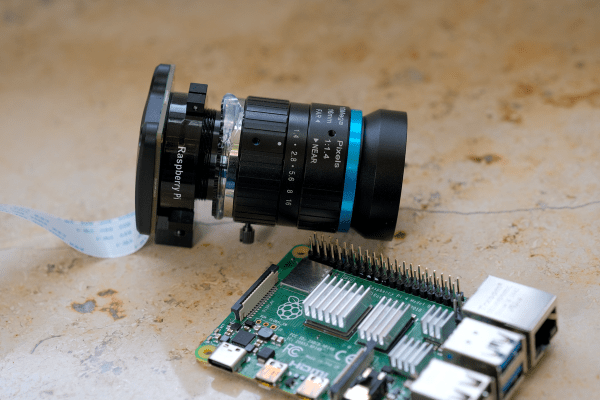
Raspberry Pi has just introduced a new camera module in the high-quality camera format. For the same $50 price you would shell out for the HQ camera, you get roughly eight times fewer pixels. But this is a global shutter camera, and if you need a global shutter, there’s just no substitute. That’s a big deal for the Raspberry Pi ecosystem.

Global vs Rolling

Most cameras out there today use CMOS sensors in rolling shutter mode. That means that the sensor starts in the upper left corner and rasters along, reading out exposure values from each row before moving down to the next row, and then starting up at the top again. The benefit is simpler CMOS design, but the downside is that none of the pixels are exposed or read at the same instant.

Continue reading “New Raspberry Pi Camera With Global Shutter”