Hackaday Podcast 197: Decoding VHS, Engineering The TV Guardian, And Gitting Code Into Your ESP32s

This week, Editor-in-Chief Elliot Williams and Assignments Editor Kristina Panos delighted in the aural qualities of Kristina’s brand new, real (read: XLR) microphone before embarking on creating a podcast highlighting the best of the previous week’s hacks.

This week in the news, NASA returned to the Moon with Artemis I, and this time, there are CubeSats involved. After that, it’s on to the What’s That Sound results show, marred by Kristina’s cheating scandal (listening ahead of time) and Elliot’s reading the filename aloud before we started recording. Finally, we move on to the hacks — they start with a trip to the 90s both sonically and visually, and end with a really nice alarm clock that’s decidedly 70s, and definitely Hackaday.

Check out the links below if you want to follow along, and as always, tell us what you think about this episode in the comments!

And/or download it and listen offline.
Continue reading “Hackaday Podcast 197: Decoding VHS, Engineering The TV Guardian, And Gitting Code Into Your ESP32s”

Retrotechtacular: A 1960s Look At The 21st Century Home

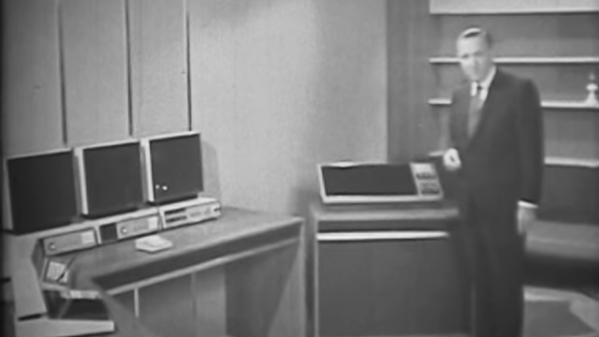
If you only watch the first 60 seconds of 1967’s “At Home, 2001,” you’ll be forgiven for thinking that the film is riddled with missed predictions. And to be sure, the cold open is rife with them, from disposable paper furniture to seashell-shaped houses that look like they’re extruded from concrete. Really, the only clear winner from that first tranche of predictions is the rise of the microwave oven, which given the expense of magnetrons in 1967 and the complexity of the electronics needed to drive them was a non-obvious development.

But pushing beyond that opening to the meat of this film reveals a fair number of domestic trends that actually did manage to come true, at least partially, and if not by 2001 then shortly thereafter. The film is an educational piece hosted by iconic American newsman Walter Cronkite, who lends his gravitas to the proceedings. The film opens with “Uncle Walter” sonorously pontificating on the unsustainability of the “ticky tacky” spawl of the suburbs and how the situation simply must change.

Continue reading “Retrotechtacular: A 1960s Look At The 21st Century Home”

Supercon 2022: Sam Mulvey Shows You How To FM Radio

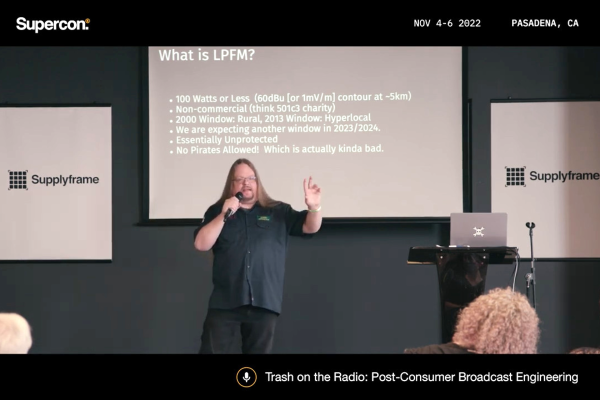
Sam Mulvey built his own radio station in Tacoma, WA. Is there a better way to meld ham radio practice with a colossal number of DIY electrical and computer projects? Sam would say there isn’t one! This 45-minute talk is basically the lessons-learned review of setting up KTQA 95.3 – the radio station on the hill.

Sam starts out the talk by introducing you to LPFM. And maybe you didn’t know that there’s a special type of license issued by the US FCC allowing non-profit community radio stations up to 100 W, covering an radius of around 5 km. It’s like running a pirate radio station, but by jumping through a few legal hoops, made legal.

Trash on the Radio

Putting a radio station together on a budget requires a ton of clever choices, flexibility, and above all, luck. But if you’re willing to repair a busted CD player or turntable, scrounge up some used computers, and work on your own amplifiers, the budget doesn’t have to be the limiting factor.

Being cheap means a lot of DIY. For instance, Sam and friends made a custom console to support all the gear and hide all the wiring. Some hot tips from the physical build-out: painted cinderblocks make great studio monitor stands, and Cat-5 can carry two channels of balanced audio along with power, with sufficient isolation that it all sounds clean. Continue reading “Supercon 2022: Sam Mulvey Shows You How To FM Radio”

Hyundai To Lead US Market For Hydrogen Fuel Cell Trucks

Hydrogen has long been touted as a potential fuel of the future. While it’s failed to catch on in cars as batteries have taken a strong lead, it still holds great promise for larger vehicles like trucks.

Hyundai have been working diligently in this space over the last few years, with its Xcient line of fuel-cell powered trucks. It’s set to dominate the world of hydrogen trucking in the US as it brings a fleet of vehicles to California next year.

Continue reading “Hyundai To Lead US Market For Hydrogen Fuel Cell Trucks”

Battery Engineering Hack Chat

Join us on Wednesday, December 14 at noon Pacific for the Battery Engineering Hack Chat with Dave Sopchak!

Of all the things driving technology forward, you’d have to say that the ability of chip makers to squeeze more complex circuits than ever onto silicon has to rank right up there. And while that’s no doubt true, it only tells a part of the story. For our money, though, the advancements in battery technology over the last 30 years or so are the real champ, because without compact, cheap, energy-dense batteries, almost none of the cool stuff we see today, from smartphones to electric vehicles, would be practical.

Battery technology has come a long way from the days when carbon-zinc and nickel-cadmium cells were kings. New chemistries, better materials and methods, and engineering improvements have all contributed to incredibly powerful, incredibly compact batteries that make applications nobody could have thought of just a few decades ago possible.

join-hack-chatDave Sopchak has been in the thick of battery engineering since taking a doctorate in electrochemistry from Case Western Reserve. Since then he has worked at several fuel cell start-ups, and is now working on a lithium-air battery that sounds really interesting. We’ve asked him to help us wrap up the 2022 Hack Chat series with a discussion on battery engineering, with a focus on upcoming technologies and advancements that could really put some power in your pocket.

Our Hack Chats are live community events in the Hackaday.io Hack Chat group messaging. This week we’ll be sitting down on Wednesday, December 14 at 12:00 PM Pacific time. If time zones have you tied up, we have a handy time zone converter.

Students Rebel Against Heat-Sensing Crotch Monitor Surveillance Devices

Surveillance has become a ubiquitous part of modern life. Public spaces are dotted with CCTV cameras inside and out. Recent years have seen the technology spread to the suburbs with porch cameras spreading the eye of big tech and law enforcement ever further.

Outside of mere cameras, companies are rushing to develop all manner of new devices to surveil individuals, too. One such device intended to track students quickly drew the ire of scholars at Northeastern University, and the cohort fought back.

Continue reading “Students Rebel Against Heat-Sensing Crotch Monitor Surveillance Devices”

Hackaday Links Column Banner

Hackaday Links: December 11, 2022

“They paved paradise and put up a parking lot.” That might be stretching things a bit, especially when the “paradise” in question is in New Jersey, but there’s a move afoot to redevelop the site of the original “Big Bang Antenna” that has some people pretty upset. Known simply as “The Horn Antenna” since it was built by Bell Labs in 1959 atop a hill in Holmdel, New Jersey, the antenna was originally designed to study long-distance microwave communications. But in 1964, Bell Labs researchers Arno Penzias and Robert Wilson accidentally discovered the microwave remnants of the Big Bang, the cosmic background radiation, using the antenna, earning it a place in scientific history. So far, the only action taken by the township committee has been to authorize a study to look into whether the site should be redeveloped. But the fact that the site is one of the highest points in Monmouth County with sweeping views of Manhattan has some people wondering what’s really on tap for the site. A petition to save the antenna currently has about 3,400 signatures, so you might want to check that out — after all, you don’t know what you’ve got ’til it’s gone.

Continue reading “Hackaday Links: December 11, 2022”