This excellent content from the Hackaday writing crew highlights recurring topics and popular series like Linux-Fu, 3D-Printering, Hackaday Links, This Week in Security, Inputs of Interest, Profiles in Science, Retrotechtacular, Ask Hackaday, Teardowns, Reviews, and many more.
Filament-based 3D printers spent a long time at the developmental forefront for hobbyists, but resin-based printers have absolutely done a lot of catching up, and so have the resins they use. It used to be broadly true that resin prints looked great but were brittle, but that’s really not the case anymore.
A bigger variety of resins and properties are available to hobbyists than ever before, so if that’s what’s been keeping you away, it’s maybe time for another look. There are tough resins, there are stiff resins, there are heat-resistant resins, and more. Some make casting easy, and some are even flexible. If your part or application needs a particular property, there is probably a resin for it out there.
It may sound like a provocative statement to make, but technology has been on a downward trend for a long time. That’s not a moral or ethical proclamation, but rather an observation about the scale of technology. Where once the height of technology was something like a water-powered mill, whose smallest parts were the size of a human hand and tolerances were measured in inches, today we routinely build machines by etching silicon chips with features measured in nanometers, look inside the smallest of cells and manipulate their innards, and use microscopes that can visualize materials at the atomic level.
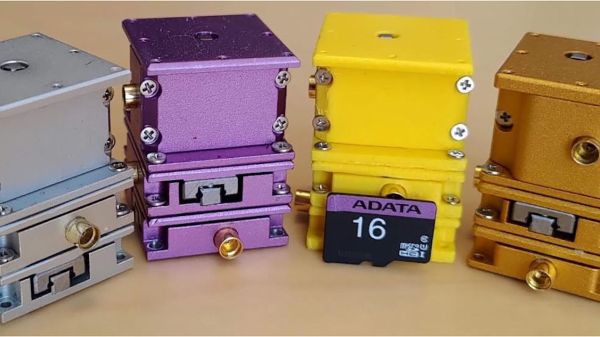
The world has gotten much, much smaller lately, and operating on that scale requires thinking about motion in a different way than we’ve been used to. Being able to move things at nanometer resolutions isn’t easy, but it’s not impossible, and it can even be accomplished on a DIYer’s budget — if you know what you’re doing.
To help us sort through the realities of nano-scale positioning, En-Te Hwu, a professor at the Technical University of Denmark who works on micromachines for intelligent drug delivery, has spun up some really interesting low-cost nanopositioning systems. Using old DVD players or off-the-shelf linear slides, he’s able to achieve nanoscale movement and sensing for a variety of purposes. He’ll stop by the Hack Chat to discuss how we can build nanopositioning and sensing into our projects, and to start exploring the world we can’t even see.
“Don’t worry, that’ll buff right out.” Alarming news this week as the James Webb Space Telescope team announced that a meteoroid had hit the space observatory’s massive primary mirror. While far from unexpected, the strike on mirror segment C3 (the sixth mirror from the top going clockwise, roughly in the “south southeast” position) that occurred back in late May was larger than any of the simulations or test strikes performed on Earth prior to launch. It was also not part of any known meteoroid storm in the telescope’s orbit; if it had been, controllers would have been able to maneuver the spacecraft to protect the gold-plated beryllium segments. The rogue space rock apparently did enough damage to be noticeable in the data coming back from the telescope and to require adjustment to the position of the mirror segment. While it certainly won’t be the last time this happens, it would have been nice to see one picture from Webb before it started accumulating hits.
When we think of robotics, the first thing that usually comes to mind for many of us is some sort of industrial arm that’s bolted to the floor, or perhaps a semi-autonomous rover trudging its way across the dusty Martian landscape. While these two environments are about as different as can be, the basic “rules” are pretty much the same. Being on firm ground ground gives the robot a clear understanding of its position and orientation, which greatly simplifies tasks such as avoiding collisions or interacting with nearby objects.
But what happens when that reference point goes away? How does a robot navigate when it’s flying through open space or hovering in mid-air? That’s just one of the problems that fascinates Nick Rehm, who stopped by to host this week’s Aerial Robotics Hack Chat to talk about his passion for flying robots. He’s currently an aerospace engineer at Johns Hopkins Applied Physics Laboratory, where he works on the unique challenges faced by autonomous flying vehicles such as the detection and avoidance of mid-air collisions, as well as the development of vertical take-off and landing (VTOL) systems. But before he had his Master’s in Aerospace Engineering and Rotorcraft, he got started the same way many of us did, by playing around with DIY projects.
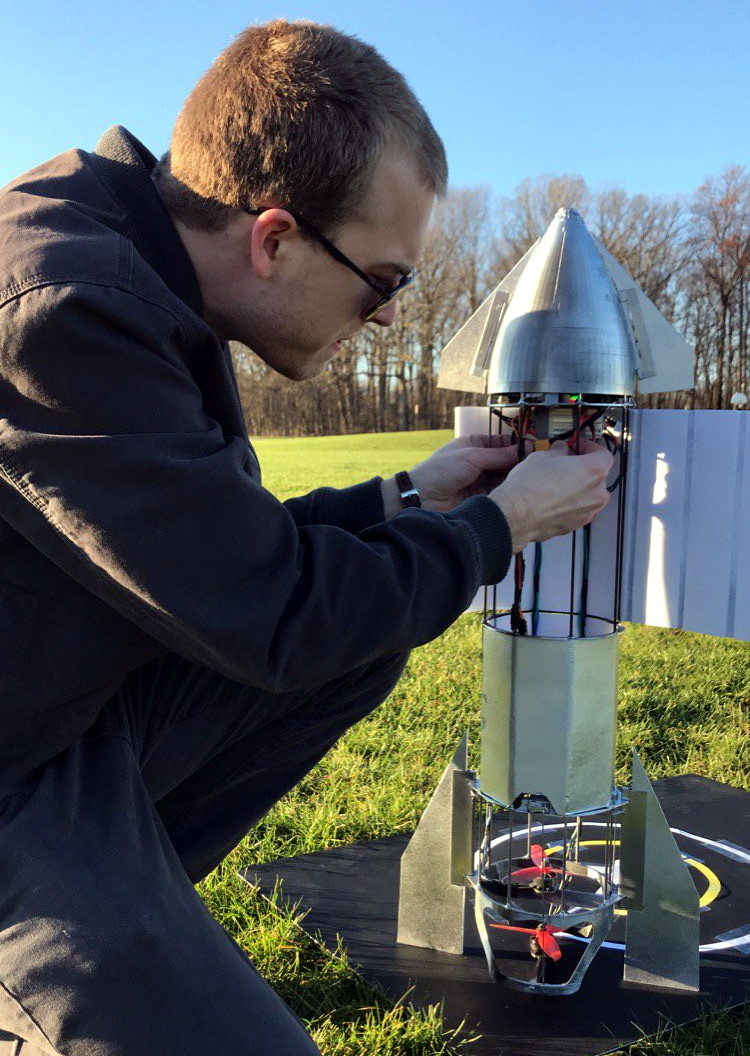
In fact, regular Hackaday readers will likely recall seeing some of his impressive builds. His autonomous ekranoplan designed to follow a target using computer vision graced the front page in April. Back in 2020, we took a look at his recreation of SpaceX’s Starship prototype, which used a realistic arrangement of control surfaces and vectored thrust to perform the spacecraft’s signature “Belly Flop” maneuver — albeit with RC motors and propellers instead of rocket engines. But even before that, Nick recalls asking his mother for permission to pull apart a Wii controller so he could use its inertial measurement unit (IMU) in a wooden-framed tricopter he was working on.
Discussing some of these hobby builds leads the Chat towards Nick’s dRehmFlight project, a GPLv3 licensed flight control package that can run on relatively low-cost hardware, namely a Teensy 4.0 microcontroller paired with the GY-521 MPU6050 IMU. The project is designed to let hobbyists easily experiment with VTOL craft, specifically those that transition between vertical and horizontal flight profiles, and has powered the bulk of Nick’s own flying craft.
Moving onto more technical questions, Nick says one of the most difficult aspects when designing an autonomous flying vehicle is getting your constraints nailed down. What he means by that is having a clear goal of what the craft needs to do, and critically, how long it needs to do it. How far does the craft need to be able to fly? How fast? Does it need to loiter at the target location, and if so, for how long? The answers to these questions will largely dictate the form of the final vehicle, and are key to determining if it’s worth implementing the complexity of transitioning from VTOL to fixed-wing horizontal flight.
But according to Nick, the biggest challenge in aerial robotics is onboard state estimation. That is, the ability for the craft to know its position and orientation relative to the ground. While high-performance computers have gotten lighter and sensors have improved, he says there’s still no substitute for having a ground-based tracking system. He mentions that those fancy demonstrations you’ve seen with drones flying in formation and working collaboratively towards a task will almost certainly have an array of motion capture cameras tucked off to the side. This makes for an impressive show, but greatly limits the practical application of these drone swarms.
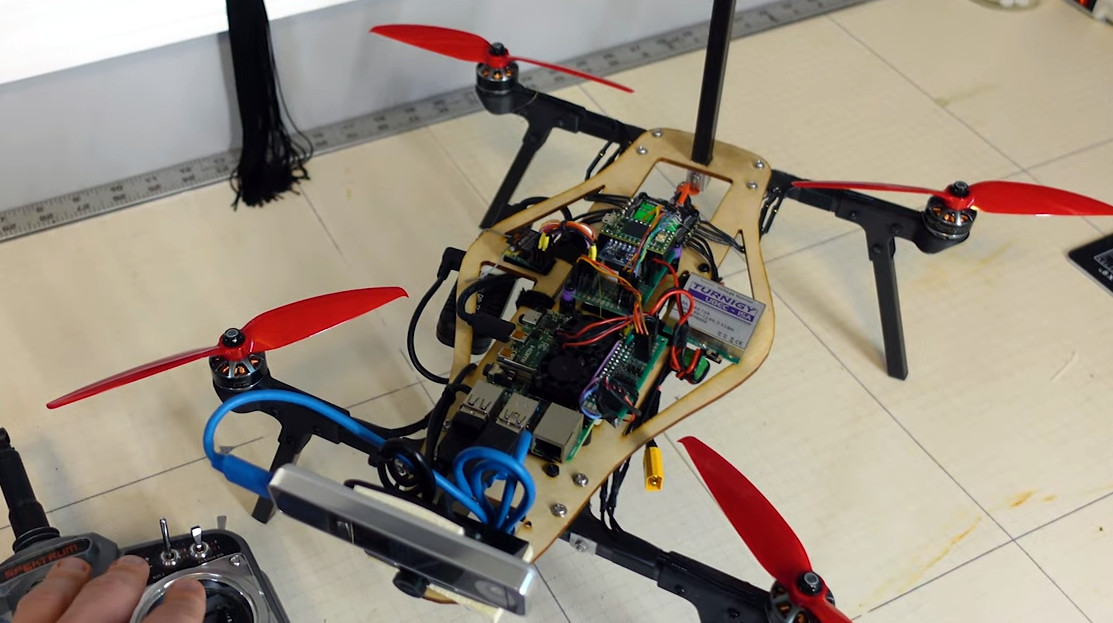
Nick’s custom Raspberry Pi 4-powered quadcopter lets him test autonomous flight techniques.
So what does the future of aerial robotics look like? Nick says open source projects like ArduPilot and PX4 are still great choices for hobbyists, but sees promise in newer platforms which pair the traditional autopilot with more onboard computing power, such as Auterion’s Skynode. More powerful flight controllers can enable techniques such as simultaneous localization and mapping (SLAM), which uses 3D scans of the environment to help the robot orient itself. He’s also very interested in technologies that enable autonomous flight in GPS-denied environments, which is critical for robotic craft that need to operate indoors or in situations where satellite navigation is unavailable or unreliable. In light of the incredible success of NASA’s Ingenuity helicopter, we imagine these techniques will also play an invaluable role in the future airborne exploration of Mars.
We want to thank Nick for hosting this week’s Aerial Robotics Hack Chat, which turned out to be one of the fastest hours in recent memory. His experience as both an avid hobbyist and a professional in the field provided exactly the sort of insight the Hackaday community looks for, and his gracious offer to keep in touch with several of those who attended the Chat to further discuss their projects speaks to how passionate he is about this topic. We expect to see great things from Nick going forward, and would love to have him join us again in the future to see what he’s been up to.
The Hack Chat is a weekly online chat session hosted by leading experts from all corners of the hardware hacking universe. It’s a great way for hackers connect in a fun and informal way, but if you can’t make it live, these overview posts as well as the transcripts posted to Hackaday.io make sure you don’t miss out.
Join Hackaday Editor-in-Chief Elliot Williams and Assignments Editor Kristina Panos for a free-as-in-beer showcase of the week’s most gnarly but palatable hacks. But first, a reminder! Round 2 of the 2022 Hackaday Prize comes to an end in the early hours of Sunday, June 12th, so there’s still enough time to put a project together and get it entered.
This week, we discuss the utility of those squishy foam balls in projects and issue the PSA that it is in fact pool noodle season, so go get ’em. We drool over if-you-have-to-ask-you-can’t-afford-it 3D printers with staircases and such, and wonder why breadboard game controls didn’t already exist. Later on we laugh about lasers, shake the bottle of LTSpice tips from [fesz], and ponder under-door attacks. Finally, we’re back to frickin’ laser beams again, and we discover that there’s a fruity demoscene in Kristina’s backyard.
If you roll way back through the history of open source webmail projects, you’ll find Horde, a groupware web application. First released in 1998 on Freshmeat, it gained some notoriety in early 2012 when it was discovered that the 3.0 release had been tampered with, and packages containing a backdoor had been shipped for three months. While this time around it isn’t an intentional backdoor, there is a very serious problem in the Horde webmail interface. Or more accurately, a pair of problems. The most serious is CVE-2022-30287, an RCE bug allowing an authenticated user to trigger code execution on the connected server.
The vulnerable element is the Turba address book module, which uses a PHP factory method to access a specific address book. The create() method has an interesting bit of code, that first checks the initialization value. If it’s a string, that value is understood as the name of the local address book to access. However, if the factory is initialized with an array, any of the address book drivers can be used, including the IMSP driver. IMSP fetches serialized data from remote servers, and deserializes it. And yes, PHP can have deserialization bugs, and this one runs code on the host.
But it’s not that bad, it’s only authenticated users, right? That would be bad enough, but that second bug is a Cross-site Request Forgery, CSRF, triggered by viewing an email. So on a vulnerable Horde server, any user viewing a malicious message would trigger RCE on the server. Oof. So let’s talk fixes. There is a new version of the Turba module that seems to fix the bugs, but it’s not clear that the actual Horde suite has pushed an update that includes it. So you may be on your own. As is pointed out on the Sonar Blog where the vulnerability was discovered, Horde itself seems to be essentially unmaintained at this point. Maybe time to consider migrating to a newer platform. Continue reading “This Week In Security: For The Horde, Feature Not A Bug, And Confluence”→
In any era, the story of electronics has very much been about figuring out how to make something happen with what’s available at the time. And as is often the case, the most interesting developments come from occasions when needs exceed what’s available. That’s when real innovation takes place, even if circumstances conspire to keep the innovation from ever taking hold in the marketplace.
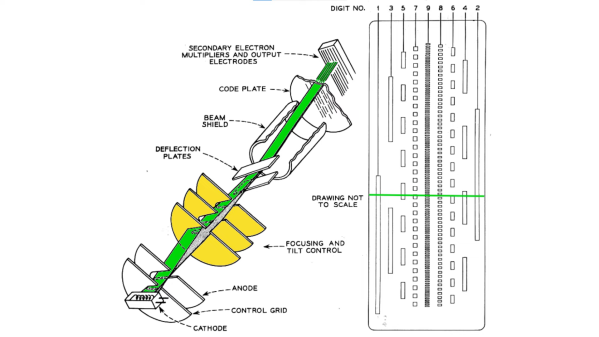
This gem of a video from the Antique Wireless Association has a perfect example of this: the long-lost analog-to-digital converter vacuum tube. Like almost every mid-20th-century innovation in electronics, this one traces its roots back to the Bell Laboratories, which was keenly interested in improving bandwidth on its massive network of copper lines and microwave links. As early as 1947, one Dr. Frank Gray, a physicist at Bell Labs, had been working on a vacuum tube that could directly convert an analog signal into a digital representation. His solution was a cathode ray tube similar to the CRT in an oscilloscope. A beam of electrons would shine down the length of the tube onto a shadow mask containing holes arranged in a “reflected binary code,” which would later be known as a Gray code. The analog signal to be digitized was applied to a pair of vertical deflector plates, which moved the beam into a position along the plate corresponding to the voltage. A pair of horizontal deflector plates would then scan the beam across the shadow mask; where electrons fell on a hole, they would pass through to an output plate to be registered as a bit to be set.