Friday Hack Chat: FPGA Bootcamp

For this week’s Hack Chat, we’re going to be talking all about FPGAs, with our own resident FPGA expert.
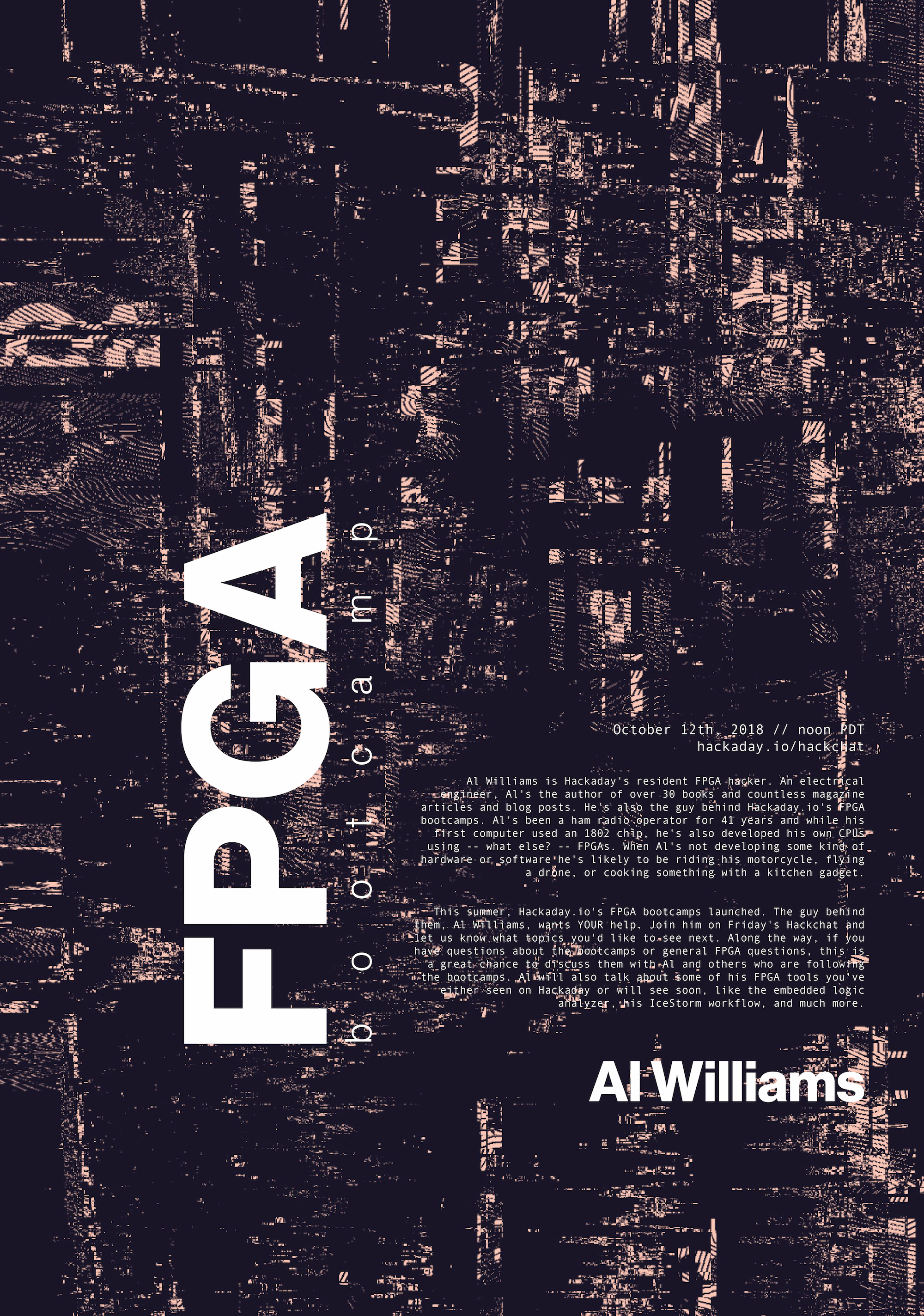
This summer, Hackaday.io launched FPGA bootcamps, simple, easy-to-follow tutorials that will get you up and running with Verilog. These were all done by Al Williams, Hackaday’s resident FPGA hacker. Al’s an electrical engineer, author of over thirty books, countless magazine articles, and thousands of blog posts. He’s been an amateur radio operator for 41 years, and his first computer used an 1802 chip.

Now Al is putting a little bit of his wisdom over on Hackaday.io. He’s written up a bunch of tutorials that will get you started in programmable digital logic. Everything from a refresher on the ins and outs of nands and nors. a short introduction to Verilog, moving into sequential logic, to putting that code on real FPGA hardware is already up, and this bootcamp isn’t done yet.

If you want to get started in FPGA design, Al’s the guy you want to talk to. During this Hack chat, you’ll be able to ask questions about FPGAs, and about what’s coming up in future bootcamps. We’ll also be talking about Al’s other projects that you might see on Hackaday in the future, like the embedded logic analyzer, his IceStorm workflow, and much more.

During this Hack Chat, we’re going to be talking about:

  • How to use the FPGA tutorials
  • What other FPGAs you can use the tutorials for and how
  • Other Hackaday Bootcamp topics — FPGA or otherwise — that you’d like to see.

You are, of course, encouraged to add your own questions to the discussion. You can do that by leaving a comment on the FPGA Bootcamp Hack Chat and we’ll put that in the queue for the Hack Chat discussion.

join-hack-chat

Our Hack Chats are live community events on the Hackaday.io Hack Chat group messaging. This week we’ll be sitting down on Friday, October 12th, at noon, Pacific time. If time zones got you down, we have a handy time zone converter.

Click that speech bubble to the right, and you’ll be taken directly to the Hack Chat group on Hackaday.io.

You don’t have to wait until Friday; join whenever you want and you can see what the community is talking about.


This Year’s Nobel Prizes Are Straight Out Of Science Fiction

In the 1966 science fiction movie Fantastic Voyage, medical personnel are shrunken to the size of microbes to enter a scientist’s body to perform brain surgery. Due to the work of this year’s winners of the Nobel Prize in Physics, laser tools now do work at this scale.

Arthur Ashkin won for his development of optical tweezers that use a laser to grip and manipulate objects as small a molecule. And Gérard Mourou and Donna Strickland won for coming up with a way to produce ultra-short laser pulses at a high-intensity, used now for performing millions of corrective laser eye surgeries every year.

Here is a look at these inventions, their inventors, and the applications which made them important enough to win a Nobel.

Continue reading “This Year’s Nobel Prizes Are Straight Out Of Science Fiction”

A Funny Thing Happened On Ada Lovelace Day…

Today is Ada Lovelace Day, a day to celebrate and encourage women in the fields of science and technology. The day is named after “Augusta Ada King-Noel, Countess of Lovelace, born Byron”, or Lady Ada Lovelace for short. You can read up more on her life and contribution to computer science at Wikipedia, for instance.

But it’s not really fair to half of the world’s population to dedicate just one day to observing the contributions of female scientists and then lavish all the laurels solely on Lovelace. So last year, the day after Ada Lovelace day, Brian Benchoff sent an internal e-mail at Hackaday HQ suggesting we tell the stories of other women in science. We put our heads together and came up with a couple dozen leads so quickly, it was clear that we were on to something good.

From a writer’s perspective, the stories of women in science are particularly appealing because they are undertold. Sure, everyone knows of Marie Curie’s brilliant and tragic dedication to uncovering the mysteries of radioactivity. But did you know how Rita Levi-Montalcini had to hide from the Italian Fascists and the German Nazis using fake names, doing research on scarce chicken eggs in her parent’s kitchen, before she would eventually discover nerve growth factor and win the Nobel Prize? We didn’t.

Do you know which biochemist is the American who’s logged the most time in space? Dr. Peggy Whitson, the space ninja. But the honor of being the first civilian in space goes to Soviet skydiver Valentina Tereshkova. Margaret Hamilton was lead software engineer on the code that got the first feet on the moon, but in the days before astronauts had learned to trust the silicon, John Glenn wanted Katherine Johnson to double-check the orbital calculations before he set foot in the Friendship 7.

And on it goes. Maria Goeppert-Mayer figured out the structure of nuclear shells, Kathleen Booth invented assembly language, and Françoise Barré-Sinoussi discovered HIV. Stephanie Kwolek even saved Hackaday writer Dan Maloney’s life by inventing Kevlar.

In all, we’ve written 30 profiles of women in science in the last year — far too many to list here by name. You can browse them all by using the Biography category. (We’ve thrown in biographies of a few men too, because women don’t have a monopoly on neat stories.)

We’re not done yet, either. So thank you, Ada Lovelace, for giving us the impetus to cover the fascinating stories and important contributions of so many women in science!

Hack My House: Running Raspberry Pi Without An SD Card

Many of us have experienced the pain that is a Raspberry Pi with a corrupted SD card. I suspect the erase-on-write nature of flash memory is responsible for much of the problem. Regardless of the cause, one solution is to use PXE booting with the Raspberry Pi 3. That’s a fancy way to say we’ll be booting the Raspberry Pi over the network, instead of from an SD card.

What does this have to do with Hacking My House? As I discussed last time, I’m using Raspberry Pi as Infrastructure by building them into the walls of every room in my house. You don’t want to drag out a ladder and screwdriver to swap out a misbehaving SD card, so booting over the network is a really good solution. I know I promised we’d discuss cabling and cameras. Think of this as a parenthetical article — we’ll talk about Ethernet and ZoneMinder next time.

So let’s dive in and see what the Preboot Execution Environment (PXE) is all about and how to use PXE with Raspberry Pi.

Continue reading “Hack My House: Running Raspberry Pi Without An SD Card”

New Part Day: The RISC-V Chip With Built-In Neural Networks

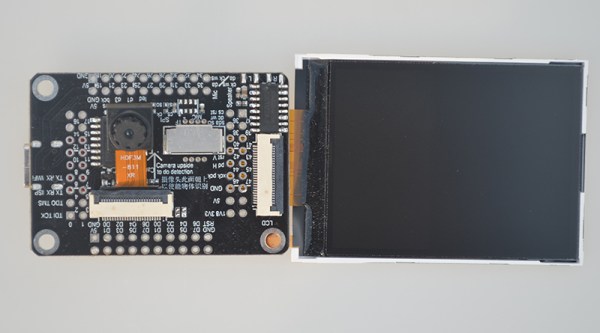
After exploring a few random online shops one day, [David] (thanks for sending this in, by the way) ran across a very interesting chip. It’s a dual-core, RISC-V chip running at 400MHz. There’s 6 MB of SRAM on the CPU, and there’s 2MB for convolutional neural network acceleration. There is, apparently, WiFi on some versions. There are already SDKs available on GitHub, and a bare chip costs a dollar or two. Interested? Log in to Taobao, realize Taobao does pre-orders, and all this can be yours.

This is a preorder — because apparently you can do that as a seller on TaoBao, but the Sipeed M1 K210 is available as a ‘core’ board with 72 pins in a one-inch square package, a version with WiFi, or as a complete development board with an OV2640 camera, 2.4 inch LCD, microphone, and onboard USB. There are videos of this chip running a face detection routine. It found Obama.

A bit of googling tells us this chip comes from a company named Kendryte, and here the specs are repeated: this is a dual-core RISC-V with an FPU, a bunch of RAM, and can run TensorFlow. Documentation is available, although the datasheet will need to be translated, and as of this writing there’s a GitHub filled with SDKs and examples, with some of the repos updated in the last hour.

Over the years we’ve seen a few RISC-V chips given development boards, and you can buy them right now. The HiFive 1 is an exceptionally powerful microcontroller with processing power that puts it right up against the Teensy (which is built around a Freescale chip), but it’s also fairly expensive. We’re not sure the Arduino Cinque (also RISC-V) ever made it to production, but again, expensive. The idea that a RISC-V microcontroller could be available for just a few dollars is very interesting, it even comes with SDKs and utilities to make the chip useful.

Hackaday Links Column Banner

Hackaday Links: October 7, 2018

Ah, crap. We lost a good one, people. [Samm Sheperd] passed away last month. We’ve seen his stuff before, from a plane with a squirrel cage fan, to completely owning a bunch of engineering students by auditing a class. The obit is available as a Google Doc, and there’s a Samm Sheperd Memorial Fund for the Big Lake Youth Camp in Gladstone, Oregon.

FranLab is closing down! Fran is one of the hardware greats, and she’s being evicted. If you’ve got 2000sqft of workshop space in Philly you’d like to spare, you know who to talk to. There will, probably, be a crowdfunding thing going up shortly, and we’ll post a link when it’s up.

The Parallax Propeller is probably one of the most architecturally interesting microcontrollers out there. It’s somewhat famous for being a multi-core chip, and is commonly used in VGA generation, reading keyboards, and other tasks where you need to do multiple real-time operations simultaneously. The Parallax Propeller 2, the next version of this chip, is in the works, and now there’s real silicon. Everything is working as expected, and we might see this out in the wild real soon.

Thought artistic PCBs were just a con thing? Not anymore, I guess. There has been a lot of activity on Tindie with the Shitty Add-Ons with [TwinkleTwinkie] and [Potato Nightmare] releasing a host of very cool badges for your badges. Most of these are Shitty Add-Ons, and there will be an update to the Shitty Add-On spec shortly. It’s going to be backwards-comparable, so don’t worry.

Unnecessary drama!?! In my 3D printing community?!? Yes, it’s true, there was a small tiff over the Midwest RepRap Festival this week. Here’s what went down. You got three guys. John, Sonny, and Steve. Steve owns SeeMeCNC, based in Goshen, Indiana. John worked for SeeMeCNC until this year, and has been the ‘community manager’ for MRRF along with Sonny. Seeing as how the RepRap Festival is the only thing that ever happens in Goshen, Steve wanted to get the ball rolling for next year’s MRRF, so he sent out an email, sending the community into chaos. No, there’s not some gigantic fracture in the 3D printing community, John and Sonny, ‘were just slacking’ (it’s five months out, dudes. plenty of time.), and Steve wanted to get everything rolling. No problem here, just a bunch of unnecessary drama in the 3D printing community. As usual.

Supercon Talks That Inspire You To Take On Something New

There’s wealth of activities at the Hackaday Superconference but we’ve saved a few for today’s announcement that will inspire you to take on something new and different. Check out the eight talks below that will push you to try the unexpected, to look at old things in a new way, and to propel your hardware adventures for another year.

This is the Ultimate Hardware Conference and you need to be there! We’ll continue to announce speakers and workshops as final confirmations come in. Supercon will sell out so grab your ticket now before it’s too late.

Samy Kamkar
Ultra Low Cost, Low Power, Low Weight, Light-up Mesh Networkings

How to “float” a mesh network with light-up balloons in the air without re-powering.

Carl Bugeja
Building Motors from PCBs

Ongoing design and prototyping experiments that use Printed Circuit Boards (either rigid or flexible) as a coil in conjunction with rare earth magnets to create interesting motors and actuators.

Joan Horvath and Rich Cameron
Hacker Calculus

Travel back to Isaac Newton’s work to rethink calculus and make it intuitive using 3D printed open-source designs.

Rob Ryan-Silva
Making it Matter for Developing Countries

Building hardware in support of foreign aid projects. Learn what considerations really matter when designing for developing country contexts.

Dominic Spill
Ridiculous Radios

RF engineers put great effort into crafting high quality radio systems. I am not one of those engineers. Experimenting with radio protocols using SDR.

Michael Rigsby
Connect the Dots; Choices Make a Life

How does life unfold if you create things? Nothing created is wasted — following your dreams will lead you somewhere (maybe not where you planned), but to a good place. How I quit my engineering job and built interesting things as a career.

Hunter Scott
Why Phased Arrays Are Cool and How to Build One

At the intersection of the two black arts of RF engineering and antenna design is the phased array. But don’t worry, they’re not as hard to understand as you might think.


Charles Alexanian
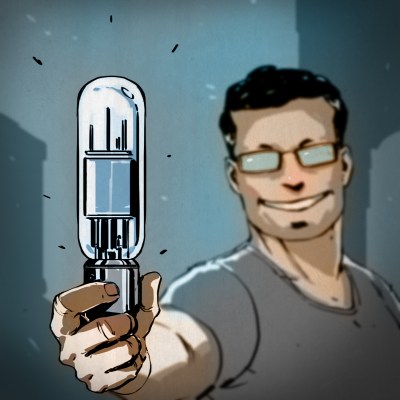
Small Scale Vacuum Tube Construction

Showing the process for the construction of vacuum tubes. Tubes will be built and tested on site using glass working torches and other specialized tools

We Want You at Supercon!

The Hackaday Superconference is a can’t-miss event for hardware hackers everywhere. Join in on three amazing days of talks and workshops focusing on hardware creation. This is your community of hardware hackers who congregate to hack on the official hardware badge and on a slew of other projects that show up for the fun. Get your ticket right away!