Raspberry Pi, Send Me A Letter

The abundance of small networked boards running Linux — like the Raspberry Pi — is a boon for developers. It is easy enough to put a small cheap computer on the network. The fact that Linux has a lot of software is a double-edged sword. On the one hand, it is a good bet that anything you want to do has been done. On the other hand, some of the solutions are a bit large for a tiny embedded system.

Take, for example, e-mail. Historically, Linux hosts operate as mail transfer agents that can send and receive mail for all their users and possibly even relay mail to others. In today’s world, that’s usually overkill, but the capability is there. It is possible to install big mail transfer agents into a Raspberry Pi. The question is: should you?

What Do You Want?

The answer, of course, depends on what you want to do. If you have a dedicated board sending out text and maybe even files using an external mail server (like, say, Gmail), then the answer is no. You don’t need a piece of software listening for incoming connections, sorting through multiple users, and so on.

Luckily, there are some simple solutions if you know how to set up and configure them. The key is to avoid the big mail programs that do everything you don’t need.

Mail Front Ends

Let’s tackle sending mail first. If you try to grab the mailutils package, you’ll see it drags along a lot of stuff including mysql. Keep in mind, none of this will actually send mail. It just gives you some tools to get mail ready to send.

Luckily, the bsd-mailx package has a lot less overhead and will do the job. Look at the man page to see what options you have with mailx; you can do things like attach files, set a subject, and specify addresses.

It is a little difficult to set up for Gmail, though, thanks to Google’s security. You’ll need the certutil tool from the libnss3-tools package. You’ll need to create a certificate store, import Google’s certificate, and then set up a lot of options to mailx. I don’t suggest it. If you insist, though, you can find directions on the Web.

SSMTP

By default, programs like mailx and other Linux mail commands rely on a backend (often sendmail). Not only does that drag around too much overhead, it is also a full mail system, sending and receiving and relaying–overkill for our little Pi computers.

Luckily, SSMTP is available which only sends mail and is relatively lightweight. You need a configuration file to point it to your mail server. For Gmail, it would look like this:

#
# Config file for sSMTP sendmail
#
# The person who gets all mail for userids < 1000
# Make this empty to disable rewriting.
root=postmaster

# The place where the mail goes. The actual machine name is required no 
# MX records are consulted. Commonly mailhosts are named mail.domain.com
mailhub=smtp.gmail.com:587

# Where will the mail seem to come from?
rewriteDomain=yourdomain.com

# The full hostname
hostname=yourhostname
AuthUser=YourGmailUserID
AuthPass=YourGmailPassword
UseTLS=Yes
UseSTARTTLS=YES
# Are users allowed to set their own From: address?
# YES - Allow the user to specify their own From: address
# NO - Use the system generated From: address
FromLineOverride=YES

You can use a mail agent like mailx or you can just use ssmtp directly:

ssmtp someone@somewhere.com

Enter a message on the standard input and end it with a Control+D (standard end of file for Linux).

Google Authentication

There’s only one catch. If you are using Gmail, you’ll find that Google wants you to use stronger authentication. If you are using two-factor (that is, Google Authenticator), this isn’t going to work at all. You’ll need to generate an app password. Even if you aren’t, you will probably need to relax Google’s fear of spammers on your account. You need to turn on the “Access for less secure apps” setting. If you don’t want to do this on your primary e-mail account, considering making an account that you only use for sending data from the Pi.

Sending Files

Depending on the mail software you use, there are a few ways you can attach a file. However, the mpack program makes it very easy:

mpack -a -s 'Data File' datafile.csv me@hackaday.com

The above command will send datafile.csv as an attachment with the subject “Data File.” Pretty simple.

Receiving Mail

What if you want to reverse the process and receive mail on the Pi? There is a program called fetchmail that can grab e-mails from an IMAP or POP3 server. It is possible to make it only read the first unread message and send it to a script or program of your choosing.

You have to build a configuration file (or use the fetchmailconf program to build it). For example, here’s a simple .fetchmailrc file:

poll imap.gmail.com
protocol IMAP
user "user@gmail.com" with password "yourpassword" mda "/home/pi/mailscript.sh"
folder 'INBOX'
fetchlimit 1
keep
ssl

You can leave the “keep” line out if you don’t mind fetchmail deleting the mail after processing. The file should be in your home directory (unless you specify with the -f option) and it needs to not be readable and writable by other users (e.g., chmod 600 .fetchmailrc). According to the fetchmail FAQ, there are some issues with Gmail, so you might want to consider some of the suggestions provided. However, for simple tasks like this, you should be able to work it all out.

In particular, the mailscript.sh file is where you can process the e-mail. You might, for example, look for certain keyword commands and take some action (perhaps replying using ssmtp).

Special Delivery

You might not think of the Raspberry Pi as an e-mail machine. However, the fact that it is a pretty vanilla Linux setup means you can use all sorts of interesting tools meant for bigger computers. You just have to know they exist.

Homemade Capacitors Of A Mad Scientist

Once upon a time I was a real mad scientist. I was into non-conventional propulsion with the idea of somehow interacting with the quantum vacuum fluctuations, the zero point energy field. I was into it despite having only a vague understanding of what that was and without regard for how unlikely or impossible anyone said it was to interact with on a macro scale. But we all had to come from somewhere, and that was my introduction to the world of high voltages and homemade capacitors.

And along the way I made some pretty interesting, or different, capacitors which I’ll talk about here.

Large Wax Cylindrical Capacitor

As the photos show, this capacitor is fairly large, appearing like a thick chunk of paraffin wax sandwiched between two wood disks. Inside, the lead wires go to two aluminum flashing disks that are the capacitor plates spaced 2.5cm (1 inch) apart. But in between them the dielectric consists of seven more aluminum flashing disks separated by plain cotton sheets immersed in more paraffin wax. See, I told you these capacitors were different.

I won’t go into the reasoning behind the construction — it was all shot-in-the-dark ideas, backed by hope, unicorn hairs, and practically no theory. The interesting thing here was the experiment itself. It worked!

I sat the capacitor on top of a tall 4″ diameter ABS pipe which in turn sat on a digital scale on the floor. High voltage in the tens of kilovolts was put across the capacitor through thickly insulated wires. The power supply contained a flyback transformer and Cockcroft-Walton voltage multiplier at the HV side. As I dialed up the voltage, the scale showed a reducing weight. I had weight-loss!

But after a few hours of reversing polarities and flipping the capacitor the other way around and taking plenty of notes, I found the cause. The weight-loss happened only when the feed wires were oriented with the top one feeding downward as shown in the diagram, but there was no weight change when the top wire was oriented horizontally. I’d seen high voltage wires moving before and here it was again, producing what looked like weight-loss on the scale.

But that’s only one of the interesting capacitors I’ve made. After the break we get into gravitators, polysulfide and even barium titanate.

Continue reading “Homemade Capacitors Of A Mad Scientist”

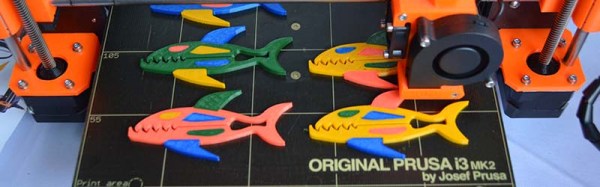
Maker Faire Multicolor And Multi Material 3D Printing

The next frontier of desktop 3D printing is multi-material and multi-color prints. Right now, you can buy a dual toolhead for a Lulzbot, and dual toolheads from other companies exist, although they are a bit rare. In the next few years, we’re going to see a lot of printers able to print dissolvable supports and full-color 3D printers.

Printing in more than one color is almost here, but that doesn’t mean we’re on the cusp of a complete revolution. Multi-material printing is lagging a little bit behind; you’ll be able to print two colors of PLA next year, but printing an object in PLA and ABS is going to be a bit tricky. Printing something in PLA and nylon will be very hard. Color mixing, likewise, will be tricky. We can do it, the tools are getting there, but think of this year as a preview of what we’ll be doing in five years.

Continue reading “Maker Faire Multicolor And Multi Material 3D Printing”

Hackaday Links: October 2, 2016

Hey Elon, three weeks ago I was in Burning Man in the Nevada desert and after I dug myself a nice K-hole I notice that Mars is a lot like the Nevada desert which got me thinking that if we can live here we can live on Mars but then I realized that Mars really isn’t a lot like the Nevada desert because there are toilets here but if we could build toilets on Mars it would be a lot like the Nevada desert? This week Elon Musk unveiled the Interplanetary Transport System at the International Astronautical Congress in Guadalajara. Instead of filling the room with industry experts the highlights of the Q&A session consisted of a woman who wanted to give Elon a kiss onstage and some guy who was super, super high. Discussion of the technical feasibility of a big, heavy window on the Heart of Gold has not appeared anywhere. Zero thought has been given to the consequences of building a civilization consisting entirely of the wealthiest 1% of Earth’s population. I fully support the Interplanetary Transport System; I’m going because this planet sucks.

[FoamieNinja] over on /r/radiocontrol is experimenting with single bladed propellers. Single bladed propellers are the most efficient way of pushing air behind an engine but haven’t really seen widespread use because they’re really weird, and I don’t know if you can do a variable pitch prop like this. You can find these types of props rarely on big-sized aircraft such as vintage J-3 Cubs sporting a 40HP engine. I haven’t seen them on anything bigger.

Next weekend is the Open Hardware Summit in Portland, Oregon. Hackaday is going to be there, and there’s a BringAHack at OSH Park on Thursday. Last year at the summit, the Open Source Hardware Certification was announced. This year, OSHWA is ready to launch their certification program. The takeaway from last year is that Open Hardware Certification will be free, self-certifying, with penalties based on fines for non-compliance.

The ESP32 is here, but most of them are still in a shipping container somewhere in the Pacific. Here’s a breakout board for the Espressif ESP-WROOM-02.

The J-Core is a clean room, open source CPU and SOC. Currently, it’s only implemented in VHDL until someone has a ton of money to burn on an ASIC. Now, the J-Core is supported by Linux. That makes an ASIC just a bit more likely. Thanks [Stefano] for the tip.

MakerBot is not at the New York Maker Faire this year. This is the greatest proof of the imminent failure of MakerBot, but it does deserve some context. In 2009, MakerBot demoed their first printer, the Cupcake, at the New York Maker Faire in Queens, NY. This was, by any reasonable historical reckoning, the introduction of a simple, easy to use, consumer 3D printer to the masses. The current trend of cheap desktop printers began seven years ago this weekend. MakerBot was so successful that it can be argued that Make:, the magazine and the faire, has tried to take credit for the consumer 3D printer ecosystem, simply because they hosted the launch of the Cupcake. Over the years, everyone has tried to ride MakerBot’s coattails. Since then, a few things happened. Last month, MakerBot introduced a new line of (China-manufactured) 3D printers, and they don’t have a booth. The reasons for this could be that Maker Faire is horrifically expensive for any vendor, and MakerBot is going to be at CES next year anyway, but this is it. The MakerBot obituary was not premature. We won.

Calling All Procrastinators

We have your number… you’re one who likes to while away the daylight hours, then make a mad effort throughout the night to finish everything before the sun again rises. In fact, that describes a lot of us Hackaday writers.

Put those well-honed cramming skills to good use this weekend, because Monday morning is the deadline to enter the 2016 Hackaday Prize. The current challenge is to show us your Assistive Technology. Prototyping some hardware to make life a little bit better for people dealing with a disability, to help those who are aging in place, to provide more widespread access to health care, and the like. We will pick 20 entries from this challenge to win $1000 each and become eligible for one of the five huge prizes.

Huge prizes you say? We’re talking about a grand prize of $150,000 and a residency at the Supplyframe Design Lab in Pasadena, plus four other cash prizes of $25k, $10k, $10k, and $5k. Twenty final projects have been chosen from each of the first four challenges, and there have already been over 1000 total entries! But your chances of pulling a rabbit out of the hat this weekend are still really good. So far there are just under 200 entries in this final challenge — twenty will move forward on Monday.

Call up your friends and stock up on Red Vines and Red Bull (Club Mate if you can get it). Occupy your hackerspace and get to work. If you are pulling all nighter’s in a bid to take Assistive Technology by storm, make sure you let us know on Twitter so we can follow along.

Creating A PCB In Everything: Eagle DRC And Gerber Files

For the next post in the Creating A PCB series, we’re going to continue our explorations of Eagle. In Part 1,  I went over how to create a part from scratch in Eagle. In Part 2, we used this part to create the small example board from the Introduction.

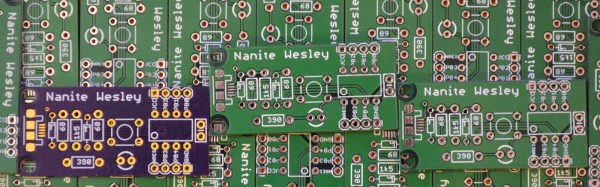
This time around I’ll be going over Design Rule Check (DRC) — or making sure your board house can actually fabricate what you’ve designed. I’ll also be covering the creation of Gerber files (so you can get the PCB fabbed anywhere you want), and putting real art into the silkscreen and soldermask layers of your boards.

The idea behind this series is to explore different EDA suites and PCB design tools by designing the same circuit in each. You can check out the rest of the posts in this series right here.

Continue reading “Creating A PCB In Everything: Eagle DRC And Gerber Files”

Ask Hackaday: How Do You Make A Hotplate?

Greetings fellow nerds. The Internet’s favorite artificial baritone chemist has a problem. His hotplates burn up too fast. He needs your help to fix this problem.

[NurdRage] is famous around these parts for his very in-depth explorations of chemistry including the best ways to etch a PCB, building a thermometer probe with no instructions, and chemical synthesis that shouldn’t be performed by anyone without years of experience in a lab. Over the past few years, he’s had a problem: hotplates suck. The heating element is usually poorly constructed, and right now he has two broken hotplates on his bench. These things aren’t cheap, either: a bare-bones hotplate with a magnetic stirrer runs about $600.

Now, [NurdRage] is asking for help. He’s contacted a few manufacturers in China to get a hundred or so of these hotplate heating elements made. Right now, the cost for a mica and metal foil hotplate is about $30 / piece, with a minimum order quantity of 100. That’s $3,000 that could be better spent on something a bit more interesting than a heating element, and this is where you come in: how do you build the heating element for a hotplate, and do it cheaply?

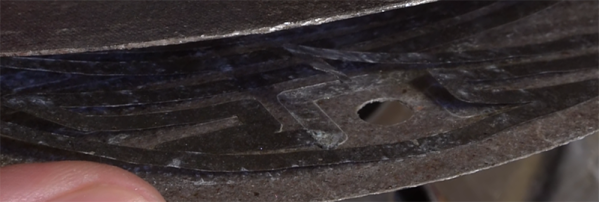
If you buy a hotplate from the usual lab equipment supplier, you’ll get a few pieces of mica and a thin trace of metal foil. Eventually, the metal foil will oxidize, and the entire hotplate will stop working. Repairs can be done with copper tape, but by the time that repair is needed, the heating element is already on its way out.

The requirements for this heating element include a maximum temperature of around 350 ºC. That’s a fair bit hotter than any PCB-based heat bed from a 3D printer gets, so consider that line of reasoning a dead end. This temperature is also above what most resins, thermoplastics, and composites can handle, which is why these hotplates use mica as an insulator.

Right now, [NurdRage] will probably end up spending $3,000 for a group buy of these heating elements. That’s really not that bad – for the price of five hotplates, he’ll have enough heating elements to last through the rest of his YouTube career. There must be a better way, though, so if you have an idea of how to make a high-temperature heating element the DIY way, leave a note in the comments.