Two Portable Oscilloscopes: Shootout

Last time I introduced you to two relatively inexpensive and somewhat portable scopes: the EM125, which is a cross between a digital voltmeter and an oscilloscope, and the Wave Rambler, which is a scope probe with a USB connector attached. Both of the devices cost about $100, and both have their plusses and minuses.

This time, though, I wanted actually to look at some real-world signals. To make that easy, I grabbed yet another scope-like thing I had handy: an Embedded Artists Labtool. This is an interesting board in its own right. It is an LPC-Link programmer attached to an LPC ARM board that has several high-speed A/D channels. However, I’m not using any of that capability for now. The board also has a cheap ARM processor (an LPC812) on it that serves only to generate test signals. The idea is you can use the Labtool in a classroom with no additional equipment.

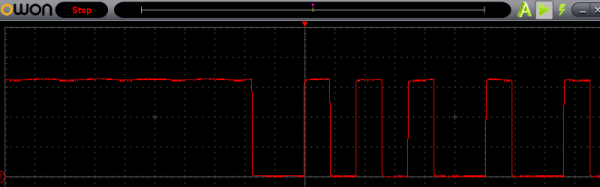
The Labtool’s demo CPU generates a lot of different signals, but with only one channel on the test scopes, it didn’t make sense to look at, for example, I2C data. So I stuck with two different test signals: a varying pulse width modulation signals and a serial UART transmitter.

Continue reading “Two Portable Oscilloscopes: Shootout”

Warbots: Is It Already Too Late?

In 1971, a non-profit formed that holds the World Economic Forum each year. The Forum claims it “Engages the foremost political, business and other leaders of society to shape global, regional and industry agendas.” This year, the Forum hosted a session: What If: Robots Go To War? Participants included a computer science professor, an electrical engineering professor, the chairman of BAE, a senior fellow at the Vienna Center for Disarmament and Non-Proliferation, and a Time magazine editor.

Continue reading “Warbots: Is It Already Too Late?”

3D Printer Tool: Set Your Extruder Steps With Ease

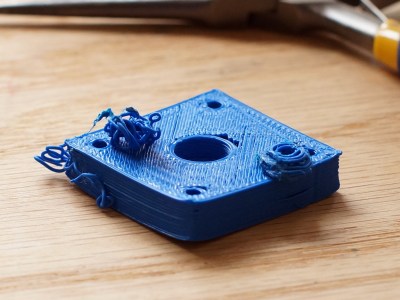
My printer has other issues that i'm still tuning out, but the warping in PLA and excessive surface roughness has all the signs of over extrusion.
My printer has other issues that I’m still tuning out, but the warping in PLA and excessive surface roughness has all the signs of over extrusion.

I have an old Prusa i2 that, like an old car, has been getting some major part replacements lately after many many hours of service. Recently both the extruder and the extruder motor died. The extruder died of brass fill filament sintering to the inside of the nozzle (always flush your extruder of exotic filaments). The motor died at the wires of constant flexing. Regardless, I replaced the motors and found myself with an issue; the new motor and hotend (junk motor from the junk bin, and an E3D v6, which is fantastic) worked way better and was pushing out too much filament.

The hotend, driver gear, extruder mechanics, back pressure, motor, and plastic type all work together to set how much plastic you can push through the nozzle at once. Even the speed at which the plastic is going through the nozzle can change how much friction that plastic experiences. Most of these effects are somewhat negligible. The printer does, however, have a sort of baseline steps per mm of plastic you can set.

The goal is to have a steps per mm that is exactly matched to how much plastic the printer pushes out. If you say 10mm, 10mm of filament should be eaten by the extruder. This setting is the “steps per mm” in the firmware configuration. This number should be close to perfect. Once it is, you can tune it by setting the “extrusion multiplier” setting in most slicers when you switch materials, or have environmental differences to compensate for.

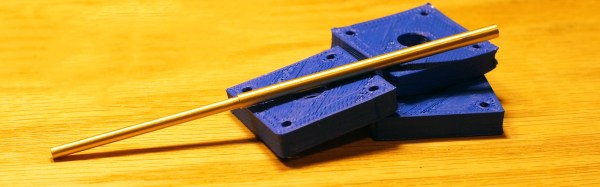
This little guy lets you tune the steps per mm exactly.

The problem comes in measuring the filament that is extruded. Filament comes off a spool and is pulled through an imprecisely held nozzle in an imprecisely made extruder assembly. On top of all that, the filament twists and curves. This makes it difficult to hold against a ruler or caliper and get a trustworthy measurement.

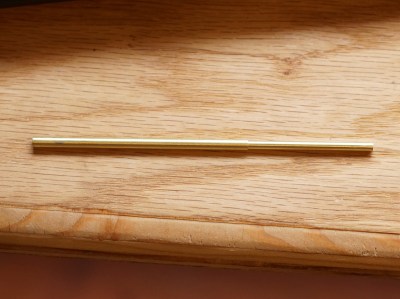
I have come up with a little measuring device you can make with some brass tubing, sandpaper, a saw (or pipe cutter), a pencil torch, solder, and some calipers. To start with, find two pieces of tubing. The first’s ID must fit closely with the filament size you use. The second tube must allow the inside tubing to slide inside of it closely. A close fit is essential.

Continue reading “3D Printer Tool: Set Your Extruder Steps With Ease”

Whiskey Tango Foxtrot Is The Phonetic Alphabet?

Sometimes words just have to be spelled for others. I’ve been on phone conversations where the person on the other end is spelling for me and it’s painful. “Was that a ‘b’ or a ‘p’?” Sometimes they’ll try on the fly to use words with the beginning letter trying to convey the letter: “B as in boy”. Then they’ll get stumped mumbling while they think desperately for ‘k’ words… ‘ketchup’. Okay, but is that really ketchup or catsup? Now think how much easier spelling is on a phone than over a poor quality radio channel. What we say, and how we say it is the key to our brain’s ability to error correct human speech. It’s a solved problem that was built into radio etiquette long ago.

Continue reading “Whiskey Tango Foxtrot Is The Phonetic Alphabet?”

Overunity, Free Energy And Perpetual Motion: The Strange Side Of YouTube

Spend enough time on YouTube, and you’ll eventually find yourself in one of the many dark corners hiding within it. No, I’m not talking about the comments. In this case, I mean the many videos dedicated to free energy, overunity devices, perpetual motion machines, or anything else that violates the laws of thermodynamics by trying to get out more energy than is put in. The human race has been reaching for impossible dreams of perpetual motion and free energy for just about all of recorded history. Now it’s convenient to find them all in one place.

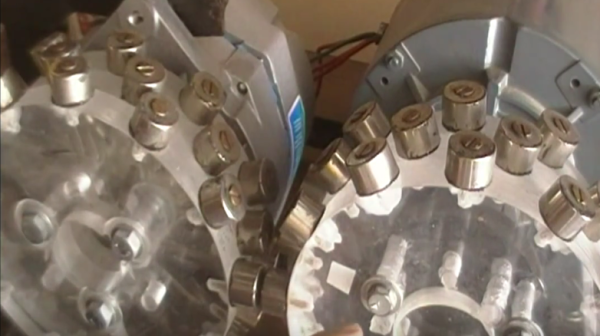
searl_effect_generator-shot0001Browsing the tubes, it’s easy to break free energy videos down into two major groups: enthusiasts and scammers. Catching a scammer is easy – they’re looking for money. Somewhere in the video or description will be a link to a website with more information. Eventually that will lead you to a place where the scammer attempts to part you and your hard-earned money.

Names like John Searl, Muammer Yildiz, and M. T. Keshe go here. Searl especially deserves note because he’s been at it for decades.  Supposedly, his “Searl Effect Generator” SEG has been built several times, but the prototypes generate so much power they create their own anti-gravity field and fly off into space. Obviously this man and his staff need your money to continue their work. Scammers deserve disdain and public shaming. These are the folks who know their “discoveries” are nothing more than snake oil.

On the other side of the coin lie the enthusiasts. These are the backyard tinkerers, the ones who put down their computers, pick up their tools, and try to build something. Sounds a lot like the average Hackaday reader, doesn’t it? I have to admit I went into this article with the same disdain for the enthusiasts that I have for the scammers, possibly even more. In some cases, these are the folks who truly believe they can have a chance to violate the laws of thermodynamics. Inevitably these folks fail to build free energy generators, overunity devices, or whatever their pursuit is, but they all do seem to learn something in the process. A lot can be said about the builds themselves. Some of these are awesome devices. Even if they don’t work for their intended purpose, they are great demonstrations of magnetism or chemistry. This is where I had a change of heart. If someone wants to spend their time working on an impossible hack, then more power to them. I may not think they have any chance of success, but at the very least, they’ll learn how to build.

Continue reading “Overunity, Free Energy And Perpetual Motion: The Strange Side Of YouTube”

Hackaday Links: January 24, 2016

The RepRap wiki was spammed this week. Everything is fine now, but I feel I should call attention to the fact that the RepRap wiki needs some people to contribute, organize, and maintain everything. The wikis for obscure anime shows are better than the RepRap wiki, so if you’re looking to contribute to an important open source project, there ‘ya go.

The 200cc, 5.5HP, 4-stroke OHV Honda GX200 engine is found in a whole lot of tools, and is a fantastic power plant to build a go-kart around. It also costs about $350. There are clones of this engine available direct from China for about $100. Here’s how you add a turbo to one of these clone engines.

Freescale makes some pretty cool sensors and [Juan Ignacio Cerrudo] figured they needed breakout boards. He has some boards for a low-power three-axis accelerometer, an accelerometer and magnetometer, and a pressure sensor.

The Tektronix TDS744A is an older but still extremely capable 500MHz, 2Gsps, 4-channel scope. You can upgrade it to the 1GHz TDS784A by desoldering a few resistors. Very cool if you’re looking for a cheap-ish 1GHz scope.

[TheBackyardScientist] hung out with some cub scouts a few weekends ago and launched a high altitude balloon over Florida. The payload included a game camera, APRS tracker, GoPro, and a few other bits and bobs. The balloon reached 106,000 feet and landed only a few miles from Cape Canaveral.

Big RC planes – UAVs especially – are a pain to launch. Flying wings above a certain size are just dangerous to launch by hand, and landing gear is heavy and for the most part unnecessary. What’s the next best solution? A trebuchet, of course. It mounts on a car and is able to give a UAV a little bit of altitude and some speed. A pretty good idea that could be easily implemented with some load-bearing PVC pipe.

Everybody likes the Game of Life, so here’s one built with a 6502. It’s built around a Western Design Center 65c816 board we’ve seen before, nine MAX7219 LED controllers mapped to the VIA, and nine 8×8 LED matrix displays. Here’s a video of it in action.

About a month ago, a search of AliExpress turned up Apple’s A8 CPU. I bought one. Here’s what I got. It’s a stupidly small pitch BGA, and I don’t have a datasheet. What am I going to do with it? Make a non-functioning board with a few ports, resistors, no traces, and the A8 chip planted square in the middle.

Hacklet 92 – Workbenches And Toolboxes

Everyone needs a place to work. While some of us have well equipped labs with soldering stations, oscilloscopes, and a myriad of other tools, others perform their hacks on the kitchen table. Still, some hackers have to be on the go – taking their tools and work space along with them on the road. This week’s Hacklet is all about the best toolbox and workbench projects on Hackaday.io!
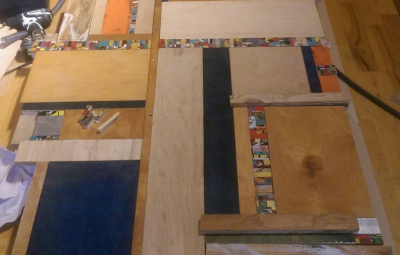
worktableWe start at the top – in this case, a bench top. [KickSucker] created Mondrian Inspired Work Table as a multi-use tabletop for all kinds of projects. Rather than slap down a piece of plywood, [KickSucker] took a more artistic route. Piet Mondrian was a dutch artist known for painting irregular grids of black and white lines. He’d fill a few of the rectangles up with primary colors, but leave most of them white. Between different off-cuts of wood, and colorful bits of skateboard deck [KickSucker] had the makings of an awesome work surface. The frame of the bench is an IKEA expedite shelf unit. The frame is made from MDF, with the offcuts laid on top of it. The fun part was arranging all the pieces to make lines and colors. The result is a great custom work table, and a heck of a lot less wood scraps lying around the shop. That’s a double win in our book!
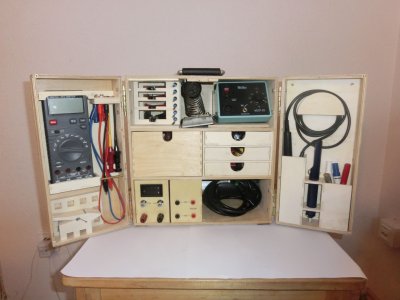
toolboxNext up is [M.Hehr] with Portable Workbench & mini Lab. [M.Hehr] has wanted a portable electronic workstation for years. We’re betting he’s seen a few of them here on the blog. While cleaning up the lab before Christmas, [M.Hehr] found a couple of wooden IKEA boxes. Each box held some drawers. An idea formed in [M.Hehr’s] head. It was time to put the plan in motion! The boxes were attached and hinged. Custom brackets were cut on a Shapeoko 2 router. Everything – even the screws were recycled. [M.Hehr] created a perfect space for each tool, ensuring that things won’t end up in a tangled mess when the box is carried around. We really love the retractable power point and custom-made power supply!
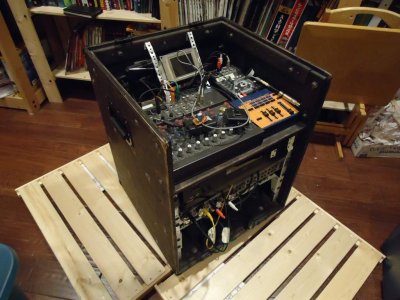
roadcaseNext we’ve got [Tim Trzepacz] with Musician’s Road Box with 9 space rack. [Tim’s] sister [Tina] was playing a lot of music on the road, and needed a way to organize her gear. There are plenty of commercial solutions for this, but [Tim] decided to roll the perfect solution. He designed a plywood box with a 9U rack. [Tina’s] mixer and backing sound sources were located on the top, while effects and other modules were located in the rack. [Tim] spent a good amount of time designing the box. He was able to get the cut list down to a single piece of plywood, with room to spare. This is perfect for a 4′ x 8′ router like the ShopBot. When it comes time to hit the road, the case seals up to a rugged package. Standard roadcase corners and twist-latches finish this awesome piece.
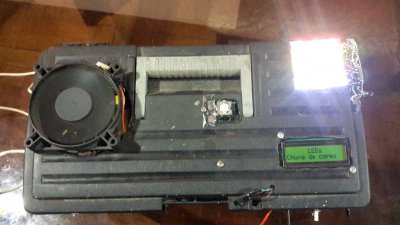
boxtopFinally we have [Géllo] with protoBox. [Géllo] is into induction heating, which requires a Zero Voltage Switching (ZVS) flyback driver. ProtoBox started life as a place for [Géllo] to store his ZVS. It has evolved to become a small portable electronics lab. [Géllo] powers the box with a set of lithium-ion batteries sourced from old laptops. This particular ZVS design is plenty powerful enough to heat metal red hot, or create some nice arcs. [Géllo] added an Arduino Mega, a Bluetooth radio, and a 2×16 character LCD. The system is controlled with relays. A bluetooth enabled smartphone can be used to enable or disable any feature. [Géllo’s] assembly techniques are a bit scary, especially considering the fact that this is a high power design. However, this is a great proof of concept!

If you want to see more workbench and toolbox projects, check out our new workbench and toolbox list! If I missed your project, don’t be shy! Just drop me a message on Hackaday.io. That’s it for this week’s Hacklet. As always, see you next week. Same hack time, same hack channel, bringing you the best of Hackaday.io!