Retrotechtacular: How A Bicycle Is Made

Does your bicycle master boardwalk and quagmire with aplomb? If it was built by the Raleigh Bicycle Company, it ought to. This week’s Retrotechtacular is a 1945-era look into the start-to-finish production of a standard bicycle. At the time of filming, Raleigh had already been producing bicycles for nearly 60 years.

The film centers on a boy and his father discussing the purchase of a bicycle in the drawing office of the plant where a bicycle begins its life. The penny-farthing gets a brief mention so that the modern “safety model”—wherein the rider sits balanced between two wheels of equal size—can be compared. The pair are speaking with the chief designer about the model and the father inquires as to their manufacturing process.

We are given the complete story from frame to forks and from hubs to handlebars. The frame is forged from high-quality steel whose mettle is tested both with heat and with a strain much greater than it will receive in manufacture or use. It is formed from long pieces that are rolled into tubes, flame sealed at the joint, and cut to length. The frame pieces are connected with brackets, which are formed from a single piece of steel. This process is particularly interesting.


Continue reading “Retrotechtacular: How A Bicycle Is Made” →

Developed On Hackaday: The Designs

We know that many of our readers have been impatiently waiting to discover what the Hackaday community-developed offline password keeper project will look like. Today we present you several designs that our mechanical contributors came up with and we will ask you to give your opinion about them. Obviously these are just preliminary cases that may evolve along the way, but we will only produce the electronics for the designs you prefer.

All the designs are embedded after the break, with a multiple-choices poll to express your interest. You may also want to join the Mooltipass Google Group in case you’d want to talk about the designs in more depth or meet their creators. On the firmware side, I just finished soldering many mooltipass prototypes that will be shipped in the coming days to our firmware developers. As you may have noticed, this project is gaining speed!

Continue reading “Developed On Hackaday: The Designs” →

Hackaday Links: January 19, 2014

hackaday-links-chain

[Nick] wrote in to tell us about his first blog post. He’s showing off a PWM LED driver he build around a 555 timer. This project uses a lot of basics; some 555 experience, PCB etching, and surface mount soldering. We’d like to know more about the blue substrate on his circuit board!

After seeing the BOM spreadsheet with KiCAD integration a couple of weeks back, [Vassilis] sent in a link to his own Excel-based Bill of Materials helper. We’re wondering if anyone has a similar tool that will work with Open Office?

While we’re on the topic of downloadable documents, here’s a reference PDF for all types of DC measurements. The collection is a free offering from Keithley. [Thanks Buddy]

Since you’re brushing up on your knowledge you may also be interested in a free online microcontroller course offered by UT Austin. They’re targeting the Tiva C Launchpad as the dev board for the class.

This website seems to be a little creepy, but the teardrop shaped 3D printed music box which is being shown off is actually rather neat.

Hackaday Alum [Phil Burgess] threw together a point and shoot camera for Adafruit. It’s a Raspberry Pi, camera board, touchscreen display, and USB battery all rubber banded together. The processing power of the RPi is used to add image processing effects which are shown off in the demo video.

We don’t own a DeLorean. If we did, we’d probably follow the lead of Queen’s University Belfast and turn it into and electric vehicle. [Thanks Jake]

The 3D photocopiers are coming. Here’s a hacked together proof-of-concept from [Marcelo Ruiz]. After laser scanning the part is milled from floral foam.


Fail Of The Week: Color Meter For Adjusting LEDs

fotw-color-meter

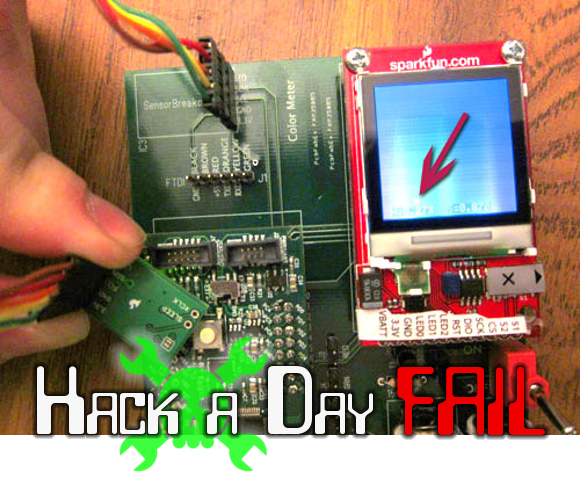
[John Peterson] answered our call to document your hacks by discussing what he learned while building this color meter. He conceived the project as a way to precisely match the color output of LEDs driven with a PWM signal. The thought was that it could sample an LED’s output, then use that data to calculate values necessary to match the color of other LEDs. This is a good idea when using LEDs of different types, but even diodes from the same production line can show variations in color output.

Of course this project wouldn’t be featured as a Fail of the Week if it worked as he had expected. It turns out the sensor that he used, an Avago ADJD-S371-QR999 on a SparkFun breakout board, takes very quick color readings. This is great for solid objects, but not great for a light source being switched on and off like the PWM LEDs.

We like it that [John] posted a list of lesson learned on the project. The real fail is in trying to use this particular sensor, but we figure there must be some way to get meaningful data through sampling. Check out the page for the retired sensor which also includes a link to the datasheet. Can you think of a firmware hack which would allow this hardware to sample so that the PWM value could be extrapolated through averaging or other calculations? Let us know in the comments.


2013-09-05-Hackaday-Fail-tips-tileFail of the Week is a Hackaday column which runs every Wednesday. Help keep the fun rolling by writing about your past failures and sending us a link to the story — or sending in links to fail write ups you find in your Internet travels.

3D Printering: Making A Thing With SketchUp

printering

Imagine for a second it’s the mid-1980s and you’re looking in to desktop publishing setups. Those new LaserJets and LaserWriters are pretty cool, but imagine the desktop publishing world if you couldn’t create your own documents. Yes, it seems absurd to have a printing press that won’t create unique documents.

Now flash forward 30 years to the world of desktop manufacturing and rapid prototyping. There are dozens of repositories for 3D printable objects, but making something of your own design is apparently a dark art and arcane knowledge to everyone buying 3D printers for plastic octopodes and bottle openers.

This week, by popular demand, we’re going to be making a ‘thing’ in SketchUp Make. It’s free, easy, and surprisingly versatile despite its limited tool set. Common sense and Google algorithms dictate I link to previous tutorials in this series below:

And now on with the show. You’re gonna want to click the ‘read more’ link.

Continue reading “3D Printering: Making A Thing With SketchUp” →

Retrotechtacular: The Genesis Of The Transistor

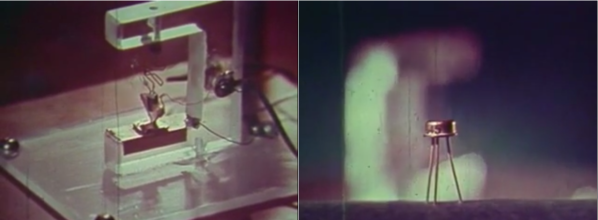
Few births are easy. Even fewer result in a Nobel Prize, and hardly any at all are the work of three men. This 1965 film from the AT&T archives is a retrospection on the birth of the transistor nine years after its creators, [Walter Brattain], [John Bardeen], and [William Shockley] received a Nobel Prize in Physics for their discovery and implementation of the transistor effect.

The transistor is the result of the study of semiconductors such as germanium. Prior to the research that led directly to the transistor, it was known that the conductivity of semiconductors increases when their temperature is raised. The converse is true for metals such as tungsten. Semiconductor conductivity also increases when they are exposed to light. Another key to their discovery is that when a metal such as copper is in contact with a semiconductor, conductivity is less in one direction than the other. This particular property was exploited in early radio technology as seen in crystal radios, for copper oxide rectifiers used in telephony, and for microwave radar in WWII.

After WWII, AT&T’s Bell Labs put a lot of time and research into the study of semiconductors, as their properties weren’t fully understood. Researchers focused on the simplest semiconductors, silicon and germanium, and did so in two areas: bulk properties and surface properties. During this time, [Shockley] proposed the field effect, supposing that the electrons near the surface of a semiconductor could be controlled under the influence of an external electric field.

Continue reading “Retrotechtacular: The Genesis Of The Transistor” →

Hackaday Links: January 12, 2014

hackaday-links-chain

[Kyle] teaches photography and after being dismayed at the shuttering of film and darkroom programs at schools the world over decided to create a resource for film photography. There’s a lot of cool stuff on here like mixing up a batch of Rodinal developer with Tylenol, lye, and sodium sulphite, and assessing flea market film cameras. There are more tutorials coming that will include setting up a dark room, developing prints, and playing around with large format cameras.

[hifatpeople] built a binary calculator out of LEGO® bricks or toys. It started off as a series of logic gates built out of LEGO® bricks or toys in the LEGO® Digital Designer. These logic gates were combined into half adders, the half adders combined into full adders, and the full adders combined into a huge plastic calculator. Unfortunately, buying the LEGO® bricks or toys necessary to turn this digital design into a physical model would cost about $1000 using the LEGO® Pick-A-Brick service. Does anyone have a ton of LEGO® Technic® bricks or toys sitting around? We’d love to see this built.

Think you need a PID controller and fancy electronics to do reflow soldering in a toaster oven? Not so, it seems. [Sivan] is just using a meter with a thermocouple, a kitchen timer, and a little bit of patience to reflow solder very easily.

The folks at DreamSourceLabs realized a lot of electronic test equipment – from oscilloscopes and logic analyzers to protocol and RF analyzers were all included a sampling circuit. They designed the DSLogic that puts a sampler and USB plug on one board, with a whole bunch of different tools connected to a pin header. It’s a pretty cool idea for a modular approach to test equipment.

Adafruit just released an iDevice game. It’s a resistor color code game and much more educational than Candy Crush. With a $0.99 coupon for the Adafruit store, it’s effectively free if you’re buying anything at Adafruit anytime soon. Check out the video and the awesome adorable component “muppets”.