Retrotechtacular: The Secret Life Of The Electric Light

Normally, when we pick out something to carry the “Retrotechtacular” banner, it’s a film from the good old days when technology was young and fresh, and filmmakers were paid by one corporate giant or another to produce a film extolling the benefits of their products or services, often with a not-so-subtle “celebrate the march of progress” undertone.

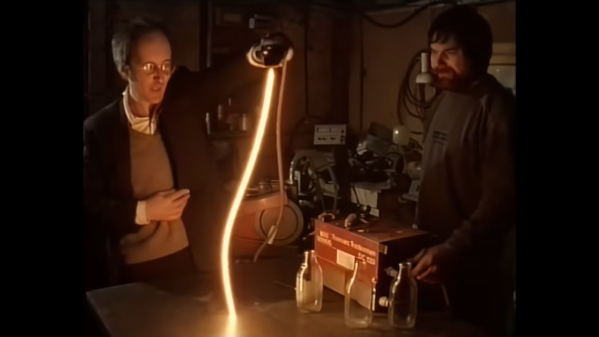
So when we spied this remastered version of The Secret Life of the Electric Light an episode from [Tim Hunkin]’s fabulous educational The Secret Life of Machines TV series, we didn’t really think it would be good Retrotechtacular fodder. But just watching a few minutes reminded us of why the series was must-see TV back in the 1990s (when it first aired widely here in the States), especially for the budding geek. When viewed with eyes more used to CGI animations and high production values, what [Tim] and his collaborator, the late [Rex Garrod], accomplished with each of these programs is truly astounding. Almost every bit of the material, as well as the delivery, has an off-the-cuff quality to it that belies what must have taken an enormous amount of planning and organization to pull off. [Tim] and [Rex] obviously went to a lot of trouble to make it look like they didn’t go to a lot of trouble, and the result is films that home in on the essentials of technology in a way few programs have ever managed, and none since. And the set-piece at the end of each episode — often meeting its pyrotechnic destruction — always were real crowd-pleasers. They still are.

We have to say the remastered versions of The Secret Life episodes, all of which appear to be posted at [Tim]’s YouTube channel, look just great, and the retrospectives at the end of each episode where he talks about the travails of production are priceless. Also posted are his more recent The Secret Life of Components, which is a treasure trove of practical tips for makers and backyard engineers that’s well worth watching too.

Continue reading “Retrotechtacular: The Secret Life Of The Electric Light”

Retrotechtacular: Discovering Aerodynamics With The Chrysler Airflow

When you think about it, for most of human history we’ve been a pretty slow bunch. At any time before about 150 years ago, if you were moving faster than a horse can run, you were probably falling to your death. And so the need to take aerodynamics into consideration is a pretty new thing.

The relative novelty of aerodynamic design struck us pretty hard when we stumbled across this mid-1930s film about getting better performance from cars. It was produced for the Chrysler Sales Corporation and featured the innovative design of the 1934 Chrysler Airflow. The film’s narration makes it clear why the carmaker would go through the trouble of completely rethinking how cars are made; despite doubling average engine horsepower over the preceding decade, cars had added only about 15% to their top speed. And while to our 21st-century eyes, the Chrysler Airflow might look like a bulked-up Volkswagen Beetle, compared to the standard automotive designs of the day, it was a huge aerodynamic leap forward. This makes sense with what else was going on in the technology world at the time — air travel — the innovations of which, such as wind tunnel testing of models, were spilling over into other areas of design. There’s also the influence of [Orville Wright], who was called in to consult on the Airflow design.

While the Airflow wasn’t exactly a huge hit with the motoring public — not that many were built, and very few remain today; [Jay Leno] is one of the few owners, because of course he is — it set standards that would influence automotive designs for the next 80 years. It’s fascinating too that something seemingly as simple as moving the engine forward and streamlining the body a bit took so long to hit upon, and yet yielded so much bang for the buck.

Continue reading “Retrotechtacular: Discovering Aerodynamics With The Chrysler Airflow”

Retrotechtacular: The Drama Of Metal Forming

It may seem overwrought, but The Drama of Metal Forming actually is pretty dramatic.

This film is another classic of mid-century corporate communications that was typically shown in schools, which the sponsor — in this case Shell Oil — seeks to make a point about the inevitable march of progress, and succeeds mainly in showing children and young adults what lay in store for them as they entered a working world that needed strong backs more than anything.

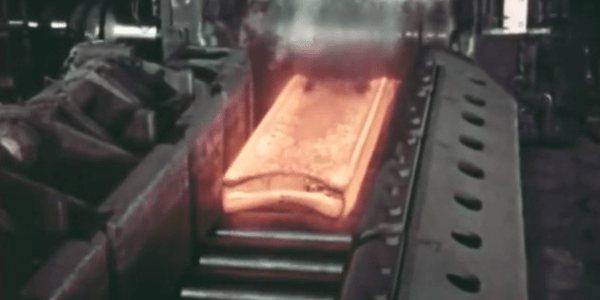
Despite the narrator’s accent, the factories shown appear to be in England, and the work performed therein is a brutal yet beautiful ballet of carefully coordinated moves. The sheer power of the slabbing mills at the start of the film is staggering, especially when we’re told that the ingots the mill is slinging about effortlessly weigh in at 14 tons apiece. Seeing metal from the same ingots shooting through the last section of a roller mill at high speed before being rolled into coils gives one pause, too; the catastrophe that would result if that razor-sharp and red-hot metal somehow escaped the mill doesn’t bear imagining. Similarly, the wire drawing process that’s shown later even sounds dangerous, with the sound increasing in pitch to a malignant whine as the die diameter steps down and the velocity of the wire increases.

There are the usual charming anachronisms, such as the complete lack of safety gear and the wanton disregard for any of a hundred things that could instantly kill you. One thing that impressed us was the lack of hearing protection, which no doubt led to widespread hearing damage. Those were simpler times, though, and the march of progress couldn’t stop for safety gear. Continue reading “Retrotechtacular: The Drama Of Metal Forming”

Retrotechtacular: Double For Nothing

If you are in the market for web hosting in 2021 and you sign up with one of the cloud computing providers, you’ll soon see how the different resources are priced. Storage and bandwidth are cheap, while CPU time is expensive. This reflects the state of a modern computer, in which a typical disk drive now holds a terabyte or more and rising by the year while a new processor is becoming a bottleneck whose performance hasn’t increased as much as the manufacturers would like over models from years ago.

Twice As Much Hardware From A Bit Of Software?

In the early 1990s though it was a different matter. A 486 or early Pentium processor was pretty powerful compared to the DOS or Windows 3.1 software it was expected to run, and it was the memory and disk space attached to it that limited performance… and cost an arm and a leg. There was a period in about 1995 when a supposed fire in a chip factory somewhere sent RAM prices into the hundreds of dollars per megabyte, briefly causing an epidemic of RAM raiding in which criminals would break into offices and take only the SIMs from the computers.

A solution to this problem came perhaps surprisingly from the software industry. Disk Doubler was a DOS driver that promised more disk space, achieving this seemingly impossible feat by compressing the disk to fit more data on it. Processor power swapped for disk space was a reasonable trade at the time so it became extremely popular, and eventually Microsoft incorporated their own disk compression into DOS. In some cases it could even speed up a computer with a slow disk drive, as I found out as a student with a 286 packing an MFM drive.

Something For Nothing, Perhaps It’s Too Good To Be True.

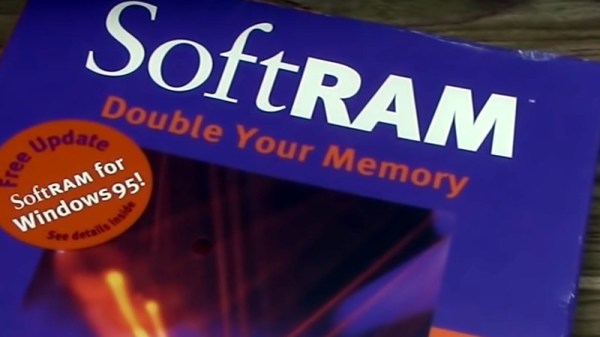
If compression could increase disk space then couldn’t it do the same for RAM? The industry came to the rescue once more with an array of RAM doubler products, first applying the disk doubling technique to on-disk virtual memory, and then doing the same with the contents of the memory itself. The first approach worked at the expense of a system slow-down, while the second, not so much. In fact it was little more than a scam, with software products promising much but delivering absolutely nothing behind the scenes.

Continue reading “Retrotechtacular: Double For Nothing”

Retrotechtacular: Manufacturing Philco Germanium Transistors

There was a time when all major corporations maintained film production departments to crank out public relations pieces, and the electronic industry was no exception. Indeed, in the sea-change years of the mid-20th century, corporate propaganda like this look at Philco transistor manufacturing was more important than ever, as companies tried to pivot from vacuum tubes to solid-state components, and needed to build the consumer electronics markets that would power the next few decades of rapid growth.

The film below was produced in 1957, just a decade since the invention of the transistor and only a few years since Philco invented the surface-barrier transistor, the technology behind the components. It shows them being made in their “completely air-conditioned, modern plant” in Pennsylvania. The semiconductor was germanium, of course — the narrator only refers to “silly-con” transistors once near the end of the film — but the SBT process, with opposing jets of indium sulfate electrolyte being used to both etch the germanium chip and form the collector and emitter of the transistor, is a fascinating process, and these transistors were quite the advance back in the day. It’s interesting, too, to watch the casual nature of the manufacturing process — no clean rooms, no hair nets, and only a lab coat and “vacuum welcome mats” to keep things reasonably clean.

As in most such corporate productions, superlatives abound, so be prepared for quite a bit of hyperbole on the part of the Mid-Atlantic-accented narrator. And we noticed a bit of a whoopsie near the end, when he proudly intoned that Philco transistors would be aboard the “first Earth satellite.” They were used in the radio of Explorer 1, but the Russians had other ideas about who was going to be first.

And speaking of propaganda, don’t forget that at around this time, vacuum tube companies were fighting for their lives too. That’s where something like this designer’s guide to the evils of transistors came from.

Continue reading “Retrotechtacular: Manufacturing Philco Germanium Transistors”

Retrotechtacular: CT2, When Receiving Mobile Phone Calls Wasn’t A Priority

Over the years we’ve brought you many examples in this series showing you technologies that were once mighty. The most entertaining though are the technological dead ends, ideas which once seemed as though they might be the Next Big Thing, but with hindsight are so impractical or downright useless as to elicit amazement that they ever saw the light of day.

Today’s subject is just such a technology, and it was a serious product with the backing of some of the largest technology companies in multiple countries from the late 1980s into the early ’90s. CT2 was one of the first all-digital mobile phone networks available to the public, so why has it disappeared without trace?

Continue reading “Retrotechtacular: CT2, When Receiving Mobile Phone Calls Wasn’t A Priority”

Retrotechtacular: Philips Factory Tour, Circa 1930s

If you’ve got a half-hour or so to spare, you could do worse than this video trip through a Philips factory in the 1930s.

The film is presented without narration, but from the Dutch title cards and the fact that it’s Philips, we gather that this factory of gigantic proportions was somewhere in the Netherlands. In any case, it looks like something right out of [Fritz Lang]’s Metropolis and turned the rawest of materials into finished consumer products.

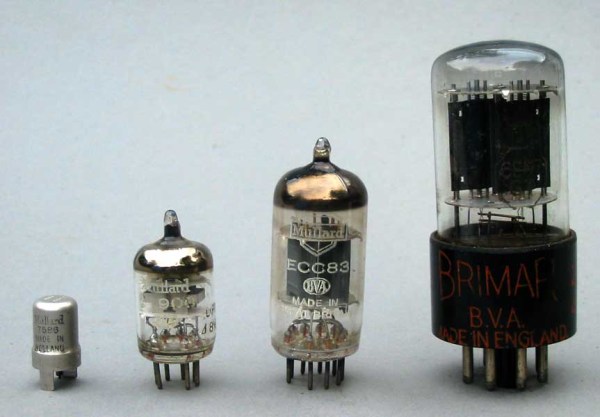
Much of the film focuses on the making of vacuum tubes; the sheer physicality of the job is what really stands out here. The upper body strength that the glassblowers had to have boggles the mind. Check out the chops — and the soon-to-be very unfashionable mustache — on the glassblower at the 12:00 mark. And it wasn’t just the gents who had mad skills — the fine motor control needed for the delicate assembly of the innards of the tubes, which seems to be mostly staffed by women, is just as impressive. We were also surprised by the amount these manual crafts were assisted by automated systems.

Especially interesting is the section where they build the luidspreker. Without narration or captions, it’s a little hard to tell what’s going on, but it appears that they used an enormous press to form chips of Bakelite into sleek covers for the speakers, which themselves are super-chunky affairs made from scratch in the factory. We’re also treated to assembly of the radios, packaging of finished products, and a group of dockworkers who clearly didn’t read the “Fragile” labels pasted on the boxes.

One can’t help but wonder if these people had the slightest inkling of what was about to sweep over them and the rest of the world. And if they did, would they even begin to comprehend how much the very products that they were making would contribute to both the slaughter of the coming war as well as to the sparing of so many lives? Likely not, but the film is still an interesting glimpse into the creation of an industry, one that relied very much on craftsmanship to get it started.

Continue reading “Retrotechtacular: Philips Factory Tour, Circa 1930s”