Retrotechtacular: Philips Factory Tour, Circa 1930s

If you’ve got a half-hour or so to spare, you could do worse than this video trip through a Philips factory in the 1930s.

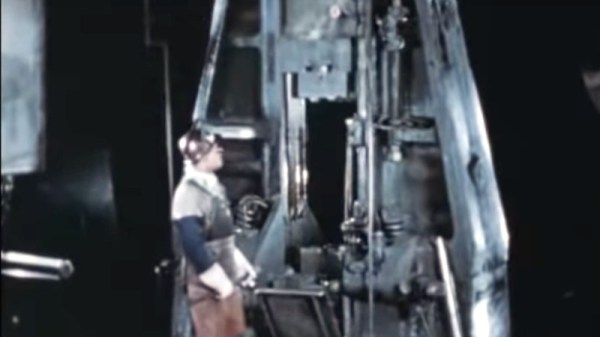
The film is presented without narration, but from the Dutch title cards and the fact that it’s Philips, we gather that this factory of gigantic proportions was somewhere in the Netherlands. In any case, it looks like something right out of [Fritz Lang]’s Metropolis and turned the rawest of materials into finished consumer products.

Much of the film focuses on the making of vacuum tubes; the sheer physicality of the job is what really stands out here. The upper body strength that the glassblowers had to have boggles the mind. Check out the chops — and the soon-to-be very unfashionable mustache — on the glassblower at the 12:00 mark. And it wasn’t just the gents who had mad skills — the fine motor control needed for the delicate assembly of the innards of the tubes, which seems to be mostly staffed by women, is just as impressive. We were also surprised by the amount these manual crafts were assisted by automated systems.

Especially interesting is the section where they build the luidspreker. Without narration or captions, it’s a little hard to tell what’s going on, but it appears that they used an enormous press to form chips of Bakelite into sleek covers for the speakers, which themselves are super-chunky affairs made from scratch in the factory. We’re also treated to assembly of the radios, packaging of finished products, and a group of dockworkers who clearly didn’t read the “Fragile” labels pasted on the boxes.

One can’t help but wonder if these people had the slightest inkling of what was about to sweep over them and the rest of the world. And if they did, would they even begin to comprehend how much the very products that they were making would contribute to both the slaughter of the coming war as well as to the sparing of so many lives? Likely not, but the film is still an interesting glimpse into the creation of an industry, one that relied very much on craftsmanship to get it started.

Continue reading “Retrotechtacular: Philips Factory Tour, Circa 1930s”
Retrotechtacular: Design For Assembly, 1980s-Style

To get its engineers thinking about design for assembly back in the 1980s, Westinghouse made a video about a product optimized for assembly: the IBM Proprinter. The technology may be dated, but the film presents a great look at how companies designed not only for manufacturing, but also for ease of assembly.

It’s not clear whether Westinghouse and IBM collaborated on the project, but given the inside knowledge of the dot-matrix printer’s assembly, it seems like they did. The first few minutes are occupied by an unidentified Westinghouse executive talking about design for assembly in general terms, and how it impacts the bottom line. Skip ahead to 3:41 if talking suits aren’t your thing.

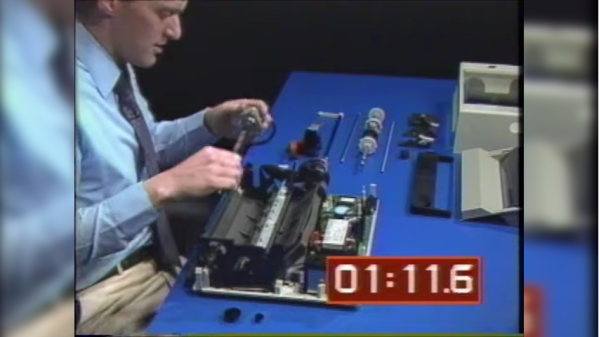
Once the engineer gets going on the printer, though, things get really interesting. The printer’s guts are laid out before him, ready to be assembled. What’s notably absent from the table are tools — the Proprinter was so well designed that the only tool needed is a pair of human hands. And they don’t have to be particularly dexterous hands, either — the design favors motions that are straight down, letting gravity assist the assembly process and preventing assemblers from the need to contort their bodies. Almost everything is held in place by compliant mechanisms built into the plastic parts. There are a few gems in the film, like the plastic lead screw that drives the printhead, obviating the need to string a fussy timing belt, or the unique roller that twists to lock onto a long shaft, rather than having to be pushed to its center.

We found this film which we’ve placed below the break to be very instructive, and the fact that a device as complex as a printer can be assembled in just a few minutes without picking up a single tool is pretty illustrative of the power of designing for assembly. Slick designs that can’t be manufactured at scale are all too common in this age of powerful design tools and desktop manufacturing, so these lessons from the past might be worth relearning.

Continue reading “Retrotechtacular: Design For Assembly, 1980s-Style”

Retrotechtacular: Shake Hands With Danger

OK, you’re going to have to engage your safety squints and sit back to enjoy this one: a classic bit of safety propaganda from US heavy-equipment manufacturer Caterpillar from 1980 entitled “Shake Hands with Danger.”

Actually, you’ll probably need to engage your schlock filters for this 23-minute film too, as both the writing and the theme song are pretty hard to take. The film is one of those “Scared Straight” attempts to show just how horrifically wrong things can go both in the field and in the shop when working on anything made of stuff stronger than human flesh and bone. And in that regard, the film is highly effective — we found ourselves getting a bit queasy at a few points, with the poor dude who got his hand sucked into a bench grinder being both terrifying and relatable. [Three-Finger Joe] indeed.

Now, you might take exception with the acting, but as you watch all these vignettes, keep in mind that these are all old-school stunts — that’s actually a gigantic D9 bulldozer they crashed, and that brake chamber explosion really blew out that truck’s windows. They did a great job making the potential consequences of a moment’s thoughtlessness sickeningly vivid. Especially that arm-in-the-linkages scene. Ugh.

Whatever way you practice the hacking arts, stay safe out there. And don’t “Shake Hands with Danger.”

Continue reading “Retrotechtacular: Shake Hands With Danger”

Retrotechtacular: The $5,000 40 Pound HP Classroom Computer

See if you can talk your local school district into buying a computer that costs about $5,000 and weighs 40 pounds. That was HP’s proposition to schools back in 1968 so really it is more like $35,000 today. The calculator had a CRT display for the RPN stack that you could mirror on a big screen. You could also get a printer or plotter add-on. Pretty hot stuff for the ’60s.

The 1970 videos promoting the HP 9100, posted by the [Computer History Archive Project], shows something we’d think of as a clunky calculator, although by the standards of the day it was a pretty good one with trig functions and a crude programming capability.

Continue reading “Retrotechtacular: The $5,000 40 Pound HP Classroom Computer”

Retrotechtacular: Forging In Closed Dies

It is the norm for our Retrotechtacular series to concentrate on a technology that has passed out of use but is still of interest to Hackaday readers, so it is perhaps unusual now to feature one that is very much still with us. Drop forging is a technique for forming hot metal in dies under huge force, and while it is still a current technique the 1950s educational film we are featuring is definitely retro.

An automotive connecting rod, sectioned and acid treated to show the grain structure. (CC BY-SA 2.5)

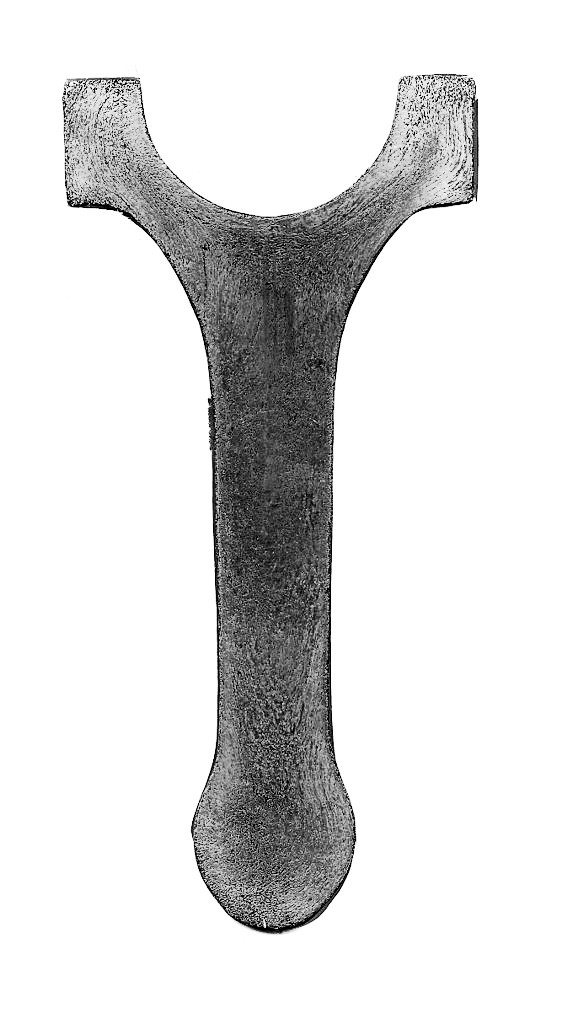
If you have followed our occasional series on blacksmithing, you’ll be familiar with the process of forming metal by heating it to a temperature at which it becomes malleable enough to deform under pressure, and using a hammer to shape it against an anvil. This process not only shapes the metal, but also forms its inner grain crystal structure such that with careful management the forging process can impart significant resistance to fatigue in the finished item. Think of drop forging as automation of the manual blacksmithing process, with the same metallurgical benefits but in which the finished product is shaped in a series of dies rather than by the blacksmith’s hammer. It loses the craft of the smith over the process, but delivers an extremely consistent result along with a high production turnover.

The film that we’ve placed below the break is an in-depth introduction to the industry in a very period style and with components for the automotive, aerospace, and defense industries of the day. It takes the viewer through the different types of press and examines the design of dies to produce in stages the required grain structure and shapes.

Of particular interest is the section on upset forging, a technique in which a piece of steel stock is forged end-on rather from above. The components themselves make the video worth watching, as we see everything from jet turbine blades to medical forceps in production, along with many parts from internal combustion engines. The smallest piece shown is a tiny carburetor part, while the largest is a huge aircraft carrier catapult part that requires a special vehicle to load it into the press.

Drop forging is generally the preserve of a large metalworking factory due to the size of the presses involved. But it’s not entirely beyond the capabilities of our community given the resources of a well-equipped hackerspace or blacksmith’s shop. My father made simple forging dies by assembling a basic shape in weld and pieces of steel stock before grinding it to his requirements and heat treating. Mounted in a large rotary fly press for repetitive small scale shaping and forming tasks in ornamental ironwork, I remember bumping them out from red hot steel bar in my early teens.

This is one of those techniques that’s useful to know about in our community, because while the need to manufacture significant quantities of ornamental ironwork may not come your way too often, it’s still worth having the capability should you need it. Meanwhile the video below the break should serve to provide you with enough heavy machinery enjoyment to brighten your day.

Continue reading “Retrotechtacular: Forging In Closed Dies”

Retrotechtacular: The Nernst Lamp

After dominating the illumination market for more than a century, it’s easy to think of the glowing filament of the standard incandescent lamp as the only way people found to turn electricity into light. But plenty of fertile minds turned out alternative designs, one of which is the fascinating Nernst lamp, which we’d previously never heard of.

If the name sounds familiar, it’s likely through exposure to [Walther Nernst]’s equation for electrochemistry, or for his “New Heat Theorem” which eventually became the Third Law of Thermodynamics. Pal of [Einstein] and eventual Nobel laureate, [Nernst] was also a bit of a tinkerer, and he came up with a design for an incandescent lamp in 1897 that was twice as efficient as carbon-filament lamps. The video below, from the Edison Tech Center, details the design, which used a ceramic “glower rod” that would incandesce when current flowed through it. The glower, though, was not conductive until it was quite hot, so separate heater coils that gave the glower a start on the process were included; these were switched off by a relay built into the base of the lamp once the glower started conducting.

It’s a complicated design, but its efficiency, coupled with a better light spectrum and the fact that it didn’t need a vacuum bulb since the glower wouldn’t oxidize like a carbon or tungsten filament, gave it certain advantages that let it stake out a decent share of the early market for electric illumination. It was even the light source for one of the first facsimile machines. We find it a very clever use of what were at the time exotic materials, and wonder if this could have lead to something like vacuum tubes without the vacuum.

Continue reading “Retrotechtacular: The Nernst Lamp”

Retrotechtacular: Wire Splicing The Army Way

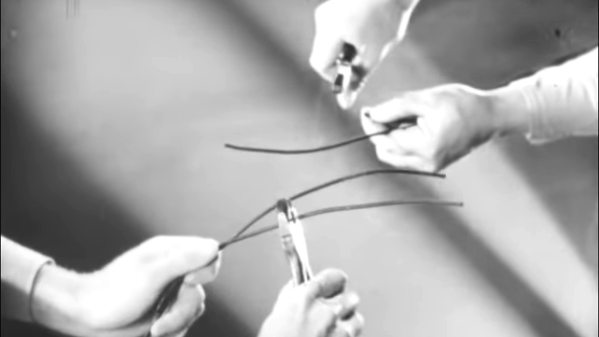
For those of us who started experimenting with electricity when we were very young, one of the essential first skills was learning how to twist wires together. It seems like there’s not much to learn, but after a few failed attempts with nothing but your fingers, you learned a few tricks that are probably still with you to this day. It’s not surprising, then, that there’s an official US Army way to twist wires together, as this Signal Corps training film from 1941 shows.

Considering that the Signal Corps had nearly 80 years of experience with wiring battlefield communications at the outbreak of World War II, their methods were pretty solid, as were their materials. The film mainly concerns the splicing together of rolls of type W110-B field wire, used by the Signal Corps to connect command posts to forward positions, observation posts, and the rear echelons. More often than not laid directly upon the ground, the wire had to be tough, waterproof, and conductive enough that field telephone gear would still work over long loop lengths. As such, the steel-reinforced, rubber-and-fabric clad cable was not the easiest stuff to splice. Where we might cringe at the stresses introduced by literally tying a conductor in knots, it was all part of the job for the wire-laying teams that did the job as quickly as possible, often while taking enemy fire.

The film also has a section on splicing a new line into an existing, in-service circuit, using a T-splice and paying careful attention to the topology of the knots used, lest they come undone under stress. It’s fascinating how much thought was put into something as mundane as twisting wires, but given the stakes, we can appreciate the attention to detail.

Continue reading “Retrotechtacular: Wire Splicing The Army Way”