Ergonomic. Wireless. Low-latency. Minimalist. Efficient. How far do you go when you design your own open-source keyboard? Checking off these boxes and providing the means for others to do so, Redditor [reverse_bias] presents the Mitosis keyboard, and this thing is cool.
The custom, split– as the namesake implies — mechanical keyboard has 23 keys on each 10 cm x 10 cm half, and, naturally, a custom keymapping for optimal personal use.
Upper and lower PCBs host the keys and electronic circuits respectively, contributing to the sleek finished look. Key caps and mechanical switches were ripped from sacrificial boards: two Waveshare core51822 Bluetooth modules are used for communication, with a third module paired with a Pro Micro make up the receiver. Continue reading “Mitosis: Anatomy Of A Custom Keyboard”→
A few months ago we reported on a case coming before the United States Supreme Court that concerned recycled printer cartridges. Battling it out were Impression Products, a printer cartridge recycling company, and Lexmark, the printer manufacturer. At issue was a shrinkwrap licence on inkjet cartridges — a legal agreement deemed to have been activated by the customer opening the cartridge packaging — that tied a discounted price to a restriction on the cartridge’s reuse.
It was of concern to us because of the consequences it could have had for the rest of the hardware world, setting a potential precedent such that any piece of hardware could have conditions still attached to it when it has passed through more than one owner, without the original purchaser being aware of agreeing to any legal agreement. This would inevitably have a significant effect on the work of most Hackaday readers, and probably prohibit many of the projects we feature.
We are therefore very pleased to see that a few days ago the Supremes made their decision, and as the EFF reports, it went in favor of Impression Products, and us, the consumer. In their words, when a patent owner:
…chooses to sell an item, that product is no longer within the limits of the monopoly and instead becomes the private individual property of the purchaser, with the rights and benefits that come along with ownership.
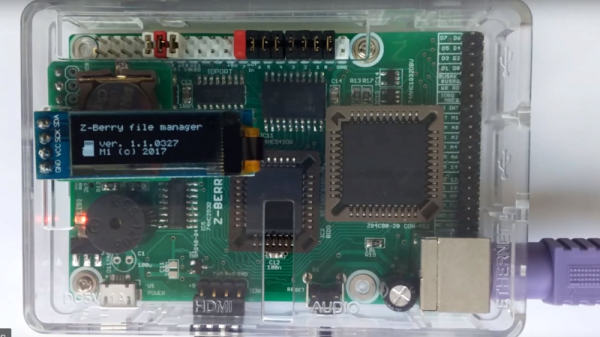
Homebrew computers are the ‘in thing’ these days and the Zilog Z80 is the most popular choice for making one on your own. We have seen some pretty awesome builds but [Martin K]’s Z-berry is the smallest on record yet. As the name suggests, the retrocomputer conforms to the Raspberry Pi form factor which includes the GPIO header.
The Z-berry is designed with a Z80 CPU running at 10 MHz (20 MHz possible) and comes with 32 kB ROM
and 512 kB RAM. In addition to the serial interface, the computer boasts an I2C bus, an SPI bus, and a PS/2 keyboard connector to boot. [Martin K] has a video where the finished system is enclosed in a Raspberry Pi case and has an I2C OLED display attached and working.
[Martin K] has posted a lot of details on how to make your own Z-berry which includes the BOM, schematic and preliminary information. We reached out to him to find out more about the software which is stable and available on request along with PCBs and sample code. Additionally, this project promises to draw much less current than the Raspberry Pi and should prove useful for anyone looking to create a retro solution to a modern problem.
We are used to stories about reverse engineering integrated circuits, in these pages. Some fascinating exposés of classic chips have been produced by people such as the ever-hard-working [Ken Shirriff].
You might think that this practice would be something new, confined only to those interested in the workings of now-obsolete silicon. But the secrets of these chips were closely guarded commercial intelligence back in the day, and there was a small industry of experts whose living came from unlocking them.
Electron micrograph of a wire bond to the Z80 CTC die
Integrated Circuit Engineering Corporation were a Scottsdale, Arizona based company who specialised in semiconductor industry data. They have long since been swallowed up in a series of corporate takeovers, but we have a fascinating window into their activities because their archive is preserved by the Smithsonian Institution. They reverse engineered integrated circuits to produce reports containing detailed information about their mechanical properties as well as their operation, and just such a report is our subject today. Their 1979 examination of the Zilog Z80 CTC (PDF) starts with an examination of the package, in this case the more expensive ceramic variant, then looks in detail at the internal construction of the die itself, and its bonding wires. We are then taken in its typewritten pages through an extensive analysis of the circuitry on the die, with gate-level circuits to explain the operation of each part.
The detail contained in this report is extraordinary, it is clear that a huge amount of work went into its production and it would have been of huge value to certain of Zilog’s customers and competitors. At the time this would have been extremely commercially sensitive information, even if it now seems like a historical curiosity.
The Z80 CTC is a 4-channel counter/timer peripheral chip for the wildly succesful Z80 8-bit microprocessor, in a 28-pin dual-in-line package. We were surprised to find from a quick search that you can still buy this chip from some of the usual suppliers rather than the surplus houses, so it may even still be in production.
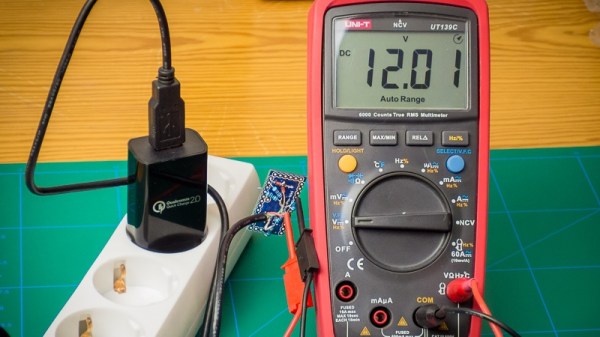
USB chargers are everywhere and it is the responsibility of every hacker to use this commonly available device to its peak potential. [Septillion] and [Hugatry] have come up with a hack to manipulate a USB charger into becoming a variable voltage source. Their project QC2Control works with chargers that employ Quick Charge 2.0 technology which includes wall warts as well as power banks.
Qualcomm’s Quick Charge is designed to deliver up to 24 watts over a micro USB connector so as to reduce the charging time of compatible devices. It requires both the charger as well as the end device to have compatible power management chips so that they may negotiate voltage limiting cycles.
In their project, [Septillion] and [Hugatry] use a 3.3 V Arduino Pro Mini to talk to the charger in question through a small circuit consisting of a few resistors and diodes. The QC2.0 device outputs voltages of 5 V, 9 V and 12 V when it sees predefined voltage levels transmitted over the D+ and D- lines, set by Arduino and voltage dividers. The code provides function calls to simplify the control of the power supply. The video below shows the hack in action.
Quick Charge has been around for a while and you can dig into the details of the inner workings as well as the design of a compatible power supply from reference designs for the TPS61088 (PDF). The patent (PDF) for the Quick Charge technology has a lot more detail for the curious.
Similar techniques have been used in the past and will prove useful for someone looking for a configurable power supply on the move. This is one for the MacGyver fans.
Counterfeit parts are becoming increasingly hard to tell the difference from the real deal, the technology used by the counterfeiters has come on leaps and bounds, so even the experts struggle to tell the real product from a good fake. Mere fake branding isn’t the biggest problem with a counterfeit though, as ieee.com reports, counterfeit parts could contain malware or be downright dangerous.
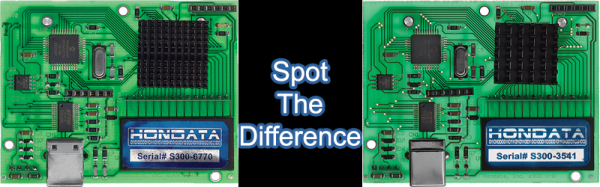
Way back in 2014 the FBI charged [Marc Heera] with selling clones of the Hondata S300, a plugin engine module for Honda cars that reads sensors, and depending on their values can change idle speed, air-fuel mixture and a plethora of other car/engine related settings. What, might you ask, is the problem, except they are obviously not genuine parts? According to Honda they had a number of issues such as random limits on engine rpm and occasionally failure to start. While the fake Hondata S300 parts where just poor clones that looked the part, anything connected to an engine control unit brings up huge safety concerns and researchers have shown that through ECU access, they could hijack a car’s steering and brakes.
It’s not just car parts being cloned, remember the fake USB-to-serial chips of FTDI-Gate? Entire routers are also being cloned, which doesn’t sound too bad until you realise that the cloners could configure your internet traffic to be redirected through their network for snooping. In 2010 Saudi citizen [Ehab Ashoor] was convicted of buying cloned Cisco Systems gigabit interface converters with the intention of selling them to the U.S Dept of Defense. While nothing sinister was afoot in [Ashoor]’s case other than greed, these routers were to be deployed in Iraq for use by the Marine Corps networks. They were then to be used for security, transmitting troop movements and relaying intelligence from field operations back to HQ.
So who are the cloners and why are they doing it? It is speculated that some of them may be state funded, as there are a lot of countries who do not trust American silicon. Circuits are reverse engineered and find their way to the international market. Then just like the FTDI-Gate case, cloners want to make profits from others intellectual property. This also brings up another question, if there is a mistrust of American silicon, nearly everything is made in China these days so why should we trust anything from there? Even analog circuits can be made to spy on you, as you can see from the piece we recently featured on compromising a processor using an analog charge pump. If you want to defend yourself from such attacks, perhaps look at previous Hackaday Prize finalist, ChipWhisperer.
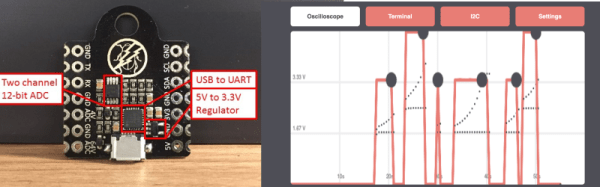
One of the best feature of the ESP8266 is its ability to self-host a web server, allowing for fairly complicated user interactions. The dEEbugger by [S-March] is a nifty little ESP8266 based device with a plethora of features in a small package.
The USB-powered device has a web user interface that enables it to be used as a low-bandwidth oscilloscope, I2C terminal, or UART terminal. As a scope, you may connect to it via your tablet and then use it as a remote voltage monitor. There is a peak detection feature which is a nice touch and gives the entire project a premium feel.
The serial terminal on an ESP8266 is not something new yet it is helpful in disconnecting the console window from the bench. The I2C terminal is where the device really shines as it can scan for connected devices on the connected bus. This Bus-Pirate like feature is useful for beginners as the software can scan the registers addresses of the devices as well.
[S-March] has made the schematic in PDF format as well as the entire code for the project available on GitHub so go right ahead and make it your own. We have had an ESP8266 based VT Terminal device in the past and merging the two would make for an excellent maker tool.