Simple Bench Power

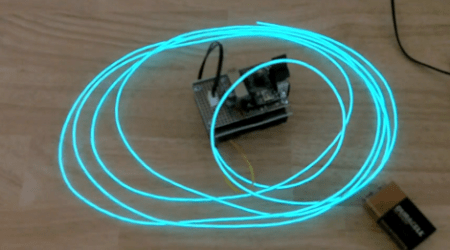
When dealing with electronics you need 1 key thing, electricity. For quite a while now if I needed 5 volts I would just grab my homebrew arduino, but that is not always handy and its tethered to the pc and it does not have 3v. If I wanted 3 volts, now I am digging around looking for my UBW32 which does have 3v3 but now I have a 50$ microncontroller with very small regulators (so therefore only small loads) dangling around just for power, and its a mess.

So I need just a board that takes some DC from a wall wart and regulates it to usable voltages, and I set about to make it. This regulator board puts out +5, +3.3, variable and negative variable voltages, is pretty easy to make, and make a nice addition to the bench. (until I can get a real bench supply someday)

Now I know this is not ground breaking hackery, but I hope it helps someone out there, join us after the break to see what’s going on.

Continue reading “Simple Bench Power”

Xerox Phaser Drum Unit Hacked, Lives To Print Another Day

Faced with a printer that would stop printing for no apparent reason, Finnish pirate and hacker [Janne] decided he had had enough. After doing a bit of research, he disassembled the drum assembly and replaced some components. The end result? Supposedly ‘broken’ printers started working again.

Continue reading “Xerox Phaser Drum Unit Hacked, Lives To Print Another Day”

Open Hacker Conference Badge Project Needs Your Help!

[Aestetix] writes in to tell us that the OpenAMD (Attendee Meta-Data) project is working on a new revision of their hardware, to be debuted at CCC Camp this fall.

For the uninitiated, OpenAMD combines an Active RFID tracking system with social networking, and is completely open-source. You walk into the conference, put on the OpenAMD badge, and suddenly you can see yourself as a dot moving around on a map. Or you can log into the social networking site, create a profile, and watch as your personal information is pulled into the mesh, which then tells you talks you might like, people you might like, where those people are, and more. There’s even an open API where you can create your own ‘killer’ apps, which may include games or other interesting aggregates of the attendee information.

Continue reading “Open Hacker Conference Badge Project Needs Your Help!”

New, Inexpensive DSO Now Shipping

Seeed Studio’s line of hacker-friendly tools has expanded by one, they’ve announced that beta units of their DSO Quad oscilloscope are now available for shipping. The DSO Quad is about the size of a thick iPod yet packs impressive features such as two 72MSPS analog channels and a signal generator. By far the coolest ‘feature’ of the DSO Quad is that it’s completely open source.

DSO Quad is a pocket size four-channel digital oscilloscope designed “for common electronic engineering tasks.” It’s based on an ARM Cortex M3 that provides 72MSPS analog bandwidth on two channels with an integrated FPGA and a high speed ADC. In addition to the four data acquisition channels (two analog, two digital), the DSO Quad has a signal generator.  This lets you put out square, triangle, saw, and sine waves from 10Hz to 1MHz. An internal 2MB USB stick can be used to store sampled data, upgrade the firmware, or run custom programs. Since the device is still in beta, some of the software specifications aren’t firm, but if you’re looking for a relatively inexpensive ‘scope, this could be the one for you. Just bear in mind that for this pre-production run you’re not getting any documentation, so be prepared to be off the reservation and on your own.

Homebrew Z80 Computer Inspires Awe

How this one missed us, we’ll never know.

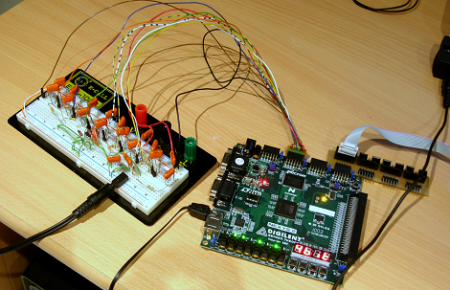
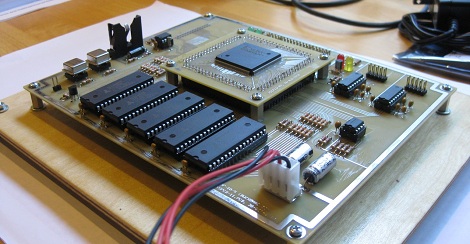
[GG] built himself a retro-styled Z80 nanocomputer over two years using all 1980’s tech. Laid out on one of the largest pieces of perfboard we’ve ever seen on a project, the computer uses a vintage Z80 CPU running at 2.5MHz, 8K ROM, 16K RAM, RS-232 and Parallel ports, an EPROM burner, and an AM95 math coprocessor for 32-bit floating point arithmetic.

We’ve seen a few homebrew computers before, including a Z80 laptop, but this blows them away. For his computer, [GG] created 8BASIC, A Basic interpreter that makes best use of the six 7-segment displays and eight 16-segment displays. The display isn’t really a limitation because [GG] also put together something in Visual Basic so his PC can communicate with his nanocomputer.

[GG] even went so far as to include error detection on the ROM and RAM, as well as an on-board power supply. If you can’t admire the dedication that went into this, at least admire the great wire porn. We’re just sad [GG] never did a proper write-up of his project. He could certainly teach us all something.

Video of [GG]’s work after the jump.

Continue reading “Homebrew Z80 Computer Inspires Awe”

Manage Your Rechargeables At A Glance

If you enjoy photography, radio controlled vehicles, or any other activity that requires you to keep multiple sets of rechargeable batteries on hand you know how much of a pain it can be if you get a dead battery mixed in with your charged batteries. This easy approach to managing your batteries while on location does not require fancy electronics, meters or anything else that might pop into mind, but rather simple stickers and storage.

The first set of labels get stuck on the battery, offering a green and red color code along with a number so its easy to keep track of which group of batteries go where and to catalog date / life. The second set of labels gets attached to your storage compartment, when a battery is charged, place it in the box so the positive end is facing the green on the storage label, and when its dead just flip it around.

While this mainly focuses on AA batteries (and even shows you how to make a simple but effective holder out of some elastic band and staples) this idea can be used with just about any type of battery for a quick glance to see where you stand on juice.

Autonomous Paintball Sentry Gun

What is the best thing about making a computer program that targets and kills anything that enters its sight? Why giving it a weapon, of course! No, we are not talking for real, but the next best thing, an Autonomous Paintball Sentry Gun.

The autonomous part of the device comes from a pc on the sideline and is fed input though a standard webcam. The feed is ran though a processing script where, once accustomed to the background has the option to fire at anything it sees moving, or a nice point n click manual mode.

The Arduino part is in a the role of driving the servo motors for X/Y movement and a trigger and is powered by a fist full of D cell batteries to give plenty of time for fun. Also, be sure to check out our other sentry guns, one using Microchip PIC, and another sporting a super compact computer running Ubuntu