Tweet-a-Watt Now Speaks To Google Power Meter

Hackaday’s own [Devlin Thyne] has been working with Adafruit to come up with a way to use the Tweet-a-Watt along with Google Power Meter. Back in March we put out the word that Google had unveiled the API for Power Meter and [Devlin] is the first we’ve heard of to come up with a way to use your own equipment with the service. You can build your own or use Adafruit’s kit and the data pulled from your energy use will be nicely displayed using the big G’s tools. Right now there’s only support for one Tweet-a-Watt but we’d image this will evolve fairly quickly into a much larger house solution. Head over to the Tweet-a-Watt code page to get the source files for this project.

[Thanks PT]

Lunkenheimer Steam Whistle, Doorbell

We’re going to straight out agree with [Pete] on how surprisingly quiet doorbells are now a days, and if we had it our way we would put his Lunkenheimer train whistle doorbell in every home*. The setup he uses is surprisingly simple, opting for a pre-built wireless doorbell that signals a microcontroller which in turn drives a relay and solenoid. While he does include a video, we felt it didn’t quite show the intensity of these whistles.

*HaD is not responsible for hearing loss and subsequent melted brains.

Cat Door Unlocks Via Facial Recognition

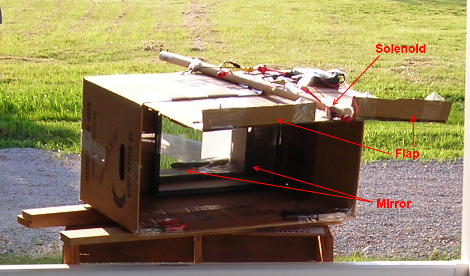
Faced with critters trying to get in and a cat that loved to show them her latest kill, the folks at Quantum Picture came up with a system that unlocks the cat door based on image recognition. As you can see above, it uses a camera to capture the profile of anything approaching the cat door. That image is compared to stored positive identification sets, making up a feline positive identification protocol. Don’t think this is necessary? In the writeup there’s a couple of images showing the outline of a skunk. Sounds like this system is a necessity.

We wonder if this lucky cat also has an Internet enabled cat feeder?

[Thanks Stephen]

TOBY: Reel Mower Bot evolved

[Grayson Sigler] rolled out a new version of his robotic mower which he calls TOBY. The previous design added motors to a reel mower but he had trouble with traction. The new design is more of a utility robot platform that is used to tow the reel motor behind it. With better wheels, a much more stable base, and plenty of power this is a significant improvement.

His parts order came since we last checked in and he now has RC fully implemented. Check out the video after the break.

Continue reading “TOBY: Reel Mower Bot evolved”

Automated Chicken Coop Door

[youtube=http://www.youtube.com/watch?v=qUKIlZIZDqc]

Here’s a pretty cool implementation of an automated door, built for a chicken coop. The electronics are fairly standard, an Arduino and a used cordless drill. The end product will be not only wireless, but automated based off of ambient light as well.  We also found the locking mechanism quite elegant. He also supplied a link to another automated chicken coop door which has a decent writeup with schematics and such. Next, he’ll have to automate their feeding as well.

[Thanks Jeri]

Remote Control Reel Mower

Challenged by hot days and steep turf [Grayson Sigler] modified his reel mower to use electric motors. The end product will be radio controlled but he lacked the necessary parts to make it wireless right now. Not to be deterred, he used a wired controller for prototyping and testing that should be easily replaced once the parts arrive. Sadly, the grade of his yard causes the small wheels to slip so he tried inserting screws into the tread for added traction. The small mower lacks the weight and footprint that the Lawnbot400 enjoys. That being said, solar charging is one of the future goals so this build, which he named RoMOW, wins out on the green scale. We’ve included the prototype video after the break that shows the blades spinning away.

Continue reading “Remote Control Reel Mower”

Motion Sensing Light Module

[Muris] is pumping out the home lighting hacks. He developed this motion sensing module as an add-on to the IR switch we saw last week. There’s some kind of fuse box above his entry door and its white cover, which you see above, is where he mounted an IR distance sensor to detect movement and switch on the lights. The RC5 infrared protocol is used to transmit the necessary signal to turn the lights on, then when a set amount of time has passed it will turn them back off again.