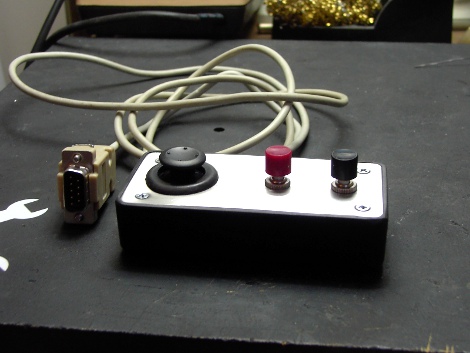
Analog Joypad For Your Retro PC

Part of the fun with old computers is playing some old school games, and while you could play them with a keyboard it is much more fun with a joystick. You can get old joysticks all day long on auction sites, but you have to watch out. Some are digital, which wont work for many games on many systems. Some were cheap to begin with and probably worn out, and many are flight sticks … ever play pac-man with a giant flight stick?

What I really wanted was a game pad like device for my 1986 Apple //c , using one of the modern thumbstick analog controllers. Using a thumbstick out of an old XBOX(1) controller, some generic parts from Radio Shack, and a little bit of effort , I ended up with exactly what I wanted.

Join us after the break and I will show you how to get there!
Continue reading “Analog Joypad For Your Retro PC”

Tutorial: Build A Manifold Clock For $10

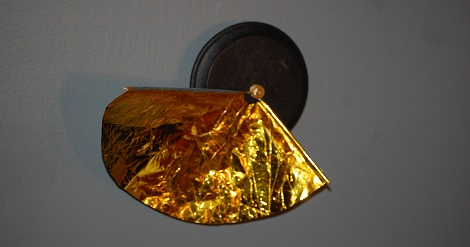
Every once in a while, the Hack a Day tip line gets a submission that is cool, but screams to be built in a few hours, possibly while consuming adult beverages. When [Shay] and [Ben] sent in their Manifold Clock Kickstarter, I knew what I had to do. To make a long story short, there’s a manifold clock hanging on my wall right now. Check out my manifold clock how-to guide after the break.

Continue reading “Tutorial: Build A Manifold Clock For $10”

Make A Simple O-scope With A FTDI Board And A Couple Of ADC’s

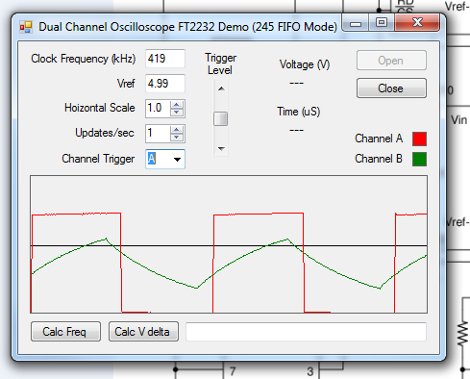
[RandomTask] has posted a nice tutorial on how to use a FTDI serial to usb converter, and a couple analog to digital converters to make a simple software oscilloscope. Using a “Universal Serial to USB converter” and one of many FTDI break out boards, he first reprograms the chip using FTDI’s programming software to put the device into a FIFO (first in first out) mode.

From there a pair of ADC0820 8 bit digital to analog converters are wired up, and input is fed to a couple 555’s for testing. It should be noted that there is no input protection, so things like voltages above 5 volts, or negative voltages are a big no-no with this setup. It still could be very handy while working with micro controllers or other digital circuits.

Data is then sent to the computer and displayed using a VB.net program, which has some basic features like scale and triggering, but also contains a couple bonuses like Calc Freq and Calc V delta calculation.

Many people have these little serial to usb converters, and might be in need of a simple scope. If you’re one of them, then you can cobble this together pretty darn quickly, and cheaply.

So You Wanna Learn FPGAs…

FPGAs are the bee’s knees. Instead of programming a chip by telling it what to do, FPGAs allow you to tell a chip what to be. Like everything though, a new skill set is needed to fully exploit the power of FPGAs. [Mike Field] decided to give back to the internet community at large and put up a crash course in FPGA design.

Right now, [Mike] has a couple of modules up that include subjects like binary math, busses, counting, and of course setting up the FPGA hardware. The recommended hardware is the Papilio One, although the Digilent Nexys2 is what [Mike] has been using so far.

We’ve seen a ton of awesome stuff that uses FPGAs, like the emulated Mac Plus, breaking HDCP, and an Ocarina of Time. [Mike]’s tutorials look like a great starting point for some FPGA work. [Mike] is also looking for some feedback on his tutorials, so if you’ve got an idea of what he should cover be sure to drop him a line.

EDIT: The server was running on an FPGA and we can’t find a cache anywhere. If you’ve found a mirror, send a message. Apparently Amazon’s EC2 runs on an FPGA.

Video Series Shows How To Build Your Own Solar-charged R/C Lawnmower

rc-solar-lawnmower

As winter is officially upon us, we’re pretty sure that the last thing most of you are thinking about is mowing your lawn. We would argue that it’s actually the ideal time to do so – that is, if you are interested in automating the process a bit.

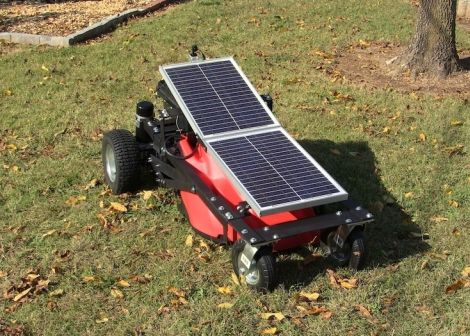
[Robert Smith] has spent a lot of time thinking about his lawn, wanting a way to sit back and relax while doing his weekly trimming. He set off for the workshop to build an R/C electric lawnmower, and thoroughly documented the process in order to help you do the same.

On his web site, you will find a series of videos detailing every bit of the solar charged R/C lawnmower’s construction, taking you through the planning phases all the way to completion. [Robert] has provided just about anything you could possibly need including parts lists, schematics, code, and more.

If the short introductory video below has you interested, be sure to swing by his site for everything you need to build one of your own.

Continue reading “Video Series Shows How To Build Your Own Solar-charged R/C Lawnmower”

An Introduction To Stepper Motors

If you’ve been reading Hack a Day for long enough, you know about our infatuation with stepper motors. These precious little devices put the oomph into our CNC routers, 3D printers, robots, and other miscellaneous projects. Steppers aren’t your run-of-the-mill motors, though. [Steaky] posted a great introduction to stepper motors that lets you hit the ground running building any moving project you could imagine.

Apart from identifying a stepper and figuring out if it works, [Steaky] goes over how to make these motors turn. The theory behind an H-bridge is easy enough, but theory isn’t something often presented in schematics or stepper driver datasheets.

We’ve pulled more than our fair share of steppers from flatbed scanners and old printers. There’s nothing wrong with scavenging old parts, and whether you’re making a robot band to play your kid’s birthday party, robochess, or one of the many 3D printers or CNC machines, there’s going to be a stepper motor in your future.

Experimenting With Bridge Rectifers For AC To DC Power Conversion

The folks over at Toymaker Television have put together another episode. This time they’re looking at bridge rectifiers and how they’re used in AC to DC converters.

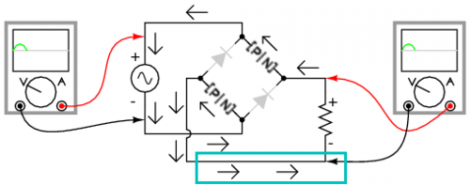
This is a simple concept which is worth taking the time to study for those unfamiliar with it. Since Alternating Current is made up of cycles of positive and negative signals it must be converted before use in Direct Current circuits; a process called rectification. This is done using a series of 1-way gates (diodes) in a layout called a bridge rectifier. That’s the diamond shape seen in the diagram above.

This episode, which is embedded after the break, takes a good long look at the concept. One of the things we like best about the presentation is that the hosts of the show talk about actual electron flow. This is always a quagmire with those new to electronics, as schematics portray flow from positive to negative, but electron theory suggests that actual electron flow is the exact opposite. Continue reading “Experimenting With Bridge Rectifers For AC To DC Power Conversion”