Weasure, A Scale That Weighs And Measures

weasure

[John Peterson] created this postal scale device for a Renesas design contest. The Weasure not only calculates the package’s total weight but the dimensions as well. He built it using a SKP16C62P evaluation board that had an LCD, pushbuttons, and indicator LEDs. The original DigiWeigh parcel scale was modified to provide PWM output and tare control. He embedded photoresistors every inch along each axis. They were angle slightly upward and the surroundings were painted black to minimize reflection. The Weasure outputs everything via a serial connection so it can be used with shipping software to generate postage.
LED Menorahs

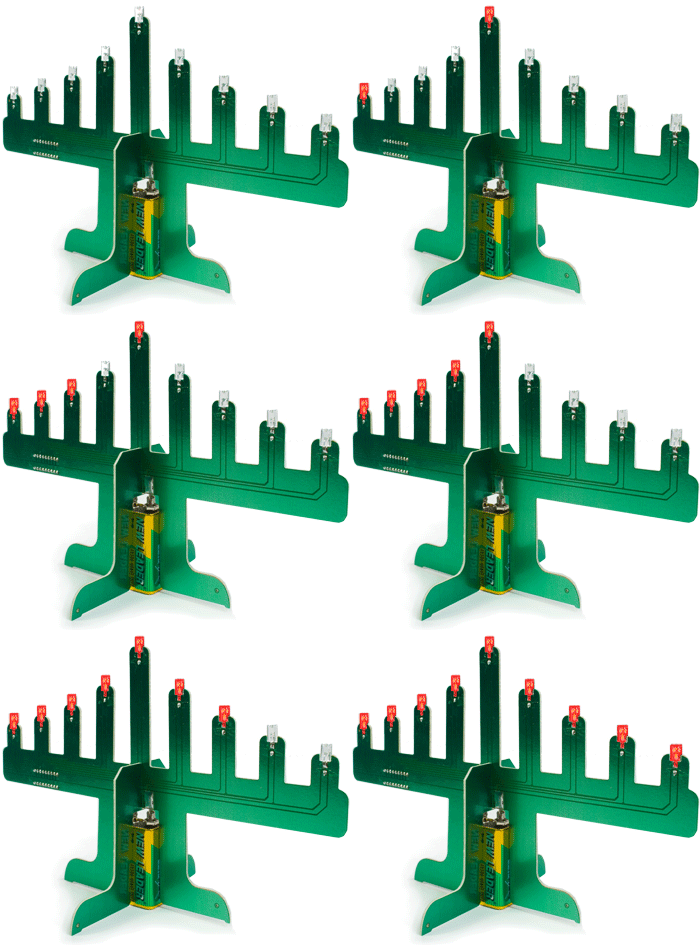
We’re barely past Halloween and people are already working on their next LED based holiday decorations. For Hanukkah, Gizmodo pointed out the PCB menorah pictured above. It uses a set of DIP switches to control which LEDs are lit. A couple years ago, Evil Mad Scientist Laboratories put together a tutorial for building a more minimal LED menorah. Each of the nine LEDs are soldered directly to the legs of an ATtiny2313 microcontroller. Every time you power up the device an additional LED is lit. [Ori] liked the project and decided to take a slightly different approach. He used an LM3914 DIP18 LED bar driver. A potentiometer controls how many of the LEDs are illuminated.

Minimalist LED Light Detecting Candle

[youtube=http://www.youtube.com/watch?v=sPe5RtUOOdc]

Our flickering LED circuit combined two known circuit, and certainly wasn’t graceful because of it. [sprite_tm] saw quite a few areas where the circuit could be reduced. He ended up taking it down to just two LEDs, a battery, and an ATtiny13. The first step was getting rid of the current limiting resistors. The datasheet shows that with a 3V supply the AVR will limit the current well below the maximum current. The light sensor was removed next. [sprite_tm] referenced an earlier post on sensing with LEDs. He measures the voltage across one of the LEDs while it is off to see how much light is hitting it. The current draw while on is 10mA and 50uA while off.

Multi-Color Fog Spreader

fog_spraed

Though we’re pretty sure this was meant for Halloween, we think it would be a perfect addition to your election night party. [marc92] shows us how he built a fog spreader with red or blue lighting. Fog machines generally spit out the fog from a single point, relying on the breeze to spread it around. [marc92] wanted it spread a little more evenly, as well as some nice mood lighting. He built a pipe system that would emit fog from a much larger area. Mounted on the pipe are red and blue LEDs.  Mix this with some of the election lighting systems and you’re set for a party. We know this is an extremely simple project, so it should give you plenty of time to get out and vote before the polls close.

Colorize Your Election Party

blue_red
[Eric] has put together a simple python script to scrape election results from CNN.com. It uses urllib2 to return the popular and electoral votes for each party and throws an ElectionWon exception when CNN calls the race. He’s planning on hooking this to DMX controlled RGB LED lighting that will shift to either blue or red as the night progresses. It’s a great starting point if you want to pull off something similar.

You may remember [Eric] for building the IKEA MAME table and the TRS-80 wireless terminal.

[photo: skenmy]

UPDATE: [Garrett] of macetech is putting the finishing touches on his version which uses 32 ShiftBrite modules and 2 4-digit displays controlled by a CuBLOC.

Cellular Automata And LED Matrix Fun

Blinkomat, an LED matrix, turned out quite well. 240 LEDs controlled by an Atmega 16 is what we call a decent bookshelf decoration. The dimensions of 12×20 were chosen due to the fact that the microcontroller has 32 I/O lines.  The LEDs are switched on and off using multiplexing. The brightness, controlled by pulse width modulation can be varied by 16 levels.  The overall effect is quite smooth an fun to look at.  He has programmed it to do other things than just cellular automata.  Our personal favorite is a simple sine wave. Watch it after the break.

Continue reading “Cellular Automata And LED Matrix Fun”

LED Life And Charlieplexing


Yesterday, we featured [Andrew]’s orientation aware camera. We want to highlight another one of his projects: LED Life. It’s a 6×5 LED matrix playing Conway’s Game of Life. He used the low power MSP430 like our e-paper clock. The best part of the writeup is his explanation of how Charlieplexing works. Microcontroller GPIO pins generally have three possible states: output high, output low, and input. This combined with the directional nature LEDs and some creative wiring means you can run a large matrix of individually addressable LEDs with just a few IO pins. Instead of just flipping the IO pins on and off you change their assigned state. Have a look at [Andrew]’s site for some great illustrations of how the system works. A video of his LED Life board is embedded below. Continue reading “LED Life And Charlieplexing”