KVM Foot Switch In A Few Steps

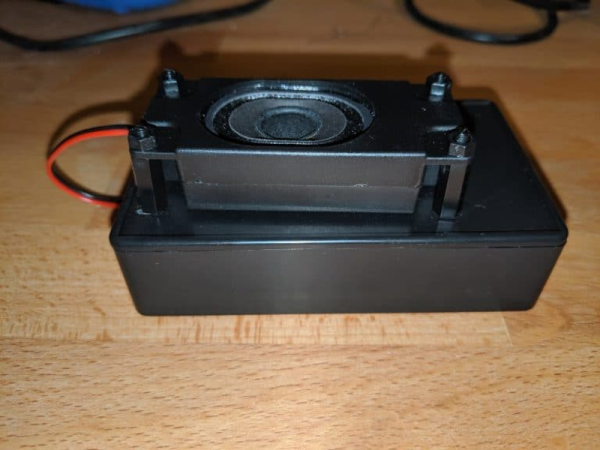
[Radishmouse], despite the handle, is not a mouse guy. Give him a keyboard and he will get around just fine in any OS or program. As it is, he’s got a handful of ThinkPads, each running a different OS. He wanted to be able to switch his nice mechanical keyboard between two laptops without the hassle of unplugging and replugging the thing. His solution: a DIY KVM foot switch.

He’s been learning about electronics and 3D design, and this problem was the perfect opportunity to dig in and get his hands dirty. After learning enough about the USB protocol and switches to figure out what had to happen, he made a prototype from a pâte tub. Though undeniably classy, this vessel would never survive the rigors of foot-stomping in feline territory. Fortunately, [radishmouse] has also been learning about 3D design. After some trial and error, he came up with a sturdy, curvy 3D-printed two-piece enclosure. We particularly like the blocks built into the bottom piece that shore up the USB ports.

There are lots of reasons to build input controls for those under-utilized appendages at the ends of your legs. You could control your ‘scope with a probe in each hand, or use a foot switch to relocate an inconvenient power button.

Via [r/functionalprint]

Xpedit Is A Mood Ring For Mother Nature

Whether you’re in the woods or way up a mountain, basic knowledge of your environment can yield a lot of power. The more you know about the temperature, humidity, barometric pressure, and your altitude, the easier it is to predict future weather and stick to your height limits. Sure, you could buy some pre-fab doohickey that does all of this, but why? [DIYMechanics] shows how easy it is to build your own pocket-sized weather station for under $20.

Xpedit’s brain is an ATMega328 running on a 20MHz crystal heartbeat. The atmospheric readings come from a BME280, a nifty all-in-one module that’s available for pennies on Ali. The rotary encoder handles user inputs, and the simple interface displays on an OLED. There’s even a tiny compass embedded in the 3D printed case.

We really like the custom alarm feature, which can buzz you via vibe motor if you’ve climbed too high, or the pressure is dropping. [DIYMechanics] has Xpedit completely open-sourced, so trek on down to the GitHub for the latest Eagles, Gerbers, and INOs. Don’t have a USBtiny ISP yet? He’s got the plans for that, too.

Maybe you’re the indoorsy type who’d rather read about mountainous jungle adventures than experience them firsthand. Add some weather-driven ambiance to your book nook by hacking an IKEA cloud lamp.

ESP8266 Sound Machine Soothes Baby Remotely

[Zack] had trouble getting his six-month-old to sleep through the night. That was before he found out about ‘shh’ videos on YouTube. These are exactly what they sound like: eight hours of someone whooshing white noise into a microphone. He set a phone up on a charger in the nursery and let one of these play overnight. But the phone was unreliable. It would lock up, or just crash completely, making the baby’s distress worse.

To restore peace in the house, he built a sound machine that both simplifies and fortifies the white noise shh-loution. It uses an ESP8266 and a DFPlayer Mini to loop a lone MP3 file of shh-video audio and play it from a small speaker. By integrating the machine with Home Assistant, he’s able to trigger the sound remotely at baby’s bedtime. ESP Home has no module for the DFPlayer, but [Zack] built one that he’s happy to share.

If you are mired in early parenthood, this is a nice, simple solution. The DFPlayer does all the work of reading from the SD card and converting the signal to analog for speaker output, so there’s no need to get your hands dirty wasting valuable sleeping or kid-playing time.

Once the kid starts toddling out of babyhood, [Zack] could turn to ESP8266-based ambient lighting to help establish the difference between sleep and wake time.

The Proof Is In The Box

Making bread dough is simple — it’s just flour and water, with some salt and yeast if you want to make things easy on yourself. Turning that dough into bread is another matter entirely. You need to punch that dough down, you need to let it rise, and you need to knead it again. At home, you’re probably content with letting the dough rise on the kitchen counter, but there’s a reason your home loaf doesn’t taste like what you would get at a good bakery. A bakery has a proofer, or a box that lets dough rise at a temperature that would be uncomfortable for humans, but perfect for yeast.

The leavening cell is a DIY proofing box that keeps dough at a steady 26° C to 28° C, the perfect temperature for making bread, pizza dough, and even yogurts. [vittorio] made this and the results look great.

The design of this build is simple enough and made out of 20×20 aluminum profiles shaped into a cubic frame. The outside of this box is 6mm thick wooden panels coated on the inside with a heat-reflective insulating mesh. Inside of that is a frame of metal mesh to which a six-meter long cable heating element is attached. This heating element is controlled via a thermostat with a probe temperature sensor on a timer. No, it’s not very complicated but the entire idea of a proofer is to have a slightly warm box.

You can check out the promo video for the Leavening Cell below.

Continue reading “The Proof Is In The Box”

Talking Washer Is A Clean Solution For The Visually Impaired

Have you shopped for an appliance lately? They’re all LEDs, LEDs everywhere. You might say that manufacturers are out of touch with the utility of tactile controls. [Wingletang]’s fancy new washing machine is cut from this modern cloth. While it does have a nice big knob for selecting cycles, the only indication of your selection is an LED. This isn’t an issue for [Wingletang], but it’s a showstopper for his visually impaired wife.

They tried to make tactile signposts for her most-used cycles with those adhesive rubber feet you use to keep cabinet doors quiet. But between the machine’s 14(!) different wash cycles and the endlessly-rotating selector knob, the tactile map idea was a wash. It was time to make the machine talk.

For his very first microcontroller project, [Wingletang] designed a completely non-invasive and totally awesome solution to this problem. He’s using LDRs arranged in a ring to detect which LED is lit. Recycled mouse pad foam and black styrene keep ambient light from creating false positives, and double as enclosure for the sensor and support boards. As [Mrs. Wingletang] cycles through with the knob, an Arduino clone mounted in a nearby project box determines which program is selected, and a Velleman KA02 audio shield plays a recorded clip of [Wingletang] announcing the cycle number and description.

The system, dubbed SOAP (Speech Output Announcing Programmes), has been a great help to [Mrs. Wingletang] for about the last year. Watch her take it for a spin after the break, and stick around for SOAP’s origin story and walk-through videos.

It’s baffling that so few washers and dryers let you know when they’re finished. Don’t waste your time checking over and over again—Laundry Spy waits for the vibrations to end and sends you a text.

Continue reading “Talking Washer Is A Clean Solution For The Visually Impaired”

Colour-Code Your Way To Timber Satisfaction

As Hackaday writers we see the insides of as many hackerspaces as we can, and some of us make it our business to be members of more than one within reach of our homes. Thus it was that a simple but extremely elegant hackerspace lifehack came our way, courtesy of our friends at Milton Keynes Makerspace.

MK Makerspace have found a home within another group, the local MK Men In Sheds is a charitable organisation providing workshop and social space for hackers of an older generation. Together the two combine to offer both a huge range of experience and a comprehensive array of tools and machinery.

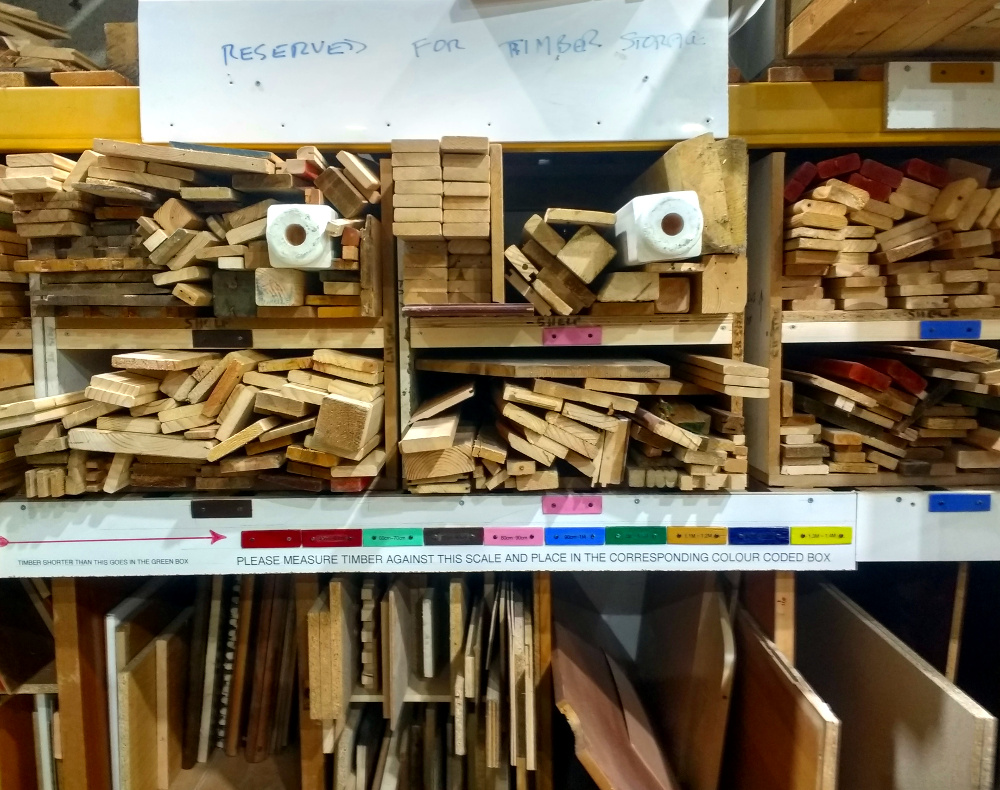
Order imposed upon the chaos of the MK Men In Sheds woodstore.

Woodwork is a strong component in the life of any Shed, and at Milton Keynes the Shed has been particularly successful in attracting donations of surplus timber. The stock of freely available mixed pieces of wood has almost everything you could wish for when working on casual projects, but despite continual sorting efforts had become an unmanageable pile among which it was often difficult to find the piece required.

Step forward MK Men In Sheds member [Ricky] whose solution was nothing short of inspired in its combination of simplicity and effectiveness. A large rack has compartments, each one of which has a coloured label. Along the front of the rack is a simple ruler calibrated in coloured blocks, and it is the work of a moment to offer a new piece of timber up to the ruler and place it in the compartment with the appropriate colour. Now any member with a need for a piece of wood  can easily select an appropriate one, and return any usable offcut for easy selection by the next.

This may be a simple piece of work, but its value as a lifehack in a communal workshop is immense. It brings to mind a piece we published a couple of years ago, about how a vibrant hackerspace follows a good wood shop. Never a truer word was spoken for people of all ages.

A Modern Solution To Tea Bag Inventory Management

Britain is famously known as a land of manners and hospitality. Few situations could make an Englishman’s stiff upper lip quiver, short of running out of tea bags while entertaining house guests. Thankfully, [The Gentleman Maker] is here and living up to his name – with a helpful tea monitor to ensure you’re never caught out again.

The Intelli-T, as it has been dubbed, monitors tea inventory by weight. An Arduino Uno combined with a HX711 IC monitors a load cell mounted under a canister, with a reed switch on the lid. Upon the canister being open and closed, the Arduino takes a measurement, determining whether tea stocks have dipped below critical levels. If the situation is dire, a Raspberry Pi connected over the serial port will sound an urgent warning to the occupants of the home. If there is adequate tea, the Raspberry Pi will instead provide a helpful tea fact to further educate the users about the hallowed beverage.

It’s a fun project, and one that has scope for further features, given the power of the Raspberry Pi. A little more work could arrange automatic ordering of more tea online, or send alerts through a service like IFTTT. We’ve seen [The Gentleman Maker]’s uniquely British hacks before, such as the umbrella that tells you the weather. Video after the break.

Continue reading “A Modern Solution To Tea Bag Inventory Management”