Handwashing Timer Makes Sure The Suds Stay On Long Enough

“Twinkle, Twinkle, Little Star”? How we wonder why you’d resort to singing a ditty to time your handwashing when you can use your social isolation time to build a touch-free electronic handwash timer that the kids — and you — might actually use.

Over the last few months, pretty much everyone on the planet has been thrust into strange, new, and oftentimes scary practices to limit the spread of the SARS-CoV-2virus and the disease it causes, COVID-19. Judging by the number of people we’ve seen leaving public restrooms without a visit to the washbasin before the outbreak began — and sadly all too often since — we collectively have a lot of work to do in tightening up our handwashing regimens. Time on target and plenty of friction are the keys to that, and [Denis Hennessy]’s “WashTimer” aims to at least help you out with the former. His build is as simple as can be: an Arduino driving an LED matrix when a proximity sensor fires. Wave your dirty paws in front of the unit as you start to scrub up, and the display goes through a nicely animated 20-second countdown, at which time it’s safe to rinse off.

[Denis] purposely made this design as simple and as customizable as possible. Perhaps you’ve got a Neopixel ring lying about rather than the LED matrix, or maybe an ultrasonic sensor would work better for you. Be creative and take this design where it needs to go to suit your needs. We can’t stress enough that handwashing is your number one defense; if you don’t need to moisturize your hands at least three times a day, you’re probably not washing often or long enough. And 20 seconds is way longer than you think it is without a prompt.

Continue reading “Handwashing Timer Makes Sure The Suds Stay On Long Enough”
Saving 4 Patients With Just 1 Ventilator

We all know that COVID-19 is stressing our health system to the limit. One of the most important machines in this battle is the ventilator. Vents are critical for patients experiencing the worst symptoms of respiratory distress from the virus. Most of the numbers predict that hospitals won’t have enough ventilators to keep up with the needs during the height of the pandemic.

Now anyone with a walkman or iPod can tell you what they do when there is one music device and two people who want to listen: Plug in a Y-connector. Wouldn’t it be great if you could do the same thing with a medical ventilator? It turns out you can – – with some important caveats.

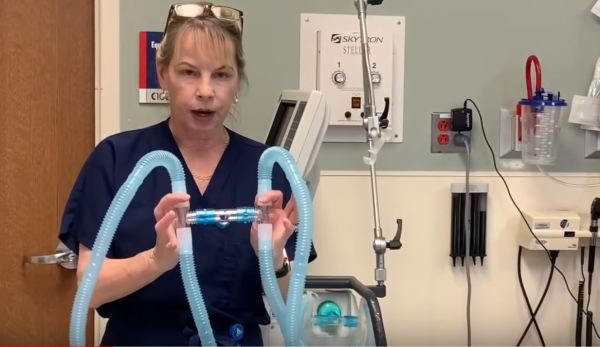
Way back in 2006, [Greg Neyman, MD and Charlene Babcock, MD] connected four simulated patients to a single ventilator. Ventilators connect to a patient with two tubes – an inflow and an exhaust. Using common parts available in just about any hospital, the doctors installed “T-tube” splitters on the inflow and exhaust tubes. They tested this with lung simulators and found that the system worked.

There were some important considerations though. The patients must be medically paralyzed, and have similar lung capacity — you couldn’t mix an adult and a child. The tubing length for each patient needs to be the same as well. The suggestion is to place the patients in a star pattern with the ventilator at the center of the star.

[Dr. Charlene Babcock] explains the whole setup in the video after the break.

Interestingly enough, this technique went from feasibility study to reality during the Las Vegas shooting a few years ago. There were more patients than ventilators, so emergency room doctors employed the technique to keep patients alive while equipment was brought in from outside hospitals. It worked — saving lives on that dark day.

The video and technique remind us of Apollo 13 and the CO2 scrubber modifications. Whatever it takes to keep people alive. We’ve already started looking into open source ventilators, but it’s good to see that medical professionals have been working on this problem for years.

Continue reading “Saving 4 Patients With Just 1 Ventilator”

Join Team Hackaday To Crunch COVID-19 Through Folding@Home

Donate your extra computer cycles to combat COVID-19. The Folding@Home project uses computers from all over the world connected through the Internet to simulate protein folding. The point is to generate the data necessary to discover treatments that can have an impact on how this virus affects humanity. The software models protein folding in a search for pharmaceutical treatments that will weaken the virus’ ability to attack the human immune system. Think of this like mining for bitcoin but instead we’re mining for a treatment to Coronavirus.

Initially developed at Standford University and released in the year 2000, this isn’t the first time Hackaday has advocated for Folding@Home. The “Team Hackaday” folding group was started by readers back in 2005 and that team number is still active, so let’s pile on and work our way up the rankings. At the time of writing, we’re ranked 267 in the world, can we get back up to number 30 like we were in 2008? To use the comparison to bitcoin once again, this is like a mining pool except what we end up with is a show of goodwill, something I think we can all use right about now.

Continue reading “Join Team Hackaday To Crunch COVID-19 Through Folding@Home”

Can A CPAP Fan Become A Ventilator?

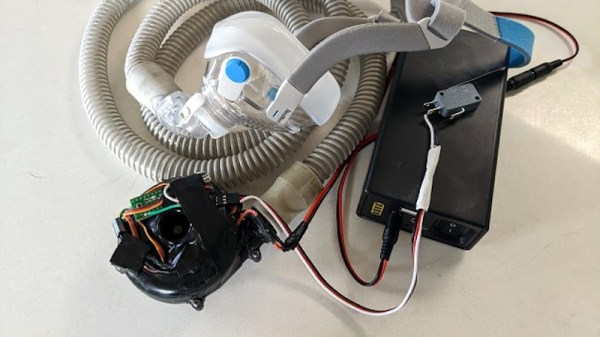
Watching the hardware community respond to the global pandemic is a fascinating process, because of the breadth of projects being considered, and also because of the differing experiences and perspectives being brought to the table. Components most of us might have been unaware of are appearing, such as the CPAP blower used by [Jcl5m1] in his ventilator design.

He starts with a very necessary disclaimer against trusting a random person on the Internet on the subject of medical equipment design, and since it must be possible to do damage with an inappropriate ventilator we can only echo that. But as a CPAP user he’s familiar with their operation and parts, and he’s taken the centrifugal blower from one of them and paired it with a speed controller and an Arduino to provide an adjustable pressure.

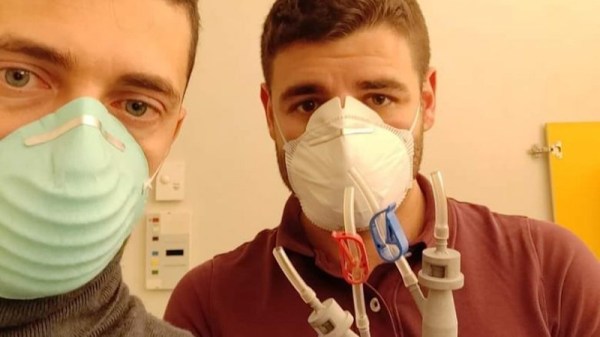
What we take away from this is not in any way a ventilator that’s ready to be hooked up to sick patients, but an interesting look at ventilators in general, CPAP components, and the possibility that this project and others like it might eventually form the basis of something more useful if they attract the attention of people with more experience in the field. We’ve already seen 3D-printing used to make valves for a respirator at a hospital in Italy.

3D Printed Parts Keep Respirators Operational During COVID-19 Epidemic

COVID-19 can seem like a paper tiger, when looking at bare mortality rates. The far greater problem is the increase in fatalities as health systems are stretched to the limit. With thousands of patients presenting all at once, hospitals quickly run out of beds and resources and suddenly, normally survivable conditions become life threatening. One Italian hospital found themselves in such a position, running out of valves for a critical respirator device needed to save their patients. Supplies were running out – but additive manufacturing was able to save the day.

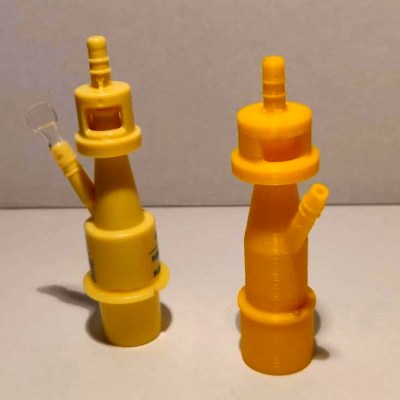
The original part, left, with its 3D-printed replacement.

While the article uses the term “reanimation device”, it’s clear we’re talking about respirators here, necessary to keep patients alive during respiratory distress. The valve in question is a plastic part, one which likely needs to be changed over when the device is used with each individual patient to provide a sterile flow of air. After the alarm was raised by Nunzia Vallini, a local journalist, a ring around of the 3D printing community led to a machine being sent down to the hospital and the parts being reproduced. Once proven to work, things were stepped up, with another company stepping in to produce the parts in quantity with a high-quality laser fusion printer.

It’s a great example of 3D printers being used to produce actual useful parts, and of the community coming together to do vital lifesaving work. We’ve seen the technology come in clutch in the medical field before, too. Stay safe out there, and live to hack another day.

Thanks to [Jarno Burger], [LuigiBrotha], and [Michael Hartmann] for the tips!

Hearing Aid Reads Your Mind

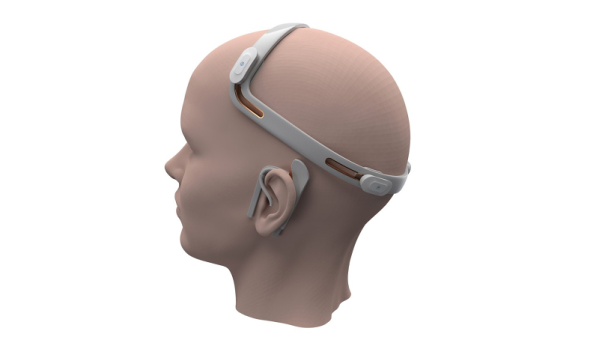
If you’ve ever seen an experienced radio operator pull a signal out of the noise, or talked to someone in a crowded noisy restaurant, you know the human brain is excellent at focusing on a particular sound. This is sometimes called the cocktail party effect and if you wear a hearing aid, this doesn’t work as well because the device amplifies everything the same. A German company, Fraunhofer, aims to change that. They’ve demonstrated a hearing aid that uses EEG sensors to determine what you are trying to hear. Then it uses that information to configure beamforming microphone arrays to focus in on the sound you want to hear.

In addition to electronically focusing sound, the device stimulates your brain using transcranial electrostimulation. A low-level electrical signal tied to the audio input directly stimulates the auditory cortex of your brain and reportedly improves intelligibility.

Continue reading “Hearing Aid Reads Your Mind”

Augmented Reality Aids In The Fight Against COVID-19

“Know your enemy” is the essence of one of the most famous quotes from [Sun Tzu]’s Art of War, and it’s as true now as it was 2,500 years ago. It also applies far beyond the martial arts, and as the world squares off for battle against COVID-19, it’s especially important to know the enemy: the novel coronavirus now dubbed SARS-CoV-2. And now, augmented reality technology is giving a boost to search for fatal flaws in the virus that can be exploited to defeat it.

The video below is a fascinating mix of 3D models of viral structures, like the external spike glycoproteins that give coronaviruses their characteristic crown appearance, layered onto live video of [Tom Goddard], a programmer/analysts at the University of California San Francisco. The tool he’s using is called ChimeraX, a molecular visualization program developed by him and his colleagues. He actually refers to this setup as “mixed reality” rather than “augmented reality”, to stress the fact that AR tends to be an experience that only the user can fully appreciate, whereas this system allows him to act as a guide on a virtual tour of the smallest of structures.

Using a depth-sensing camera and a VR headset, [Tom] is able to manipulate 3D models of the SARS virus — we don’t yet have full 3D structure data for the novel coronavirus proteins — to show us exactly how SARS binds to its receptor, angiotensin-converting enzyme-2 (ACE-2), a protein expressed on the cell surfaces of many different tissue types. It’s fascinating to see how the biding domain of the spike reaches out to latch onto ACE-2 to begin the process of invading a cell; it’s also heartening to watch [Tom]’s simulation of how the immune system responds to and blocks that binding.

It looks like ChimeraX and similar AR systems are going to prove to be powerful tools in the fight against not just COVID-19, but in all kinds of infectious diseases. Hats off to [Tom] and his team for making them available to researchers free of charge.

Continue reading “Augmented Reality Aids In The Fight Against COVID-19”