Ping Pong Spectrum Analyzer

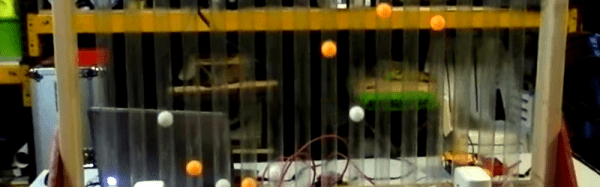
A spectrum analyzer is a pretty useful tool for working with signals where the size of the frequency components matter. Usually, the display is a screen. Sometimes, you see it done with LEDs. [Mag Laboratories] did it with ping pong balls.

The device uses a processor to calculate a Fourier transform, cutting an audio signal into 16 frequency bands. The processor converts each of these values to a PWM output that drives small fans. The fans blow the ping pong ball up the tube proportional to the fan speed. You can see the result in the video below.

Continue reading “Ping Pong Spectrum Analyzer”

Tiny ATtiny85 Game Console

[Ilya Titov] has made a game console. Not just any game console, but an extremely small ATtiny85-based console suitable for putting on a key ring and assembled into a very professional product with PCB and 3D printed case. This is a project that has been on the go since 2014, but the most recent update is a new version designed for tighter and more easy assembly.

All construction is through-hole rather than SMD, and aside from the ATtiny85 the console uses an OLED screen, piezo buzzer, tactile switches and a handful of passive components. Power comes from a single CR2032 coin cell which sits under the screen. Best of all the PCB design is available as a PDF and the 3D printed case can be found on Thingiverse.

There are two games for the console, as well as the Breakout clone whose code is in the 2014 piece linked above he’s written UFO Escape, an obstacle-avoiding side-scroller. You’ll have to burn both game and 8MHz internal clock bootloader to the ATtiny85 yourself. There are no cartridges with this console, though if the processor sits in a DIP socket the game can be changed over simply by swapping processors programmed with the appropriate game.

He’s produced a full assembly video with some UFO Escape gameplay thrown in, shown here below the break.

Continue reading “Tiny ATtiny85 Game Console”

That’s Life…on A Hackaday Badge

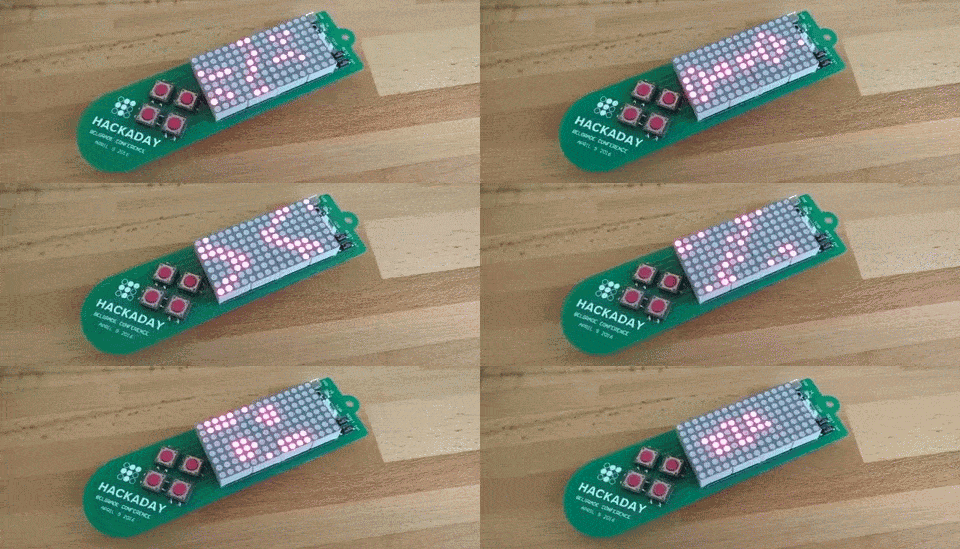
Our Hackaday Chief [Mike] sent me an e-mail the other day with a link to the Belgrade Hackaday Badge simulator. He clearly wanted me to enter something into the demo scene competition. The good news is that because of the simulator, you didn’t have to leave your desk to participate. The bad news is that I had very little time left at the end of the month, so I wanted to do something appealing but it had to be fairly easy to roll out. I wound up doing a very quick project but it had a few fine points that I thought I’d share. The end goal was to have an interesting display of Conway’s game of life on the badge.

By the way, there was a completely different project with the same goal by [Jeremias] on Hackaday.io. As far as I know, this was just the result of two people setting out to do the same thing. You’ll see the user interface is a good bit different, so you might see which you prefer.

If you haven’t seen it, the real badge is below. The emulator, of course, just runs as a window on your PC. For those that will be at the conference, or just want to program closer to the actual hardware, there is now a preconfigured MPLABX framework  for the PIC18LF25K50 and the bootloader/kernel running on this badge.

Continue reading “That’s Life…on A Hackaday Badge”

Ethernet Controller Discovered In The ESP8266

The venerable ESP8266 has rocked the Internet of Things world. Originally little more than a curious $3 WiFi-to-serial bridge, bit by bit, the true power of the ESP has become known, fully programmable, with a treasure trove of peripherals it seemed that the list of things the ESP couldn’t do was short. On that list, at least until today was Ethernet.

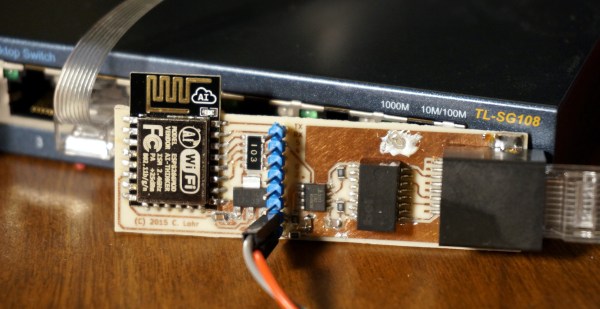
No, despite the misleading title, the ESP does not have a MAC and/or PHY, but what it does have is an incredible 80 MHz DMA-able shift register which can be used to communicate 10BASE-T Ethernet using a new project, espthernet. Join me after the break for video proof, and a deep dive into how this is possible.

Continue reading “Ethernet Controller Discovered In The ESP8266”

Intel Ups The Dev Board Ante With The Quark D2000

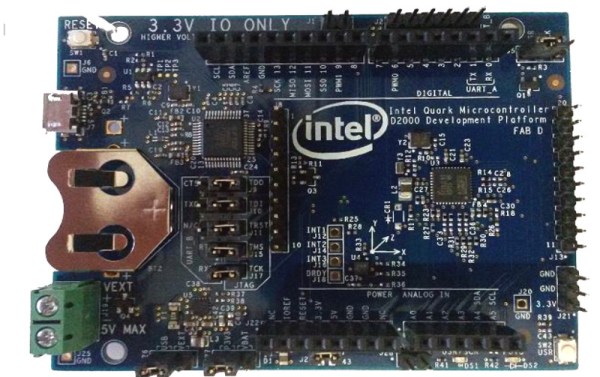
Intel have a developer board that is new to the market, based on their Quark (formerly “Mint Valley”) D2000 low-power x86 microcontroller. This is a micropower 32-bit processor running at 32MHz, and with 32kB of Flash and 8kB of RAM. It’s roughly equivalent to a Pentium-class processor without the x87 FPU, and it has the usual impressive array of built-in microcontroller peripherals and I/O choices.

The board has an Arduino-compatible shield footprint, an FTDI chip for USB connectivity, a compass, acceleration, and temperature sensor chip, and a coin cell holder with micropower switching regulator. Intel provide their own System Studio For Microcontrollers dev environment, based around the familiar Eclipse IDE.

Best of all is the price, under $15 from an assortment of the usual large electronics wholesalers.

This board joins a throng of others in the low-cost microcontroller development board space, each of which will have attributes that its manufacturers will hope make it stand out. Facing such competition the Intel board will have to be something rather special to achieve that aim, so why should it excite your interest? We would point to the low price, the x86 code if that is your flavour of choice, and the relatively tiny power consumption.

Stepping back from the dev board for a moment, consider this processor as an illustration of technological progress in semiconductor fabrication. Over twenty years ago this chip’s Pentium ancestor ran on 5 volts and got so hot you could fry an egg on it, here is a Pentium that can run on a few milliwatts from a coin cell. Fortunately you won’t be running Windows 95 on it though.

We’re sure we’ll see plenty of projects here in the future using the Quark. Intel’s previous effort in this space, the Edison, has made several appearances. We’ve covered its launch in 2014, looked at someone running Doom on it, and examined its use with audio effects.

Thanks [Nolan M] for the tip.

The Onion Omega Carputer Can Be Controlled Via WiFi

The Onion Omega, a curiously named ultra-tiny linux-based WiFi board, is a useful little device for everything Internet of Things related. [Daniel] decided to use it to connect his car to the internet.

Most new cars these days have remote start built in, and slowly, manufacturers are catching up to modern technology and including apps to control various features of their vehicles. But for old cars, there’s not much you can do aside from after-market remote start kits and the likes.

Undeterred, [Daniel] wanted to bring his car into the 21st century by manually adding an extra key fob, a remote start protocol, and a data connection to the vehicle’s on board computer.

Continue reading “The Onion Omega Carputer Can Be Controlled Via WiFi”

Embed With Elliot: ARM Makefile Madness

To wrap up my quick tour through the wonderland of make and makefiles, we’re going to look at a pair of possible makefiles for building ARM projects. Although I’m specifically targeting the STM32F407, the chip on a dev board that I have on my desk, it’s reasonably straightforward to extend these to any of the ST ARM chips, and only a bit more work to extend it to any ARM processor.

If you followed along in the first two installments of this series, I demonstrated some basic usages of make that heavily leveraged the built-in rules. Then, we extended these rules to cross-compile for the AVR series of microcontrollers. Now we’re going to tackle a more complicated chip, and that’s going to mean compiling with support libraries. While not required, it’s a lot easier to get an LED blinking on the ARM platforms with some additional help.

One of the main contributions of an IDE like Arduino or mbed or similar is the ease of including external libraries through pull-down menus. If you’ve never built a makefile-based project before, you might be surprised how it’s not particularly more difficult to add libraries to your project.
Continue reading “Embed With Elliot: ARM Makefile Madness”