Model Of A Transmission Line

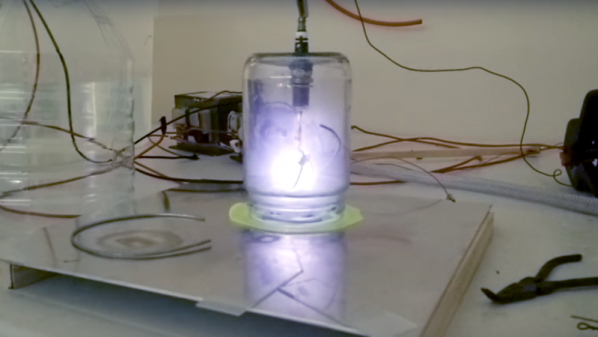
Transmission lines are the kind of thing that seems to confuse beginners. After all, the fact that short-circuits can have infinite impedance and open-circuits can behave like a short is not intuitive at all!. That’s why we like [Tinselkoala]’s latest video that shows a nice model of a transmission line. It helps to understand the line as inductors and capacitors in series-parallel connection.

Any pair of wires used to transmit electrical power have tiny amounts of inductance and capacitance. This is not a problem with DC or low-frequency AC, but when the frequency is sufficiently high, weird things start to happen. The energy tends to escape as radio waves, and current reflects from discontinuities such as connectors and cable joints.  For this reason, transmission lines for high frequency signals use specialized construction to minimize those effects and reduce power losses.

[Tinselkoala] has built a model of a transmission line using coils and capacitors to simulate the inductance and capacitance of the line, with LED’s placed between the coils. He feeds the system with the signal generator with frequencies from 10 kHz to 1 MHz. In his words, they act as simple “visual voltmeters” to show the peaks and nodes of the standing waves of voltage in the line.

It is relatively simple to build your own version if you want to experiment with this fascinating subject. You will only need some magnet wire, capacitors, resistors and LED’s. If the subject sounds interesting to you,  here you can find an excellent introduction to transmission lines.

Continue reading “Model Of A Transmission Line”

Hack Your Hike With This Arduino Puzzle Geocache

For those who love to hike, no excuse is needed to hit the woods. Other folks, though, need a little coaxing to get into the great outdoors, which is where geocaching comes in: hide something in the woods, post clues to its location online, and they will come. The puzzle is the attraction, and doubly so for this geocache with an Arduino-powered game of Hangman that needs to be solved before the cache is unlocked.

The actual contents of a geocache are rarely the point — after all, it’s the journey, not the destination. But [cliptwings]’ destination is likely to be a real crowd pleaser. Like many geocaches, this one is built into a waterproof plastic ammo can. Inside the can is another door that can only be unlocked by correctly solving a classic game of Hangman. The game itself may look familiar to long-time Hackaday readers, since we featured it back in 2009. Correctly solving the puzzle opens the inner chamber to reveal the geocaching goodness within.

Cleverly, [cliptwings] mounted the volt battery for the Arduino on top of the inner door so that cachers can replace a dead battery and play the game; strangely, the cache entry on Geocaching.com (registration required) does not instruct players to bring a battery along.

It looks like the cache has already been found and solved once since being placed a few days ago in a park north of Tucson, Arizona. Other gadget caches we’ve featured include GPS-enabled reverse caches, and a puzzle cache that requires IR-vision to unlock.

Continue reading “Hack Your Hike With This Arduino Puzzle Geocache”

Thermal Panorama One Pixel At A Time

Inspiration can strike from the strangest places. Unearthing a forgotten Melexis MLX90614 thermopile from his  ‘inbox,’ [Saulius Lukse] used it to build a panoramic thermal camera.

[Lukse] made use of an ATmega328 to control the thermal sensor, and used the project to test a pair of two rotary stage motors he designed for tilt and pan, with some slip rings to keep it in motion as it captures a scene. That said, taking a 720 x 360 panoramic image one pixel at a time takes over an hour, and compiling all that information into an intelligible picture is no small feat either. An occasional hiccup are dead pixels in the image, but those are quickly filled in by averaging the temperature of adjoining pixels.

The camera  rig works — and it does turn out a nice picture — but [Lukse]  says an upgraded infrared camera to captured larger images at a time and higher resolution would not be unwelcome.


Another clever use of a thermopile might take you the route of this thermal flashlight. if you don’t build your own thermal camera outright.

[Thanks for the tip, Imn!]

A ‘Do Not Disturb’ Digital Assistant

Flow requires a certain amount of focus, and when that concentration is broken by pesky colleagues, work can suffer, on top of time wasted attempting to re-engage with the task at hand. The Technical Lead in [Estera Dezelak]’s office got fed up with being interrupted, and needed his own personal assistant to ward off the ‘just one question’-ers.

Initially, [Grega Pušnik] — the tech lead — emailed the office his schedule and blocked out times when he wasn’t to be disturbed, with other developers following suit. When that route’s effectiveness started to wane, he turned the product he was working on — a display for booking meeting rooms — into his own personal timetable display with the option to book a time-slot to answer questions. In an office that  is largely open-concept — not exactly conducive to a ‘do not disturb’ workstation — it was a godsend.

Continue reading “A ‘Do Not Disturb’ Digital Assistant”

Cheap And Easy Emergency Butane Stove

Homemade stoves are a very popular hack, you can find a zillion videos on YouTube, mostly on alcohol stoves, and they work great. Less common are butane fueled stoves, but [Thomas Kim] has uploaded a video on a super easy and cheap butane stove.

Like many other DIY stoves, the body is a soda aluminum can. After sealing the top side with aluminum foil, you just need to drill some holes in it. Other necessary components are a metal tube and a syringe needle that acts as flow regulator. [Thomas Kim] makes an interesting fixture that is attached to the can and lets you control the pressure on the can valve and adjust the flame of the stove via a couple of screws.

The stove works great. It is a nice and simple project if you want to start experimenting with these stoves. Safety is important of course, working ventilated area and protect the butane source from heat (in this case the feed tube keeps it away from the burner). Some other projects you may find interesting are this easy rocket stove, or  even this project to make your own briquettes from waste materials. Enjoy and stay safe.

Smart Child Seat Aims To Prevent Tragedy

For most of us, a memory lapse is as harmless as forgetting to bring the garbage to the curb, or maybe as expensive as leaving a cell phone and cup of coffee on the roof of the car before driving off. But when the toddler sleeping peacefully in the car seat slips your mind in the parking lot, the results can be deadly.

We have no doubt that child detection systems will soon be standard equipment on cars, like backup cameras and trunk-escape levers are now. Not willing to wait, [ayavilevich] came up with his own car occupancy sensor for child seats (Update: We originally linked to the Instructable but [ayavilevich] wrote in and mentioned this is actual Hackaday Prize entry and he’s looking for more people to get involved in the project).

Dubbed Fochica, for “Forgotten Child in Car Alert,” the system is clearly a proof of concept right now, but it has potential. The Arduino Uno senses Junior’s presence in the car seat with a homebrew capacitive sensor under the padding of the seat and a magnetic reed switch in the chest harness buckle. An Android app on a smartphone pairs with a BLE module to get the sensors’ status, and when the phone goes out of Bluetooth range while the seat is occupied, the app sounds an alarm. Simple, but effective.

We like how well [ayavilevich] thought this through. Systems like this are best left uncomplicated, so any improvements he makes should probably concentrate on engineering a reliable, fieldable device. Another hack we’ve presented in the kid-safety space is fast stairwell lights for a visually impaired girl, which might provide some ideas.

Continue reading “Smart Child Seat Aims To Prevent Tragedy”

Automated Parts Counter Helps Build A Small Business

We love to see projects undertaken for the pure joy of building something new, but to be honest those builds are a dime a dozen around here. So when we see a great build that also aims to enhance productivity and push an entrepreneurial effort along, like this automated small parts counter, we sit up and take notice.

The necessity that birthed this invention is [Ryan Bates’] business of building DIY arcade game kits. The mini consoles seen in the video below are pretty slick, but kitting the nuts, bolts, spacers, and other bits together to ship out orders was an exercise in tedium. Sure, parts counting scales are a thing, but that’s hardly a walk-away solution. So with the help of some laser-cut gears and a couple of steppers, [Ryan] built a pretty capable little parts counter.

The interchangeable feed gears have holes sized to move specific parts up from a hopper to a chute. A photointerrupter counts the parts as they fall into plastic cups on an 8-position carousel, ready for bagging. [Ryan] also has a manual counter for wire crimp connectors that’s just begging to be automated, and we can see plenty of ways to leverage both solutions as he builds out his kitting system.

While we’ve seen more than a few candy sorting machines lately, it’s great to see someone building hardware to streamline the move from hobby to business like this. We’re looking forward to seeing where [Ryan] takes this from here.

Continue reading “Automated Parts Counter Helps Build A Small Business”