Scratch-built Camera Gimbal For Photographer With Cerebral Palsy

We so often hack for hacking’s sake, undertaking projects as a solitary pursuit simply for the challenge. So it’s nice to see hacking skills going to good use and helping someone out. Such was the case with this low-cost two-axis handheld camera gimbal intended to help a budding photographer with a motion disorder.

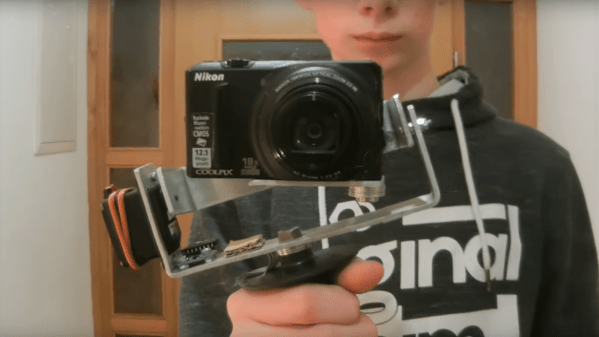
When [Tadej Strah] joined his school photography club, a fellow member who happens to have cerebral palsy needed help steadying cameras for clean shots. So rather than shell out a lot of money for a commercial gimbal, [Tadej] decided to build one for his friend. A few scraps of aluminum bar stock were bent into the gimbal frames and camera mount. Two hobby servos take care of the pitch and roll axes, controlled by an Arduino talking to an MPU-6050. Mounted to a handle from an angle grinder with the battery and electronics mounted below, the gimbal looks well-balanced and does a good job of keeping the camera level.

Hats off to [Tadej] for pitching in and solving a real world problem with his skills. We like to see people helping others directly, whether it’s building a gyroscopic spoon for Parkinson’s sufferers or vision enhancement for a nearly blind adventurer.

Continue reading “Scratch-built Camera Gimbal For Photographer With Cerebral Palsy”
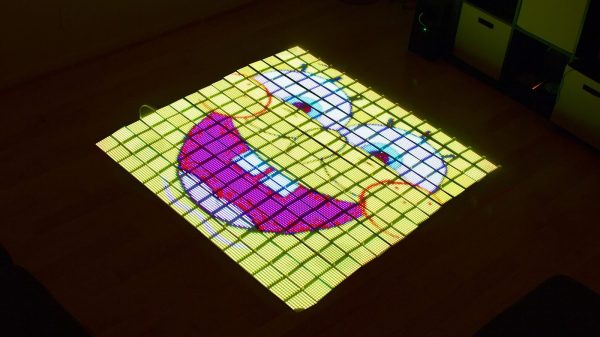
Light-Painting Robot Turns Any Floor Into Art

Is [SpongeBob SquarePants] art? Opinions will differ, but there’s little doubt about how cool it is to render a pixel-mapped time-lapse portrait of Bikini Bottom’s most famous native son with a roving light painting robot.

Inspired by the recent trend of long exposure pictures of light-adorned Roombas in darkened rooms, [Hacker House] decided to go one step beyond and make a lighted robot with less random navigational tendencies. A 3D-printed frame and wheels carries a pair of steppers and a Raspberry Pi. An 8×8 Neopixel matrix on top provides the light. The software is capable of rendering both simple vector images and rastering across a large surface to produce full-color images. You’ll notice the careful coordination between movement and light in the video below, as well as the impressive turn-on-a-dime performance of the rover, both of which make the images produced so precise.

We’ve covered a lot of light-painting videos before, including jiggering a 3D-printer and using a hanging plotter to paint. But we haven’t seen a light-painter with an essentially unlimited canvas before. We’d also love to see what two or more of these little fellows could accomplish working together.

Continue reading “Light-Painting Robot Turns Any Floor Into Art”

Can You Bull’s-Eye A Womprat With A Bean Bag?

As it turns out, a simple game of cornhole — aka, bean bag toss — can have some pretty high stakes. If you lose a round playing on this Death Star trench run cornhole table, the Rebel Alliance may pay the price.

Designed and built by [Hyperdynelabs], the table is set up to play a number of audio clips from the movie with accompanying light effects. Details on how it was made are scant, but there are at least three strips of RGBW LEDs — two that run the length of the board and one inside the exhaust port — an Arduino(presumably), and some sort of wireless connectivity to receive commands.

But it’s not just the electronic effects that make this one great. The physical build itself really nails the Death Star trench run look. This is thanks to artful use of greebles — it’s the same technique which can turn a Nissan into a Z-Wing.

When you make a shot worthy of Luke Skywalker, you’re treated to an impressive lightshow and the sound of the Death Star exploding. For a particularly bad turn, you can have the table charge up and make a show of firing back, or taunt the player if their shot goes wide.

Continue reading “Can You Bull’s-Eye A Womprat With A Bean Bag?”

Roam The Wastelands With This Fallout-Themed Mini Geiger Counter

For anyone who has worked with radioactive materials, there’s something that’s oddly comforting about the random clicks of a Geiger counter. And those comforting clicks are exactly why we like this simple pocket Geiger counter.

Another good reason to like [Tim]’s build is the Fallout theme of the case. While not an item from the game, the aesthetic he went for with the 3D-printed case certainly matches the Fallout universe. The counter itself is based on the popular Russian SBT-11A G-M tubes that are floating around eBay these days. You might recall them from coverage of this minimalist Geiger counter, and if you were inspired to buy a few of the tubes, here’s your chance for a more polished build. The case is stuffed with a LiPo pack, HV supply, and a small audio amp to drive the speaker. The video below shows it clicking merrily from a calibration source.

We can see how this project could be easily expanded — a small display that can show the counts per minute would be a great addition. But there’s something about how pocketable this is, and just the clicking alone is enough for us.

Continue reading “Roam The Wastelands With This Fallout-Themed Mini Geiger Counter”

Scrap Wood And Metal Combined For DIY Mecanum Wheels

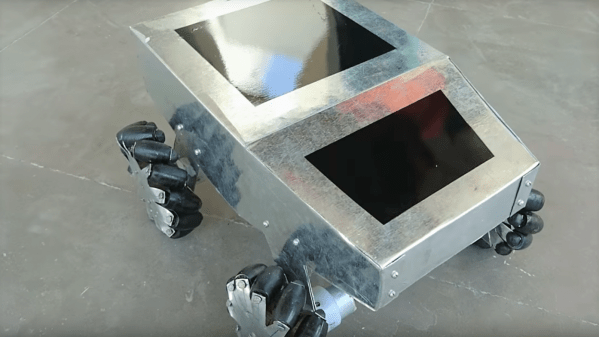
Some scrap wood, a few pieces of sheet metal, a quartet of old gear motors, and a few basic hand tools. That’s all it takes to build an omni-bot with Mecanum wheels, if you’ve got a little know-how too.

For the uninitiated, Mecanum wheels can rotate in any direction thanks to a series of tapered rollers around the circumference that are canted 45° relative to the main axle.  [Navin Khambhala]’s approach to Mecanum wheel construction is decidedly low tech and very labor intensive, but results in working wheels and a pretty agile bot. The supports for the rollers are cut from sheet steel and bent manually to hold the wooden rollers, each cut with a hole saw and tapered to a barrel shape on a makeshift lathe. Each wheel is connected directly to a gear motor shaft, and everything is mounted to a sheet steel chassis. The controls are as rudimentary as the construction methods, but the video below shows what a Mecanum-wheeled bot can do.

There’s a lot of room here for improvement, but mainly in the manufacturing methods. The entire wheel could be 3D printed, for instance, or even laser cut from MDF with a few design changes. But [Navin] scores a win for making a working wheel and a working bot from almost nothing.

Continue reading “Scrap Wood And Metal Combined For DIY Mecanum Wheels”

Automatic Deploying Lightning Rod

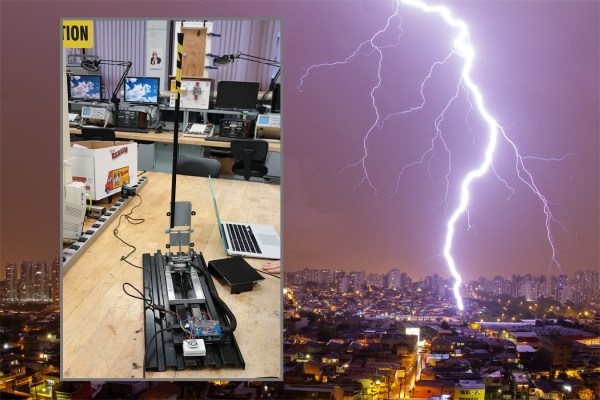
As hackers, hams, and builders of all sorts of things that go in our yards or are attached to our houses we often encounter resistance from building associations and by-laws regarding what to us are harmless necessities but to others are risks to their sight-lines, property values, or are seen as safety hazards. A student at the Bergen County Academies Mechatronics Research Lab has identified this same issue with lightning rods for homes, monuments, and buildings of fine architecture; people don’t want to add unsightly lightning rods despite their proven protections. Her solution? Detect when a storm is approaching and automatically deploy the lightning rod for the duration of the storm.

To detect the approaching storm she’s monitoring the changing barometric pressure using an Adafruit BMP085 barometric pressure, temperature and altitude sensor (now replaced by the BME280) connected to an Arduino with a motor shield. If the pressure is low and the trend has been decreasing then she pivots the lightning rod up using a motor salvaged from a satellite dish. When the risk abates, she pivots the rod back down again. Admittedly the lightning rod has yet to be attached and care will have to be taken with how the discharge cable is deployed but it’s a start. You can see it in action in the video below.

Continue reading “Automatic Deploying Lightning Rod”

Supersonic Speed Measurement With A Sound Card

You might think that if you have a need to measure the speed of a projectile that is too fast for your high-speed camera, you would have to invest in some significantly expensive equipment.

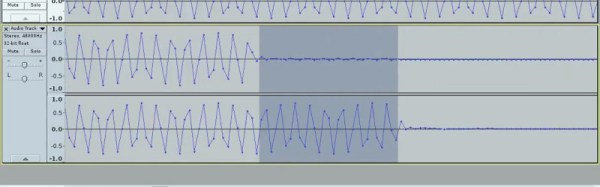
That was the problem facing [Nick Moore], and the solution he arrived at is extremely elegant in its simplicity. He’s arranged a pair of foil tapes in the path of the projectile, as it passes through them they break, and he measures the time between those breaks. The clever bit though lies not in the tapes, but in how he measures the timing. Instead of relying on a lab stuffed with equipment, he’s using his computer sound card. The outputs send a tone through each tape to the inputs, and using Audacity he can capture both tones and measure the time between the end of each one on left and right channels.

In the video below the break he demonstrates measuring the speed of a supersonic particle at 496.5 metres per second, which for such relatively simple equipment is rather an achievement. He could certainly improve his resolution by increasing the sampling frequency, but we are guessing that the choice of 48 kHz owes much to the quality of his sound card. Still, to achieve this with such a relatively basic piece of equipment is a neat achievement.

Continue reading “Supersonic Speed Measurement With A Sound Card”