Telegram Your Devices

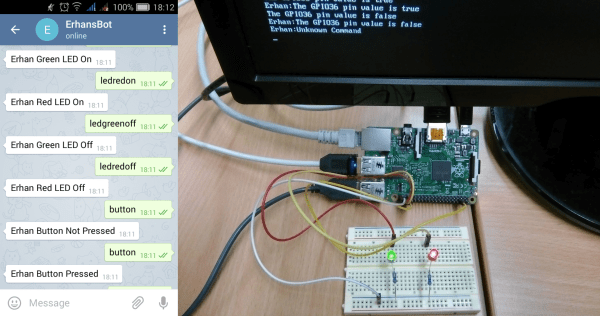
[Erhan] has been playing around with the Telegram instant messaging service. Initially, he worked out how to turn on and off LEDs from his cell phone: he sent commands from the phone through the Telegram bot API, to a computer that’s connected over serial to an MSP430 board that actually controlled the LEDs.

But that’s a little bit complicated. Better to cut out the middleman (err…microcontroller) and implement the Telegram reception and LED blinking on a Raspberry Pi. For a project that’s already using a Pi, using the instant messaging service’s resources is a very simple way to interface to a cellphone.

The code for both the standalone RPi project and the MSP430-based microcontroller application are available at [Erhan]’s GitHub. You’re going to be installing Node.js for their telegram-bot-api and jumping through the usual OAuth hoops to get your bot registered with Telegram. But once you’ve done that all on the Raspberry Pi (or target computer of your choice) it’s all just a few lines of fairly high-level code.

We’ve only seen one other Telegram application on Hackaday.io and we’re wondering why. It looks pretty slick, and with the bot’s ability to send a custom “keyboard” to the phone along with the message, it could make cell-phone-based control interfaces a cinch. Anyone else using Telegram for bots?

Robotic Pets Test An Automatic Pet Door

Lots of people get a pet and then hack solutions that help them care for their new friend, like an automatic door to provide access to the great outdoors. Then again, some people build the pet door first and then build the pets to test it.

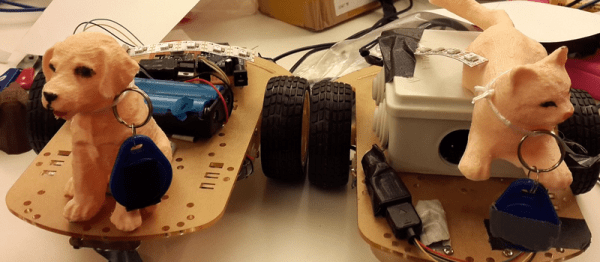
It’s actually not quite as weird as it sounds. [Amir Avni] and his wife attended a recent GeekCon and entered the GeekCon Pets event. GeekCon is a cooperative rather than competitive hackathon that encourages useless builds as a means to foster community and to just have some fun. [Amir] and his wife wanted to build a full-featured automatic pet door, and succeeded – with NFC and an ESP8266, the stepper-powered door worked exactly as planned. But without any actual animal companions to test the system, they had to hack up a few volunteers. They came up with a 3D-printed dog and cat perched atop wireless cars, and with NFC tags dangling from their collars, the door was able to differentiate between the wandering ersatz animals. The video below the break shows the adorable plastic pals in action.

It’s clear from all the pet doors and automatic waterers and feeders we’ve seen that hackers love their pets, but we’re pretty sure this is the first time the pet itself was replaced by a robot. That’s fine for the test environment, but we’d recommend the real thing for production.

Continue reading “Robotic Pets Test An Automatic Pet Door”

Google Contest Builds More Efficient Inverters

A few summers ago, Google and IEEE announced a one million dollar prize to build the most efficient and compact DC to AC inverter. It was called the Little Box Challenge, with the goal of a 2kW inverter with a power density greater than 50 Watts per cubic inch.

To put this goal into perspective, the DC inverter that would plug into a cigarette lighter in your car has a power density of about 1 or 2 Watts per cubic inch. Very expensive inverters meant for solar installations have a power density of about 5 Watts per cubic inch. This competition aimed to build an inverter with ten times the power density of what is available today.

Now, the results are in, and the results are extremely surprising. The best entry didn’t just meet the goal of 50 W/in³, it blew the goal out of the water.

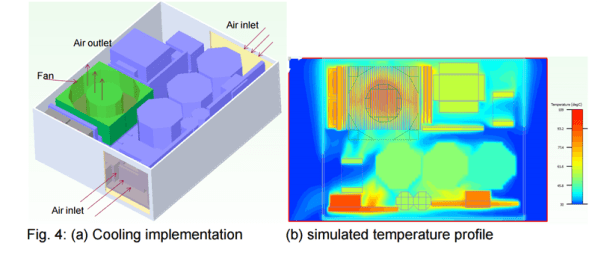
The winning entry (PDF) comes from CE+T Power, and comes in a package with a volume of 13.77 in³. That’s a power density of 143 W/in³ for a unit you can hold in the palm of your hand. The biggest innovations come from the use of GaN transistors and an incredible thermal management solution.

Other finalists for this competition include Schneider Electric Team from France that managed a 100 W/in³ and a Virginia Tech team that managed a power density of 61.2 W/in³.

Thanks [wvdv2002] for the tip.

Colin Furze Gets Burned

Consider this a public service announcement. [Colin Furze], besides being a raging lunatic, seems to have the nine lives of a cat. Well, he’s not always so lucky, and now that we’ve recovered from being grossed out by the results, we’re glad that [Colin] posted this “fail” video.

Basically, he’s firing up one of his jet engines, and there’s a big fireball. He wasn’t wearing any protective clothing. This is hardly a spoiler — please don’t watch the video below if you’re grossed out by people visiting the doctor’s office to get their horrible second degree burns all up and down their forearm treated. You’ve probably learned the lesson already just by looking at the preview image.

Naturally, we’ve covered [Colin]’s videos before. He’s either very lucky or a little bit more careful than he lets on. We’ve seen him play with fire and not get burned, and stick a jet engine on a go-kart. We’re not gonna tell you what to do, but if that were us, we’d be wearing at least long sleeves and a helmet.

Continue reading “Colin Furze Gets Burned”

Build Your Own Sensor Skin

Scientific research, especially in the area of robotics, often leverages cutting-edge technology. Labs filled with the latest measurement and fabrication gear are unleashed on the really tough problems, like how to simulate the exquisite sensing abilities of human skin. One lab doing work in this area has taken a different approach, though, by building multi-functional sensors arrays from paper.

A group from the King Abdullah University of Science and Technology in Saudi Arabia, led by [Muhammad M. Hussain], has published a fascinating paper that’s a tour de force of getting a lot done with nothing. Common household items, like Post-It notes, kitchen sponges, tissue paper, and tin foil, are used to form the basis of what they call “paper skin”. Fabrication techniques – scissors and tape – are ridiculously simple and accessible to anyone who made it through kindergarten.

They do turn to a Circuit Scribe pen for some of their sensors, but even this nod to high technology is well within their stated goal of making it possible for anyone to fabricate sensors at home. The paper goes into great detail about how the sensors are made, how they interact, and how they are interfaced. It’s worth a read to see what you can accomplish with scraps.

For another low-tech paper-based sensor, check out this capacitive touch sensor keyboard.

Thanks for the tip, [Mattias]

2,100 Mechanical Mechanisms

[Nguyen Duc Thang]’s epic 2100 Animated Mechanical Mechanisms is one of the best YouTube channels we’ve ever seen. A retired mechanical engineer, [Nguyen Duc Thang] has taken on an immense challenge: building up 3D models of nearly every imaginable mechanism in Autodesk Inventor, and animating them for your amusement and enlightenment. And, no, we haven’t watched them all for you, but we’re confident that you’ll be able to waste at least a couple of hours without our help.

If you’re actually looking for something specific, with this many mechanisms demonstrated, YouTube is not the perfect lookup table. Thankfully, [Nguyen Duc Thang] has also produced a few hundred pages of documentation (PDFs, zipped) to go along with the series, with each mechanism classified, described, and linked to the video.

This is an amazing resource as it stands, and it’s probably a good thing that we don’t have access to the 3D files; between the filament cost and the time spent shepherding our 3D printer through 2,100 mechanisms, we’d be ruined. Good thing we don’t know about the Digital Mechanism and Gear Library or KMODDL.

Thanks [alnwlsn] for the tip!
Continue reading “2,100 Mechanical Mechanisms”

Dr Noirimetla, Private Failure Investigator And The Mystery Of Galileo’s Pillars

One dark and stormy morning, Dr. Richard Noirimetla, private failure investigator, was sitting at his desk nursing his morning cup of joe. It was an addiction, but life, and engineering was hard. Intense eyes sat in a round dark-skinned face. An engineering degree from the prestigious Indian Institute of Technology hung from the wall in his sparse office. Lightning flashed outside of his window, as the rain began to beat even harder against his corner office windows.

His phone rang.

“Hello, Dr. Noirimetla, Private Failure Investigator here.” He said in deep, polite voice. “How may I help you?”

“Ah, I’m Chief of Manufacturing for Galileo Concrete Pillars Inc. We have a bit of a problem here. We used to see a failure rate above 33% for our concrete pillar operation. As part of our lean manufacturing efforts we tried to reduce that number through various improvements. However, we see a failure rate of almost 50% now. We expect foul play… from one of our suppliers. Can you come right away?” a worried man’s voice sounded over the phone.

“I see, that’s very troubling,” Noirimetla rumbled. “I’ll send over the contract detail. There will be an increased fee, but I’m on my way.”

“Sounds good, we’ll pay anything! Just get our operation up to standards!” The man bid a polite goodbye and hung up.
Continue reading “Dr Noirimetla, Private Failure Investigator And The Mystery Of Galileo’s Pillars”