Frackers: Inside The Mind Of The Junk Hacker

Hackers can be a diverse bunch. My old hackerspace had folks ranging from NSA employees (ahem, independent security contractors) to space-probe pilots to anarchist vegan punks. And we all got along because we shared a common love for what we’re doing. One summer night we were out late in Adams Morgan and my vegan-punk friend reaches into the trash can and pulls out a discarded pepperoni Jumbo Slice.

“Wait a minute! Vegans don’t eat pepperoni pizza with cheese.” But my friend was a “freegan” — a vegan who, for ethical reasons, won’t buy meat or milk but who also won’t turn it down if it’s visibly going to waste. It’s actually quite a practical and principled moral proposal if you think about it: he’s not contributing to the use of animals that he opposes, but he gets to have a slice of pizza just the same. And fishing a slice of pizza, in a cardboard container, off the top of the trashcan isn’t as gross as you’d imagine, although it pays to be picky.

A Fracker is Born

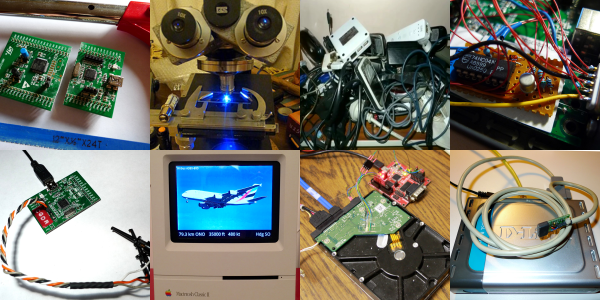
That was the night that we realized we all had something deeper in common: we were all “frackers”. If you’ve been around hackers long enough, you’ll have noticed this tendency, but maybe you’ve never put a name to it. Tearing something apart, even if you might break it in the process, isn’t a problem if you fished it out of the e-waste stream to begin with. If you’re able to turn it into something, so much the better. It’s all upside. Need practice de-soldering tricky ICs? Looking for a cheap target to learn reverse engineering on? Off to the trashcan! No hack is too dirty, no method too barbaric. It’s already junk, and you’re a fracker.
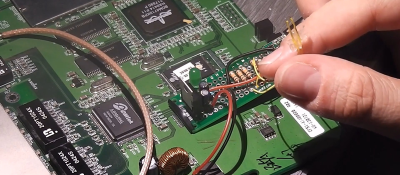
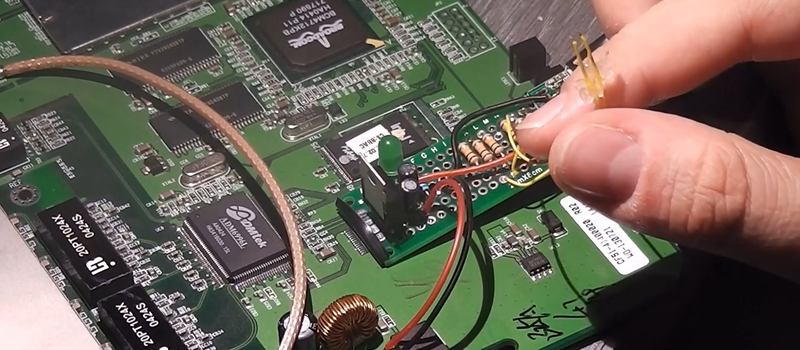
internet_radio_wrt54g-shot0008_featuredDo you have a junk shelf where you keep old heatsinks in case you need to cut some up and use it? Have you used a heat gun more frequently for harvesting parts than for stripping paint? Do you know that certain satisfaction that you get from pulling some old tech out of the junk pile and either fixing it up again or, better yet, making it do something else? You might just be a fracker too.

Continue reading “Frackers: Inside The Mind Of The Junk Hacker”

Picture Frame Mashup Taps Subreddits For “Deep Thoughts”

Remember “Deep Thoughts by Jack Handey”? We do, and we always enjoyed the quirky mix of soothing music, soft-focus nature images, and random absurd thought scrolling across the screen as bumpers between segments on Saturday Night Live. Clearly, [tvm78] remembers them, because his picture frame mashups of the r/EarthPorn and r/ShowerThoughts subreddits could have been written by Jack himself.

While [tvm78] shares no photos of his build and offers no tutorials, he makes it clear that this was his first build of any kind. He does offer a few details, like the fact that he’s driving a display with a Raspberry Pi, and he handily references a similar build that includes the code he borrowed to make his frame happen. While we feel that the original mashup works well, several helpful redditors offer suggestions for other combinations, like r/ArchitecturePorn and /r/nocontext, or r/abandonedporn and r/onelinehorror. Of course a straight grab from r/demotivational could be fun too.

We’ve seen tons of web-enabled picture frames before, and plenty of “magic mirror” builds that display useful information on a two-way mirror. But this one appeals to the cynic in us, and would make Jack Handey proud.

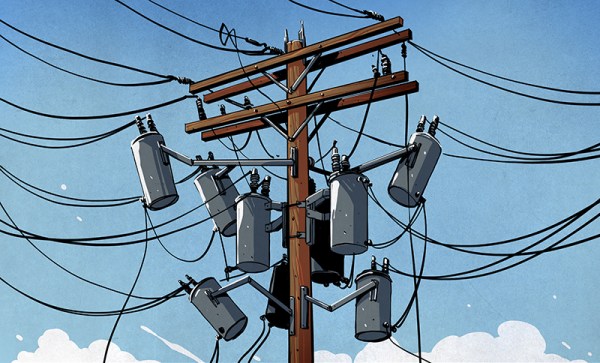
A Field Guide To The North American Utility Pole

We live under the umbrella of an intricate and fascinating web of infrastructure that enables every aspect of modern technology. But how often do we really look at it? I’ve been intrigued by utility poles for years, and I’ve picked up a thing or two that I’d like to share. Bear in mind these are just my observations from the ground in my area; I’m sure utility professionals will have better information, and regional practices will no doubt lead to very different equipment arrangements. But here’s a little of what I’ve picked up over my years as a pole geek.

Continue reading “A Field Guide To The North American Utility Pole”

Punch Card Reader For The 10 Types Of People In The World

Punch card data input is so 1890 US Census, right? Maybe not, if your goal is to educate kids about binary numbers and how they can encode characters. In which case, this paper clip and metal tape punch card reader might be just the thing you need.

Built as part of the educational outreach efforts of the MakeICT hackerspace, this project allows kids and adults to play with binary numbers and get some instant feedback. The reader itself is a simple affair of wood and plastic; bent paperclips make contact with a foil tape strip and LEDs show the state of the five input bits. A card is provided to students with spaces for the letters of a word that they want to input, along with a table to translate each letter into a number. Students use a paper punch to encode each character in binary. As the card is pulled through the reader, the letters are spoken by the Pi in turn and the whole word is pronounced at the end.

We’ll no doubt hear quibbles with the decision not to use ASCII for the character set, but we can see the logic in keeping the number of bits to a minimum and not distracting from the learning process. What’s cool about this is that it engages kids on so many levels. They learn about binary numbers, encoding systems, interfacing a computer to the real world, and if they care to delve deeper, they can learn about the code behind everything. It’s a great hook into the hacking arts.

And once the kids learn a thing or two, maybe they can use this punch-card Twitter interface to tweet their new-found knowledge.


Raspberry_Pi_LogoSmall

The Raspberry Pi Zero contest is presented by Hackaday and Adafruit. Prizes include Raspberry Pi Zeros from Adafruit and gift cards to The Hackaday Store!
See All the Entries || Enter Your Project Now!

Rope Braiding Machine Built Entirely From LEGO Technics

If you’ve ever seen a rope-braiding machine in action, you know they’re amazing machines where bobbins of thread whirl and spin in a complex dance to weave the threads under and over each other. Building one of these machines must be incredibly difficult; building one out of LEGO Technics pieces is darn near insane.

[Nico71], as hardcore a Technics builder as they come, tackled this complex build and made it work. A large drum spins horizontally and carries three groups of three planetary-mounted thread bobbins. The entire drum spins in one direction while the bobbins and another die with three holes spin the other way. The resulting braids are then fed through another spinning die, and the resulting 9-strand rope is taken up by a winding drum. The drum has a self-reversing feeding mechanism to keep the finished spool neat and tidy. The most impressive thing about the build, though, is the fact that it’s all powered by a single motor, and that everything is synchronized via gears, shafts, sprockets, chains and clutches. It’s a Technics tour de force you can see in action after the break.

[Nico71]’s build are pretty amazing. Some are pure art, others are models of classic cars and motorcycles, but things like his loom and the calculator he’s working on now are remarkable. Of course if you need to see more of the mesmerizing ballet of rope-braiding machines, check out this 16-bobbin hand-cranked version.

Continue reading “Rope Braiding Machine Built Entirely From LEGO Technics”

Variable Instruction Computing: What Is Old Is New Again

Every twenty to twenty-five years, trends and fads start reappearing. 2016 is shaping up to be a repeat of 1992; the X-files is back on the air, and a three-way presidential election is a possibility. Star Trek is coming back, again. Roll these observations back another twenty-five years, and you have The Outer LimitsStar Trek, and riots at the DNC convention in Chicago.

History repeating itself is not the exclusive domain of politics and popular culture. It happens with tech, too: the cloud is just an extension of thin clients which are an extension of time-sharing. Everything old is new again.

For the last few years, Soft Machines, a fabless semiconductor company running in stealth mode, released the first preview for an entirely new processor architecture. This new architecture, VISC, offers higher performance per Watt than anything available on the market. If you’ve been paying attention for the last decade or so, the future of computing isn’t 200-Watt space heaters that also double as powerful CPUs. The future is low power machines that are good enough to run Facebook or run some JavaScript. With servers, performance per Watt is possibly the most important metric. How will Soft Machines upend the semiconductor market with new processors and new architectures? If you know your history, it shouldn’t be a surprise.

Continue reading “Variable Instruction Computing: What Is Old Is New Again”

All This Bike Needs Is Some Snow!

It’s safe to say that the southern UK is not known for its winter snowfall. If you have lived through a British February then the chances are you’ll know a lot about rain and grey skies.

Happily this hasn’t deterred [Stuart]. Ever the optimist, he’s turned a pile of scrap metal and an unloved mountain bike into a fully functional ski-bike, and he’s just ready to go should the jet stream deliver a covering of the white stuff on the Thames Valley.

Using the facilities of rLab – Reading Makerspsce (he’s also a founder member of the up-and-coming Newbury and District Hackspace), [Stuart] didn’t just bodge together his “iCycle”. Instead he’s made it a really high quality build, with CNC’d aluminium fork stanchions to mount his skis, and foot pegs that are engineered not to let him down on the slopes. Best of all, the bike is nearly all made from scrap materials, only the bearings, axles and paint were brought in for the project.

Skiing hasn’t been featured very often in our coverage of the world of makers, however we have featured a skiing robot, back in 2009.