7400 Frequency Counter

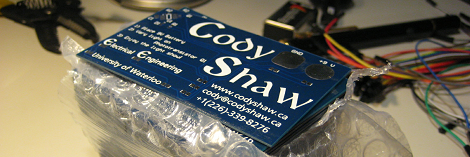
This frequency counter is [Miguel Pedroso’s] entry in the 7400 Logic contest. After looking at the design we think this is a perfect project for those who have not worked with logic ICs before. The concept is simple and [Miguel] does a great job of explaining his implementation.

At its heart the device simply counts the oscillations of an input signal for one second, then latches the total to the 7-segment displays before zeroing the counter block and starting over. Six 4029 decade counters give the device a range of 1MHz. A set of 4511 BCD to 7-segment decoders translate the count to the display. A 4521 frequency divider chip uses an on-board 4.194304 MHz crystal oscillator to time both the display latching and the counter clearing. [Miguel] mentions that tuning the load capacitors is a bit tricky. Since breadboards have their own capacitance issues it may be necessary to change the load capacitor values when moved to protoboard or the crystal won’t start oscillating. You can see those caps are not the same value, but the tests in the video after the break show that this is pretty much spot-on.

If you’d rather give this a try in HDL here’s an FPGA-based frequency counter from which you can draw some inspiration.

Continue reading “7400 Frequency Counter”

Two-player Tic-Tac-Toe From Logic Chips

Here’s another entry in the 7400 Logic contest. [Circuitchef] used gates and a few flip-flops to build a two-player electronic Tic-Tac-Toe game. The full details or shared in the PDF file he links to in his post. We’ve also linked to it after the break in case the Dropbox he is using becomes unavailable.

He provides a nice block diagram which helps to understand the game’s design. The board is arranged in a 3×3 matrix of momentary push buttons and bi-color LEDs. Each player takes turns pushing the button in the square they’d like to claim. The input circuitry uses flip-flops to establish which player’s turn it is, illuminating the appropriate color for that square. A set of 3-input AND gates monitor all possible combinations of winning patterns. The outputs of those gates are OR’d down to just one output which is used to light up the ‘Winner’ LED with the right color. If all boxes are lit up and none of those combinations is satisfied the game is declared a draw. This can all be seen in the demo embedded below the fold.

Continue reading “Two-player Tic-Tac-Toe From Logic Chips”

On Not Proving The Twin Prime Conjecture With AutoCAD

As an HVAC engineer by trade, [Carlos Paris] spends a lot of time in AutoCAD designing all those hidden pipes, tubes, and ducts hidden in a building’s rafters. One day, [Carlos] read of an open contest – the prize was over a million dollars – to generate a prime number with a billion digits. [Carlos] misheard this as, ‘a prime number greater than one billion’ and of course said this was a trivially easy task and opened up his favorite tool – AutoCAD – in an effort to discover the largest prime ever. [Carlos] never generated a remarkably large prime, but he did come up with a very, very cool visualization of prime numbers on a number line, as well as a great justification of the twin prime conjecture, a problem in mathematics that has remained unsolved for several generations.

[Carlos] started his investigations into the properties of prime numbers by drawing a series of circles on a number line in AutoCAD. These circles were of diameters of all the integers, and going down the number line, these circles started to have an interesting, chaotic pattern (see above picture). [Carlos] found that whenever two circles intersected, that position was a prime number. It’s really nothing more than a Sieve of Eratosthenes, but it’s a very cool-looking visualization nonetheless.

Looking deeper into his graph, [Carlos] discovered there were certain primes that had another prime number just two places down the number line. For example, the numbers 3 and 5, 29 and 31, and 41,and 43 are twin primes, as the difference between the primes is only 2. The idea there are infinitely many twin primes is a famous unsolved problem in mathematics – it’s obvious it must be true, but no mathematician has yet come up with a proof of this conjecture.

[Carlos] looked at his number line and simplified it to a generic prime number. By taking a generic number line and overlaying the multiples of other prime numbers on this graph, [Carlos] had a very, very clever way of understanding exactly how twin primes come into existence.

In the end, [Carlos] is no closer to proving the twin prime conjecture than anyone else. We’ve got to hand it to him, though, for nerding out with an engineer’s favorite tool – AutoCAD – and managing to derive some fairly obscure mathematics on his own.

After the break you can see [Carlos]’s videos describing the though process that went into his creation. Very, very cool work.

Continue reading “On Not Proving The Twin Prime Conjecture With AutoCAD”

Pull-string Most Useless Machine

The mechanical simplicity of this pull-string controlled most useless machine is delightful. You can see the metal gripper which is reaching up to tug on a light-fixture-style pull chain. This is how it turns itself off after you’ve pulled the string to power it up.

The device is [Alex555’s] entry in the 7400 Logic competition. We do hope that he ends up posting a schematic because we’d love to see the gritty details of how it works. After the break you can watch two doors open, allowing the arm to raise up and the gripper to grab the chain. This takes just four servo motors, which are controlled by the signal from a 555 timer and some accompanying hardware.

Apparently the chain is a fake, as the servos didn’t provide enough force to actuate that type of switch. It’s not a surprise as those pull chains do require quite a tug. An optical sensor was used to trigger the movement when your hand reaches for the chain.

Continue reading “Pull-string Most Useless Machine”

Computer Tracking Of Billiard Balls

The folks at the London-based startup GoCardless have a pool table at their office. Being the techies they are, they decided to build a system that automatically scores games. The results, while not fully complete, are still pretty impressive for something whipped up during a 48 hour hackathon.

The automated score keeper uses a webcam duct taped to the ceiling right above the center of the pool table, The balls – red and yellow balls replace the rainbow of solids and stripes to make things easier – are found using OpenCV.

This build isn’t quite finished yet. The people at GoCardless are looking to improve the accuracy of their setup by using a camera with a higher frame rate and possibly moving on to physics simulation to predict where the balls should be. If these guys get the time, they could add something like augmented reality pool table to improve shot accuracy.

Vidia after the break.

Continue reading “Computer Tracking Of Billiard Balls”

Launching A Balloon And Not Landing In The Ocean

In just a few short hours, the Yale Undergraduate Aerospace Association will launch their 4th high altitude balloon project into the rarefied air of the stratosphere and with any luck bring back pictures of the view high above Connecticut  Long Island, Rhode Island, and Martha’s Vineyard.

Inside their surprisingly strong unibody chassis is two GoPro cameras and a triple-redundant telemetry system consisting of a custom radio system capable of transmitting over 40 miles, a cell-phone based comms system and a SPOT satellite tracker.

There is one very large problem the Yale Aerospace team has had to cope with; Because they’re launching their Skyview balloon from the eastern seaboard of the US, it’s very likely their payload could end up taking a drink in the Atlantic. To solve this problem, the team developed a novel cut-down solution: a piece of nichrome heater wire is wrapped around the line tying the payload to the balloon. If the hardware receives a signal from the ground, or has a software problem, or runs out of battery power, the nichrome circuit will release the balloon from its launch vehicle to hopefully return it to solid ground.

The Yale Aerospace team has also written a custom iOS app allowing the chase cars to track the balloon in real time – a great feature if you’re trying to communicate with several cars going down the highway. You can check out the live data from the balloon on the Yale Aerospace tracking site or just head over to their twitter to read the latest news about the flight.

Scratch-built Motor Uses A Clever Design

[Lou] is on a hot streak when it comes to interesting builds. This time around he made his own motor using wood, PVC, some fasteners, and a bunch of enameled wire.

His method of building a commutator is intriguing. He first builds a rotor by cutting two opposing sides off of a PVC four-way connector and pushing a short galvanized pipe through what’s left. After adding two PVC nubs with caps and nails as pivot points he wraps the PVC and metal pipe with a continuous length of enameled wire. The enamel is then sanded off the windings around the PVC, and half is covered with electrical tape. The spinning rotor will cause the brushes to contact the bare wire during half of the rotation, and be insulated by the tape during the other half. The video after the break shows the motor in action, then walks you through each step of the build.

If you liked this video you should check out [Lou’s] water bottle rocket launcher, or his automated Ping Pong table topper which stores the game in the ceiling.

Continue reading “Scratch-built Motor Uses A Clever Design”