A 3D-printed scale model of the mechanism inside a grand piano.

Printed Piano Mechanism Sure Is Grand

Do you know how a piano works? Sure, you press a key and a hammer strikes a string, but what are the finer points of this operation? The intricacy of the ingenious mechanism is laid bare in [Mechanistic]’s 3D-printed scale model of a small section of the grand piano keyboard. The ‘grand’ distinction here is piano length-agnostic and simply refers to any non-upright. Those operate the same way, but are laid out differently in order to save space.
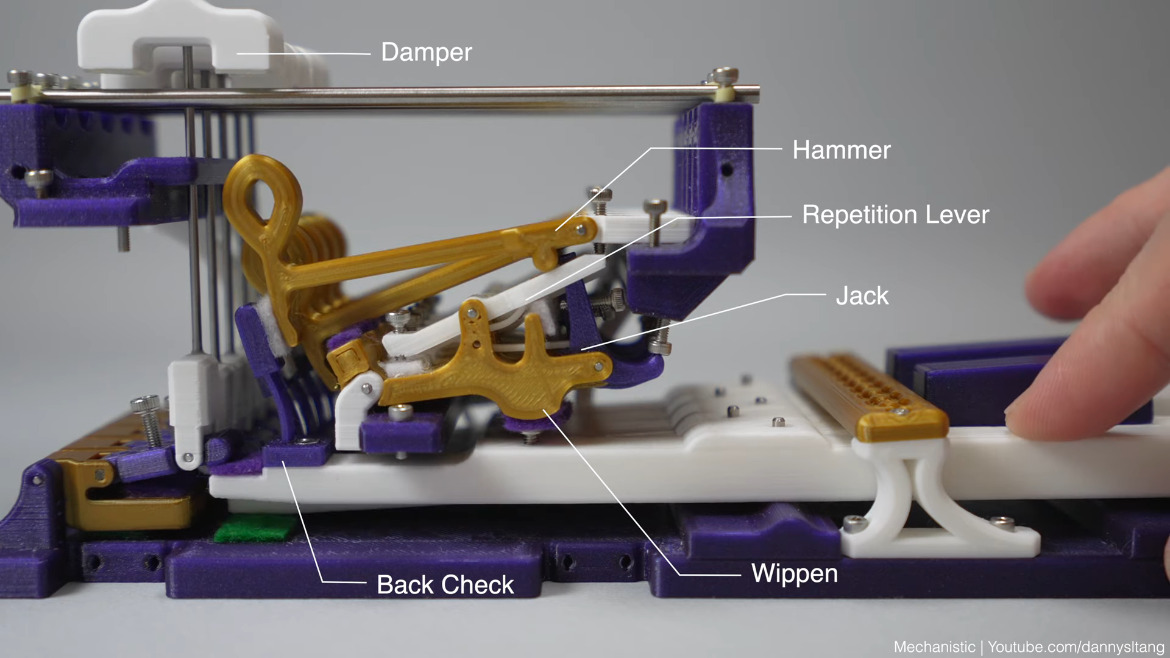
The keys of an acoustic piano are much longer than just the part that shows — they are long levers that do a lot of work, including working their own sound dampeners. The really interesting part is the mechanism that allows a note to be played repeatedly without first releasing the key. This same mechanism also lets the pianist play softly, loudly, or somewhere in between based on the amount of pressure applied.

So you know that the hammer strikes the string (or in this case, the rod), and you can probably figure that it backs off to let the string ring out. But there’s also this whole system that keeps the hammer close by for repeated strikings, as long as the person is holding down the key. Be sure to check it out in the build video after the break.

[Mechanistic] must be going for the standing ovation, because they say in the video’s comments that they will release STL files when they’re finished writing the assembly guide (!). What an encore that will be.

There are many ways to hack an acoustic piano, but don’t go thinking you can sub in guitar strings.

Continue reading “Printed Piano Mechanism Sure Is Grand”

Hacking An IKEA Lampshade Into A Stunning Dichroic Lamp

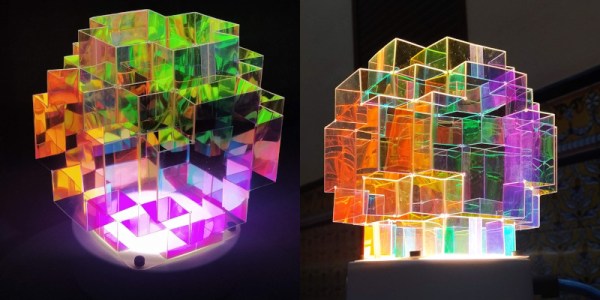
Often, when we see a colorful lamp project, it’s something that makes use of RGB LEDs and all manner of lovely animations and fading effects. This project from [Raymond Power] features beautiful shifting colors, but foregos fancy LEDs for the magic of dichroic film.

Dichroic films work with thin-film interference, with the wavelength of light passed through the film changing depending on the angle of incidence. Thus, as the observer’s viewing angle changes, the apparent color of the film changes, too. It creates particularly beautiful effects when several layers of film are laid on top of each other.

[Raymond] happened to source some of this film from a fancy IKEA lampshade. At the time, he’d been experimenting with folding paper cubes and similar constructions, and decided to meld the two ideas.

The result was a cubic dichroic lampshade, which looks truly fantastic. Sitting on top of a simple white LED light, the structure lights up with a rich blend of complementary and shifting colors.

It’s a beautiful thing, and something we’d love to have in our own home. Dichroic materials find themselves being used in some more scientific uses, too. Video after the break.

Continue reading “Hacking An IKEA Lampshade Into A Stunning Dichroic Lamp”

Successive approximation register ADC

Homebrew Circuit Explores The Mysteries Of Analog-to-Digital Conversion

When it comes to getting signals from an analog world into our computers, most of us don’t give much thought to how the hardware that does the job works. But as it turns out, there are a number of ways to skin the analog to digital conversion cat, and building your own homebrew successive approximation register ADC is a great way to dispel some of the mystery.

From his description of the project, it’s clear that [Mitsuru Yamada] wasn’t looking to build a practical ADC, but was more interested in what he could learn by rolling his own. A successive approximation register ADC works by quickly cycling through all possible voltage levels in its input range, eventually zeroing in on the voltage of the input signal at that moment and outputting its digital representation. The video below shows how the SAR ADC works visually, using an oscilloscope to show both the input voltage and the output of the internal R-2R DAC. The ADC has an input range of 0 V to 5 V and seven bits of resolution and uses nothing but commonly available 74xx series logic chips and a couple of easily sourced analogs for the sample-hold and comparator section. And as usual with one of his projects, the build quality and workmanship are impeccable.

We love these sorts of projects, which are undertaken simply for the joy of building something and learning how it works. For more of [Yamada-san]’s projects, check out his 6502-based RPN calculator, or the serial terminal that should have been.

Continue reading “Homebrew Circuit Explores The Mysteries Of Analog-to-Digital Conversion”

Halloween Build: Exquisite Ray Gun Has Sound Effects

When we first saw [lonesoulsurfer’s] ray gun, we thought it looked oddly familiar. Sure, it looks like a vintage ray gun you might see in a dozen 1950-era movies or TV shows. But still, there was something oddly familiar about it. Turns out, the core piece of it is an old-fashioned timing light used when doing a car tune-up.

This is no unobtrusive Star Trek phaser. It looks substantial and has a cool sound generator that not only gives it something to do but also sports cool control knobs out the top of the gun. The design files for the sound circuit are in a Google drive folder if you want to recreate the build.

Continue reading “Halloween Build: Exquisite Ray Gun Has Sound Effects”

Yes, You Can Put Out A Burning Gas Well With A Nuclear Bomb

Nuclear explosives were first developed as weapons of war in the pitched environment of World War II. However, after the war had passed, thoughts turned to alternative uses for this new powerful technology. Scientists and engineers alike dreamed up wild schemes to dig new canals or blast humans into space with the mighty power of the atom.

Few of these ever came to pass, with radiological concerns being the most common reason why. However, the Soviet Union did in fact manage to put nuclear explosions to good use for civilian ends. One of the first examples was using a nuke to plug an out-of-control gas well in the mid 1960s.

Continue reading “Yes, You Can Put Out A Burning Gas Well With A Nuclear Bomb”

Bicycles Are Bad At Towing, Even With Crawler Gears

Gearing can make a huge difference to a cyclist, enabling even the least fit rider to climb a steep hill, albeit slowly. [Berm Peak Express] took that to the next level, creating a super-low geared bicycle capable of actually towing seriously heavy loads.

The build consists of a custom 74-tooth sprocket for the rear wheel, paired with a 24-tooth chain ring for the pedals. The custom sprocket doesn’t have any holes drilled or other lightening measures taken, but given the slow speeds involved, the extra rotating mass probably isn’t much of an issue. With that gearing, 3.08 turns of the pedals will result in just one turn of the rear wheel, with the aim to provide tractor-like torque with the trade-off being incredibly low forward speed.

Installing the giant rear cog required using a 3D-printed guide to keep the chain tensioned, and the rear brakes are entirely absent, but it all came together. Bikes aren’t built for towing, and some issues are faced with dragging a Jeep as the bike struggles with balance and traction. However, with some effort, a grown adult can be towed in a child carriage up a hill, no problems.

The bike proves difficult to ride as the forward speed is so slow that balance is problematic. However, it was interesting to see the experiment run, and the wear marks on the hub from the huge loads put through the rear wheel. If you’re digging the weird bikes, though, check out this hubless design as well. Video after the break.

Continue reading “Bicycles Are Bad At Towing, Even With Crawler Gears”

A Glowing Potato Peeler Makes A Nernst Lamp

Over the last couple few decades there has been a great shift in electric lighting, first towards more compact and efficient fluorescent lights, and then towards LED bulbs. The old incandescent bulbs, while giving a pleasant light, were not by any means efficient. Digging into the history books the incandescent bulb as we know it was not the only game in town; while suspending a filament in a vacuum stopped it from being oxidized there was another type of light that used a ceramic element at atmospheric pressure. The Nernst lamp required its filament to be heated before it would conduct electricity, and [Drop Table Adventures] has made one using the blade from a ceramic potato peeler.

The right ceramic is not the problem given the ease of finding ceramic kitchen utensils, but two problems make a practical light difficult. The copper connections themselves become too hot and oxidize, and preheating the ceramic with a blowtorch is difficult while also keeping an even heat. Finally, they do manage a self-sustaining lamp, albeit not the brightest one.

If you think the Nernst lamp sounds familiar, maybe it’s because we covered it as part of our retrotechtacular series.

Continue reading “A Glowing Potato Peeler Makes A Nernst Lamp”