DIY MP3 Player Shows That No Hack Is Ever Obsolete

wacken_death_box

[Ole Wolf] wrote in to tell us about a project he has been working on for several years now. The Wacken Death Box serves as a reminder that once you start a DIY project, it’s probably a good idea to finish it in a reasonable amount of time, lest it risk becoming obsolete.

His Death Box is an MP3 player that he takes along on his annual trip to the Wacken Open Air Festival. His goal was to construct a portable amplified music player that could be powered from either a car battery or charger. A Via EPIA Mini-ITX computer serves as the brains of the device, blaring his tunes from a set of car loudspeakers via a two-channel 100W amp.

[Ole Wolf] used the music player for a few years, improving it as he went along. He does admit however, that with the continually dropping prices of MP3 players, he decided to bring a small portable unit along with him to the 2010 festival, leaving his box at home.

Given the fact that far smaller and more portable devices make his music box seem clunky and obsolete in comparison, you might ask why he even keeps it around. We think that every hack has its place, and while you won’t be strapping the Death Box on your back for your morning jog, it fits quite well in a variety of situations. This rugged music box would be an appropriate choice to use in your workshop, at the beach, or even on a construction job site – places where you might not want to use your comparatively fragile iDevice.

MIDI Drum Interface Helps You Step Up Your Game

rb_drum_trigger

[Dan] likes Rock Band, but playing it makes him feel as useful as a one-legged man in an ass-kicking a drumming contest. He says that even using his friend’s ION kit leaves him searching out excuses as to why he’s not as good as he should be on the drums.

Eventually, he decided that he would settle things once and for all. The final excuse he came up with was that it is too difficult to press the drum pedal rapidly without getting tired, as the Rock Band gear does not properly simulate real drum equipment. Bass pedals on professional kits are weighted and balanced to allow the drummer to exert the least amount of work for the most return, resulting in a less tiring experience.

To give him a leg up while playing the game, he decided to rig a trigger to his Yamaha MIDI bass pedal, which is properly weighted. He consulted the Rock Band forums, and after looking at a couple of different circuit diagrams, he designed his own. He etched a PCB, mounted his SMD components, and was well on his way to becoming a drum legend.

He says that the pedal interface works quite well, and despite a couple of tiny soldering setbacks, he has yet to see any errant hits register in-game.

Be sure to check out the video below of his drum trigger undergoing some tests.

Continue reading “MIDI Drum Interface Helps You Step Up Your Game”

Baking Pan Tube Amp Sounds Better Than You’d Expect

baking_pan_tube_amp

A few years back, [Gio] decided to try his hand at building a couple of tube amplifiers.

The first amp was more of an experiment to see how well a DIY single-ended tube amp would sound. The amp is based off the 6T9 design created by Spare Time Gizmos, and incorporates a pair of 6T9 vacuum tubes, hence the name.  He wired things up in an afternoon, then got busy drilling holes in a baking pan, where he mounted the amp. Bear with us for a second, it’s not as bad as it sounds. The amp actually looks pretty good mounted in the dark black steel, and this sort of enclosure is far cheaper than most DIY amp enclosures. He says that he was sure to be extra careful in isolating all of the electronic components from the metal chassis.

The second amp was built to test the performance differences between Pentode-mode and Ultra-Linear mode configurations. While both amps share a substantial amount of the same components, his UL amp benefits from slightly better capacitors and an uprated power supply, not to mention a more conventional case.

Both amps sound great, according to [Gio], but should be paired with efficient speakers for the best experience. He does note that the ultra-linear amp is the better choice, mounting options aside.

[Thanks, Philippe]

[via RetroThing]

Bluetooth Headset Battery Swap Keeps Going And Going…

bluetooth_headset_battery

[Reginaldo] purchased a cheap Bluetooth headset adapter, and while it worked well with all of his devices, he was disappointed to find that the battery life didn’t quite live up to the manufacturer’s claims. Advertised as capable of operating for 10 hours, he discovered that the device would typically die after only 7. He wanted more from the headset, so he took things into his own hands and replaced it with a much larger battery (Google Translation).

His goal was to keep the modifications as cheap as possible, so he repurposed a lot of items he had sitting around the house. He used a battery out of an old cell phone, with a capacity over six times greater than that of his original headset battery. He built a charging circuit using a MCP73863 microchip, specifically designed for managing Li-Ion/Li-Poly batteries. The Bluetooth headset was dismantled and repackaged in the shell of a cheap “audio amplifier” that he had on hand, along with the new battery and charging circuit. A nifty Hackaday logo was included on the outside of the new battery case, and the project was deemed complete.

[Reginaldo] reports that he is quite happy with his battery retrofit. The new power brick only takes about half an hour longer to charge, but can now be used for approximately 44 hours before requiring a recharge – not too shabby!

Robotic Berimbau Plays Itself

berimbau

If you have ever seen capoeira, you have undoubtedly heard the music of a berimbau. If you are not familiar, Capoeira is a Brazilian art form that melds martial arts, acrobatics, and music. This graceful fighting form is often accompanied by the sounds of a berimbau, a single-stringed musical instrument comprised of a gourd, a wooden bow, and a steel string.

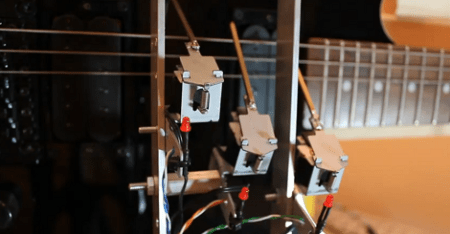
[Ivan Monsão] and [Paulo Libonati] have constructed what is considered to be the first robotic berimbau in existence, capable of playing music without any human interaction. The robot strikes the berimbau’s metal string, mechanically muting the gourd when appropriate, and even shakes the caxixi (a rattle) in time with the music.

The builder claims that the berimbau learns songs by “listening” and repeating rather than having songs pre-programmed into the system. We can’t see any evidence of that functionality from the video, though we’d love to see the learning process in action.

While we try to find our VHS copy of “Only the Strong”, be sure to take a look at the following video of the berimbau playing itself.

[Thanks, Camilo]

Continue reading “Robotic Berimbau Plays Itself”

The ElectroAxé Full-Body Percussion Suit

Carnival in Salvador, Brazil is arguably one of the biggest and craziest parties this world has ever known.  With millions in attendance for what is already an incredible audio and visual display, performers are faced with the daunting task of continually bringing something new and fresh to the masses. One could always add more fireworks or visual displays (never a bad thing), but it will only take you so far. [Kyle McDonald] and [Lucas Werthein]’s answer: The ElectroAxé Full-Body Percussion Suit as demonstrated by Carlinhos Brown at Carnival 2011.

When most people hear the word “axe” as related to music they think of an electric guitar. “Axé” however, refers to a unique Afro-Caribbean fusion genre of music that originated in Salvador in the mid 1980’s and is a favorite at Carnival. [Carlinhos Brown] is a popular Brazilian percussionist and was looking for a creative new way to express himself through his song and dance. Instead of being stuck in one place near his instruments or carrying one or two drums around “marching-band style”, he is now able to move around the stage freely – his body has become his instrument.

In order to make the magic happen, [Kyle] and [Lucas] designed custom laser cut and cnc machined drum pads containing piezo sensors and integrated them with a full-body jump suit. When struck, these sensors send a signal to an Arduino with a Sparkfun Midi Shield housed in a custom enclosure on the performer’s waist. From there the MIDI signal is sent wirelessly and then audio is played through the existing sound system – it appears that a CMD WIDI X-8 wireless MIDI system is employed for the actual wireless transmission.

Although details are somewhat scarce, there are plenty of pictures, (more) available.  You really can’t argue with the results as you watch thousands of people jam along.

Come join in the festivities with video after the break!

Continue reading “The ElectroAxé Full-Body Percussion Suit”

Antique Light Bulb Organ

Add a retro light show to any MIDI instrument with this Antique Light Bulb Organ, twelve 30 watt antique style light bulbs correspond with the 12 notes in an octave with a simple on or off action. The organ is also monitoring the pedals, so the lights will stay on as you use the sustain. Add in the natural slow reaction time of a light bulb and the effect is quite nice.

Along with MIDI instruments , you can also connect to a PC via USB allowing for remote control either with MIDI or OSC. On the hardware end there is a Atmega324P board that handles communication, user input and of course the lights. To switch the 120v AC current required by the lights twelve Sharp PR36MF22NSZF isolated solid state relays were wired up to some screw down light sockets also fitting the retro theme.

Lastly everything is placed in a nice fold up wooden cabinet, perfect for those long road trips to prevent breakage, but it also makes a nice place to put your keyboard while on stage.

Join us after the break for a quick music video that features this good looking light organ.

Continue reading “Antique Light Bulb Organ”