Digitizing Player Piano Rolls

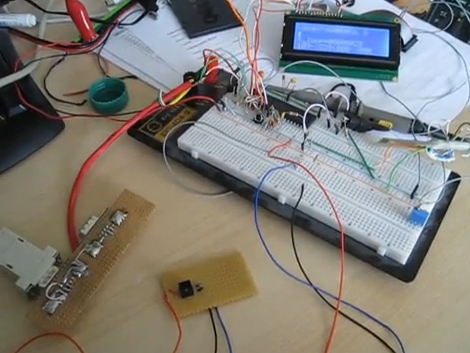
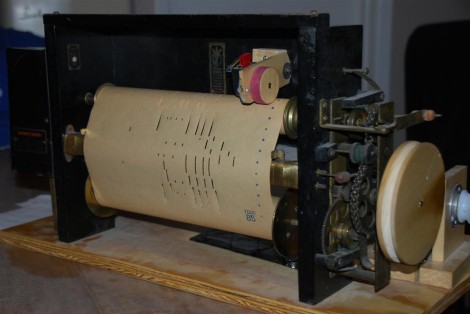
What do you do with 100 player piano rolls but no player piano? You come up with a way to digitize the information for MIDI playback. The rolls have 90 columns worth of holes, 88 for the keys and two more for pedals. Voids in the paper cause a note or pedal to be played, so an optical sensor can be used to transform the analog data into digital information. Simple enough, you’ll just need 90 sensors. But this brings up quite an alignment issue. The solution is to use fiber optic cable to position the IR light source in a hand-made 0.2″ spaced jig. At least the spacing meshes nicely with standard 0.1″ protoboard, which is what was used for mounting the sensors.

[Thanks Mike]
Singing: With Plasma!

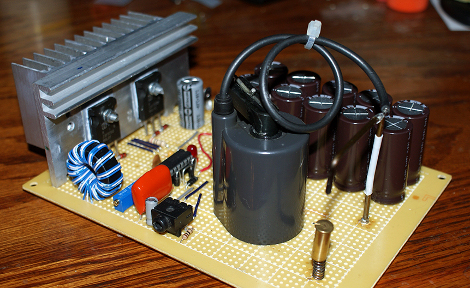
While there are many ways to produce audible sound, Plasma Speakers have to be one of the coolest. Usually very complex and expensive, we received a tip for a beginners guide to making one of these impressive novelties. Handily included are a set of schematics (one very simple schematic, the other with a few artistic illustrations). There are also a set of warnings, which include sound advice to mind the heat generated by the MOSFETs, as well as making sure that your input signal isn’t too strong. The finished product is fun to listen to, so be sure to check out the example video after the break.

Continue reading “Singing: With Plasma!”

Building A Germanium Fuzz Face Guitar Pedal

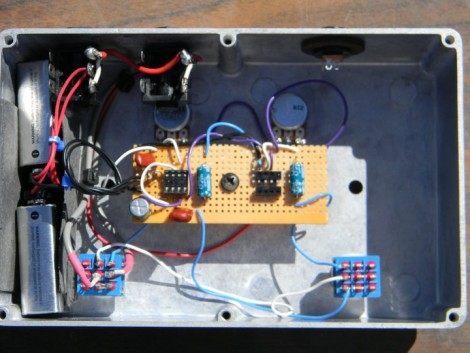
Rock in the new year with a guitar pedal you built yourself. [Doug Kovach] took the time to share his project with us in the video after the break. He starts with a bit of history of the artists that have used fuzz pedals similar to this one. It seems great guitarists have been hacking since way back. [Doug’s] rendition uses the warm sounds of germanium transistors in a design that produces professional results. But if you need something a little bit less serious try the stomp-box.

Continue reading “Building A Germanium Fuzz Face Guitar Pedal”

Tape Delay Made From Recycled Cassette Decks

Professional tape delay units are great fun, but often expensive. You’d think that with so many derelict cassette decks filling the world’s dumpsters someone must have figured out a way to make a cheap tape delay… not only in the interest of saving money (sometimes quality is worth paying for) but also in the interest of re-using otherwise wasted resources.

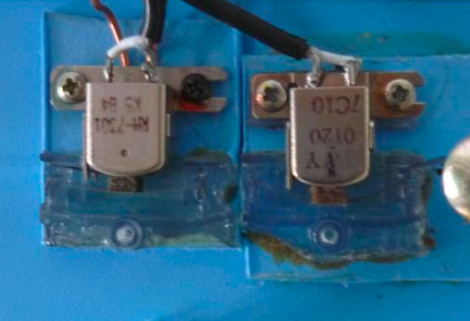
Forosdeelectronica forum user [Dano] has made just such a device from used cassette decks and miscellaneous parts (translated). First he investigated the operation of the playback, erase, and record mechanisms and broke out the tape heads. The playback head is on a plastic rail so that the delay time can be changed, while the record head is fixed. [Dano] encountered some difficulties in ensuring good quality for the recording and erasure, which is an important consideration when working with magnetic tape.

Continue reading “Tape Delay Made From Recycled Cassette Decks”

Rich Decibel’s Kequencer

It’s totally excellent when a simple concept results in something inspiring and fun. [Rich Decibel]’s Kequencer is a good example, starting off as many projects do: “I had an idea the other day and I couldn’t decide if it was good or not so I just built it to find out.” Be still our hackable hearts!

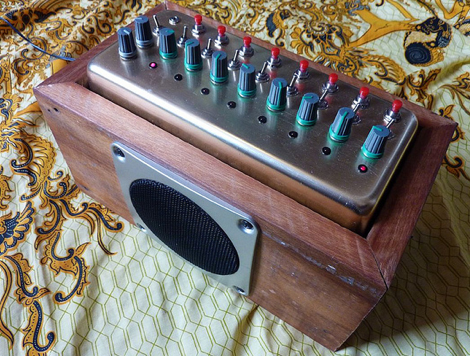
[Rich] built this sleek little sequencer from scratch and while the design may not seem very novel to begin with–eight square wave oscillators with on/off switches and pitch knobs, played in sequence–but the beauty of it is in the nuances of interaction and the potential for further hacking. From watching the video you can see how the controls can be used in very interesting ways to create and mutate adorable chippy tone patterns. Check it out after the crossfade.

Continue reading “Rich Decibel’s Kequencer”

Make Your Own Solenoids, Then Play The Xylophone

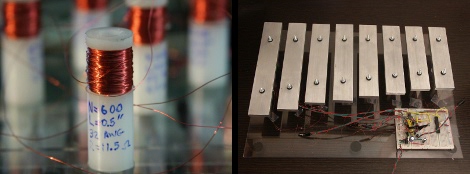
Learn to manufacture your own solenoids and then use them to play the xylophone by watching the tutorial video after the break. [Humberto Evans] and the team at Nerd Kits do a great job of not only manufacturing the coils, but the xylophone itself. The bars are machined from some aluminum stock and they take you down the rabbit hole with they why’s and how’s of engineering the keys.

We’re unlikely to replicate this machining process but the solenoids are another story all together. Starting at about 3:30 you can learn about designing, building, and using these little marvels. They’re basically an electromagnetic cuff with a metal slug in the middle. The solenoid seen above uses a body milled from HDPE and wrapped with magnet wire. The slug in the center is steel, with a few rare-earth magnets at the top. When you run current through the coil it repulses the magnets on the slug, witch then strikes the xylophone key. Using a MOSFET and a protection diode, actuating them is as simple as sending a digital high from your microcontroller of choice.

We’ve seen solenoids used to play a vibrophone before, but those were commercial units. Making your own hardware is far more hardcore.

Continue reading “Make Your Own Solenoids, Then Play The Xylophone”

Playing Piano With Optical Sensors

[Sebastian] is trying to improve the responsiveness of an electric keyboard. He was unsatisfied with the lack of adequate sensitivity to keystroke. The first step in his process was to measure how fast the quickest keystroke actually is. By setting up an LED and phototransistor and taking some measurements he found that sampling at 1 kHz would be more than adequate.

With initial testing complete he ordered some CNY70 transmissive/reflective light sensors that can be place below the keys. He measures the sensor with the ADC on an ATmega16 microcontroller. Running at 16 MHz he can sample each of the eight analog-to-digital converter channels at 1202 Hz. After doing a bunch of math he put together some lookup tables that are used to translate the ADC data into midi signals. We’ve embedded a video of one sensor controlling the midi program PianoTeq. [Sebastian] also sent us a schematic of one node in the sensor network (see it after the break).

When everything is said and done he plans to use eleven ATmega16 microcontrollers to address the 88 keys, with an additional microcontroller to act as the master using a two-wire interface for communications.

Update: [Sebastian] put up a webpage with a fairly verbose description. Reading it straight from the source really clears up a lot of questions.


Continue reading “Playing Piano With Optical Sensors”