Radio-Walkman-megaphone Hybrid

[Erich] rethought the use of a megaphone and ended up with this Mega-Tape-O-Phone. His first move was to ditch the megaphone’s amplifying circuitry in order to add his own based on an LM386 chip. From there a radio receiver joined the party followed by the guts of a tape player. He relocated the head of the tape deck to the end of a flexible cable and coated the outside of the megaphone bell with magnetic tape. Now he’s surfing the airwaves and scratching away happily.

The use of the tape head has been seen here before, but it was never in a mobile package like this is. Join us after the break for some video of this in action.
Continue reading “Radio-Walkman-megaphone Hybrid”

Stomp Box Synthesizer

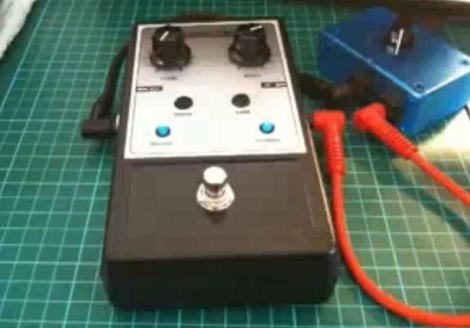
[Brian McNamara] fed the output of his guitar pedal back into its input creating a looped synthesizer. He started with an effects pedal he made but now we think he’s ended up with an electronic stomp box. Check out the results in the video after the break. Now he needs to make the knobs foot-friendly so he can monkey with this while playing guitar.

Continue reading “Stomp Box Synthesizer”

Embedding An Accelerometer And XBee In A Guitar

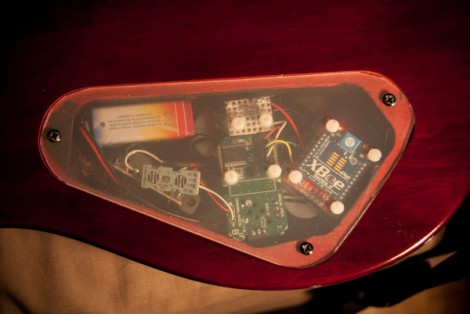
[JP Carrascal] hacked his guitar by adding motion control while removing the need for wires. He’s using a dual-Arduino system with an Mini Pro inside the guitar and a Duemilanova for the receiver connected to a computer. Wireless is provided by the XBee module seen above and a gutted Wii remote accelerometer is in there for motion sensing. Check out the artfully blurry demonstration of the motion effects after the break.

While he added some potentiometer-based controls there is also an automatic power-down feature. [JP] replaced the mono pickup with a stereo one and used the extra conductor as a switch to activate the additional electronics. We wonder if he also winds his own pickups or builds his own effects pedals.

Continue reading “Embedding An Accelerometer And XBee In A Guitar”

Spark Plug Music

[youtube http://www.youtube.com/watch?v=92qql941DM4%5D

This is (video above) perhaps the most abstract way of playing sounds…ever. Yes, we’ve heard Hard Drive music and Obsolete technology bands, but [DJ Sures] brings us the first ever, spark plug instrument.

Much like Velcro and Teflon, the musical spark plug is claimed to be an accident. After testing energy use vs. spark power with his flare stack ignition controller, [DJ Sures] noticed that different frequencies could be produced. It was only a matter of reprogramming before death metal Twinkle Twinkle Little Star is heard. Now he just needs to refine it a bit and build a full stereo cabinet.

The Wii Golf Glove

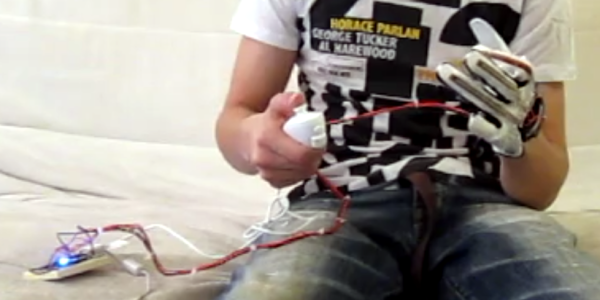
[Shu Uesugi] is filling a controller void that Nintendo has yet to address. He picked up a golf glove from Target and incorporated it into an air guitar interface. Give the video after the break a chance, you’ll start to see the full potential of this build about three and a half minutes into it. Using an Arduino, a Wii nun-chuck, and his flex-senor adorned glove [Shu] can play individual notes, strum cords, and play around with sound effects such as distortion.

So come on Nintendo, the Power Glove was one of your greatest ideas, where’s our 21st century version? I guess we’ll just have to make our own like [Shu] did. Perhaps we’ll even build our flex sensors from scratch.

Continue reading “The Wii Golf Glove”

Midi Piano Instructor

[youtube=http://www.youtube.com/watch?v=i7AfiCQQ4nE]

The MIDI piano instructor is a tool aimed at those who wish to learn to play piano, but don’t want to take lessons. The LED bar mounted above the keys lights up to show you exactly what key to press and when. We’ve seen this available in some electronic keyboards for some time, but this unit would be able to fit any standard sized keyboard.  Check the page for schematics and pictures.

[via Flickr]

Automated Guitar Pickup Winding

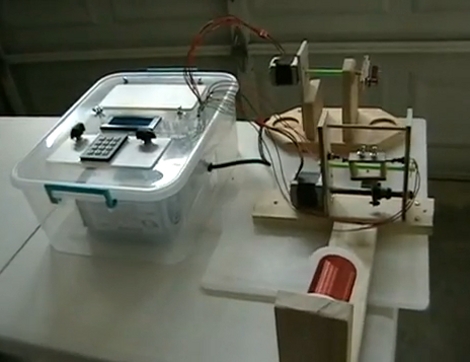
[Robert Pickering] shares his automated guitar pickup winder with us. He built it for his senior project at Old Dominion University. Two stepper motors are used to wind the magnet wire around the pickup hardware. The unit is PIC based and about six minutes into the video (embedded after the break) you can see that he used wire wrapping for this build. Curious, one of the comments on our latest Hackaday Links mentioned that wire wrapping was rarely used anymore, but here it is anyway.

We especially like the limiting switches he’s using on the traverse mechanism. There are momentary push buttons on either side of a carriage which are depressed when a drywall screw in the sides of that carriage hits them. This makes for very easy calibration because the screw can be raised or lowered with just a bit of screwdriver work. Well built and documented, we’re sure he’ll get some high marks on this one. Continue reading “Automated Guitar Pickup Winding”