Dub Siren Synth Does It The Old School Way

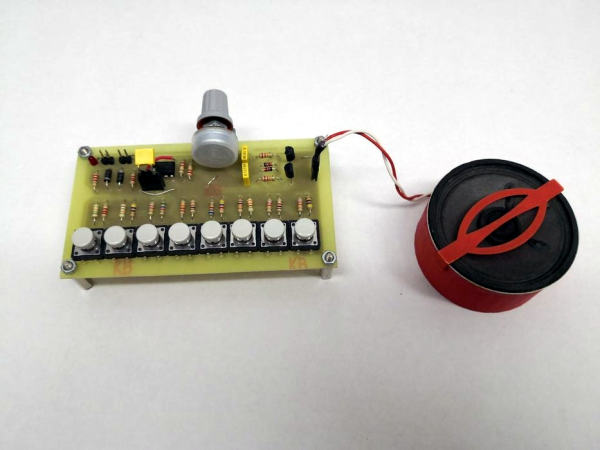
There’s little that can compare to the sheer obnoxious thrill of mashing the DJ siren when its your turn behind the decks. We’ve certainly been guilty of abusing the privilege at local house parties, and unsurprisingly have not been invited back. If we ever get another shot, though, we’d be glad to have [lonesoulsurfer]’s dub siren at the ready.

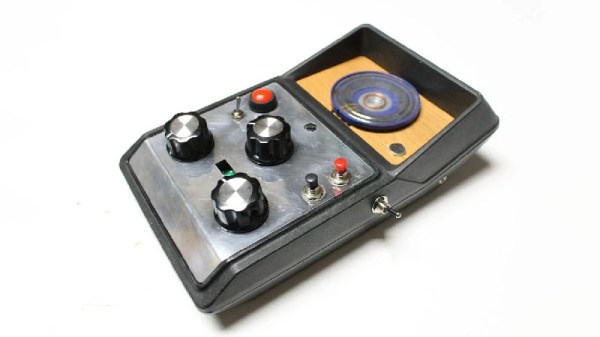
This is a build for the old-school purists. There’s no microcontrollers or digital hardware here. The synth relies on two 555 timer ICs as the oscillators and an LM741 op-amp. These parts harken right back to the dawn of the integrated circuit era, and still do a great job in this application. There’s also a cheap reverb/echo module added in to fatten up the sound. It’s all laced up in an old CB radio enclosure, with the classic woodgrain applique doing much to add to the aesthetic.

It’s a build that’s simple enough for the electronics beginner, and would make a great tactile, analog addition to any DJ’s rig. If you need some wubwubs to go with your woowoos, then consider building a Ball of Dub, too.

Continue reading “Dub Siren Synth Does It The Old School Way”

Echo And Reverb In A Pretty Little Box

These days, if there’s a chip worth using, there will be a cheap pre-built module on eBay to make using it even easier. It’s a great time saver, and projects that used to take a couple of weekends can now be completed in a rainy afternoon. [lonesoulsurfer] knows how it is, and took advantage of this very approach to build this tidy echo & reverb effects box.

The build starts with a PT2399 echo/delay line module sourced of eBay, a part that we’ve learned much about thanks to the hard work of others. A resistor is cut off the board, enabling echo as well as reverb functionality. It’s laced up in a box with a couple of pots and a switch to control the effect, and hooked up with 6.5mm audio jacks to enable it to be easily used with guitars, synths, or karaoke machines.

It’s a fun build, and one that could serve as as a useful component in a larger setup. Adding a 3PDT switch could make it more useful as a guitar pedal, or it could be integrated into a Eurorack module, too. We’d particularly love to see the results possible from stuffing five of the modules in a single box and routing them into each other in new and exciting ways. If you pull that off, drop us a line.

Thea Flowers – Creating A Sega-Inspired Hardware Synthesizer From The Ground Up

For those who grew up with video games, the legendary sounds of consoles past are an instant nostalgia hit. [Thea Flowers] first got her hands on a gamepad playing Sonic the Hedgehog, so the sounds of the Sega Genesis hold a special place in her heart. Decades later, this inspired the creation of Genesynth, a hardware synth inspired by the classic console. The journey of developing this hardware formed the basis of [Thea]’s enlightening Supercon talk.

[Thea’s] first begins by exploring why the Genesis sound is so unique. The Sega console slotted neatly into a time period where the company sought to do something more than simple subtractive synthesis, but before it was possible to use full-waveform audio at an affordable price point. In collaboration with Yamaha, the YM2612 FM synthesis chip was built, a cost-reduced sound engine similar to that in the famous DX7 synthesizer of the 1980s. This gave the Genesis abilities far beyond the basic bleeps and bloops of other consoles at the time, and [Thea] decided it simply had to be built into a dedicated hardware synth.

Continue reading “Thea Flowers – Creating A Sega-Inspired Hardware Synthesizer From The Ground Up”

Music Box Paper-Punching Machine Settles The Score

As soon as [pashiran] laid eyes on his first hand-cranked music box, he knew he was in love. Then, he started punching the holes for his first ditty. As the repetitive stress of punching heated up his arm, his love cooled a bit. Annealed by the ups and downs of this experience, he decided to design a machine that can punch the holes automatically.

Soon, [pashiran] found his people — a community of music boxers that transform MIDI files to DXF format, which creates coordinates for CAD software. In [pashiran]’s music puncher, an Arduino MEGA takes a DXF file and bubble-sorts the jumble of x-coordinates. The MEGA conducts a trio of two stepper motors and DC motor. One stepper pushes the paper through on the x-axis, and the other moves the puncher head back and forth across the paper scroll as the y-axis. The DC motor moves the punch up and down.

Now, paired with [Martin] of [Wintergatan]’s method for chaining music box paper together, [pashiran] can write a prog-rock-length opus without fear of repetitive stress injury. And since he’s published the STL and INO files, now you can, too. Watch it punch and play 250 notes worth of “See My Vest” “Be Our Guest” after the break.

There’s more than one way to avoid manually punching all those holes. When [Wintergatan] was wrestling this problem, he inspired the hacker community to create a MIDI-to-laser-cut-stencil solution.

Continue reading “Music Box Paper-Punching Machine Settles The Score”

Rock ‘n Roll With 3D-Printed Tonewheels

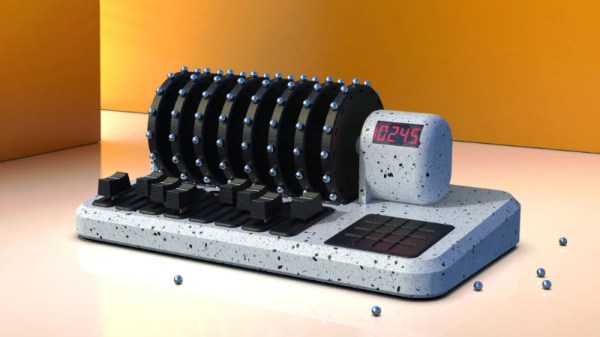
What can you do with ferromagnetic PLA? [TheMixedSignal] used it to give new meaning to the term ‘musicians’ gear’. He’s made a proof of concept for a DIY tone generator, which is the same revolutionary system that made the Hammond organ sing.

Whereas the Hammond has one tonewheel per note, this project uses an Arduino to drive a stepper at varying speeds to produce different notes. Like we said, it’s a proof of concept. [TheMixedSignal] is proving that tonewheels can be printed, pickups can be wound at home, and together they will produce audible frequencies. The principle is otherwise the same — the protruding teeth of the gear induce changes in the magnetic field of the pickup.

[TheMixedSignal] fully intends to expand on this project by adding more tone wheels, trying different gear profiles, and replacing the stepper with a brushless motor. We can’t wait to hear him play “Karn Evil 9”. In the meantime, put on those cans and check out the demo/build video after the break.

We don’t have to tell you how great Hammond organs are for making music. But did you know they can also encode secret messages?

Continue reading “Rock ‘n Roll With 3D-Printed Tonewheels”

DIY Cassette Tape Guitar Delay

Digital delay pedals are pretty good nowadays and even the cheaper ones do a pretty good job at emulating the sound of old analog delay effects. And that’s good, because the original delay effects can run you a pretty penny. If you’re in to DIY electronics, though, analog delay effects can still be built without breaking the bank, and, as an example, [Matsound] has made a tape delay using an old tape deck and regular cassette tapes.

The core of the build is a portable 3-head cassette recorder, in this case a Marantz PMD430. The circuit has been around for a while – it was originally found in an issue of Stompboxology in the 90’s. The basic idea is that with a three-head recorder (erase, record, play) the distance between the record and play heads creates a delay and you increase this delay by slowing down the recorder’s motor. You combine the output from the recorder with the dry signal from your input and, viola, tape delay.

[Matsound] added a cool feature where you can control the speed of the motor with a control voltage, so if you connect it to a keyboard and produce different voltages from different keys, you get weird, spacey effects. The video gives an overview of the features and some details of the build process are in the video’s description.

A nice build built into a nice case and a great effect! Maybe you wouldn’t take it out gigging with you, but it sure sounds pretty good!  Other delay pedals have been mentioned on the site before, like this digital delay pedal and here’s another take on the cassette tape delay.

Continue reading “DIY Cassette Tape Guitar Delay”

World’s Smallest MIDI Synth, Now Even Better

We’re pretty sure there’s no internationally recognized arbiter of records like “World’s smallest full-featured polyphonic stereo MIDI synthesizer that fits in a DIN shell”. If there isn’t, there sure should be, and we’re pretty sure [mitxela]’s Flash-Synth would hold that particular record.

This is one of those lessons that some people just can’t leave a challenge alone. First [mitxela] built a MIDI synthesizer into a DIN connector, then a couple of months later he made a somewhat more streamlined version. While both were feats of engineering derring-do, neither was entirely satisfactory. With only square wave synthesis and a limit of eight voices, plus some unpleasant audio issues and a total lack of manufacturability, the next challenge was clear.

We won’t pretend to follow all the audio arcana, of which the video below and the build log have plenty, but the technical achievement is obvious enough. The Flash-Synth has an STM32, a tantalum SMD filter capacitor that dwarfs it, and a few support components on a flexible PCB that folds back on itself twice. This bit of circuit origami is connected to a 5-pin DIN plug and stuffed into the connector’s shell, which in turn mates to a custom-machined metal housing. A stereo audio jack lives at the other end of the assembly, and the whole synth is powered parasitically off the MIDI port.

The first half of the video below is mostly a demo that proves the synth sounds great and can do just about anything; skip to the 22-minute mark for the gory build details. Suffice it to say that [mitxela]’s past experience with ludicrous scale soldering served him well here.

Continue reading “World’s Smallest MIDI Synth, Now Even Better”