Turning The Deep Note Into A Game

One of the most famous pieces of computer-generated music is the Deep Note, the audio trademark for THX. It begins with a dozen or so voices, randomly tuned between 200 and 400 Hz, then glissandos to a frequency spread of three octaves. Put that through a few thousand watts of a speaker system, play it before Jedi, and the audience will be listening.

The original THX Deep Note was created on hundreds of thousands of dollars worth of hardware running 20,000 lines of code, but that was in 1983. Now we have cheap microcontrollers, so of course, you can now fit the Deep Note in your pocket. You can even make it a game. That’s exactly what [Bob] did with his Deep Synth. It’s the Deep Note, in a Game Boy-ish format.

The hardware for this build is the 1Bitsy 1UP, a retro-inspired handheld game console from [Bob]’s friend [Pitor]. Onboard the 1Bitsy is an STM32 F4 running at 168 MHz with a 2.8″ LCD, SD card reader, and the traditional Game Boy control scheme. All the games are up to you.

[Bob] wrote an audio driver for the 1UP, but needed a good audio demo. Since the Deep Note was a good enough demo for Lucasfilms, it would obviously be a good enough demo for a microcontroller. In far less than 20,000 lines of code, [Bob] made the 1UP polyphonic, and it was surprisingly fast enough to synthesize around thirty oscillators. It actually sounds like the Deep Note, too. You can check out a video (and audio) of that after the break.

Continue reading “Turning The Deep Note Into A Game”

Elegant Drum Machine From Teensy

Playing the drums is pretty hard, especially for the uncoordinated. Doing four things at the same time, all while keeping an even tempo, isn’t reasonable for most of us. Rather than hiring a drummer for your band who is well versed in this art, though, you might opt instead to outsource this job to a machine instead. It’s cheaper and also less likely to result in spontaneous combustion.

This drum machine is actually a MIDI Euclidean sequencer. Euclidean rhythms are interesting in their own regard, but the basics are that a common denominator between two beats is found in order to automatically generate complicated beats. This particular unit is running on a Teensy 3.5 and consists of four RGB rotary encoders, an SSD1306 LCD, four momentary buttons, and four 16 LED Neopixel rings. Setting each of the dials increases the number of beats for that particular channel, and it can be configured for an almost limitless combination of beats and patterns.

To really get a feel of what’s going on here, it’s worth it to check out the video after the break. MIDI is also a fascinating standard, beyond the fact that it’s one of the few remaining standards created in the 80s that still enjoys active use, it can also be used to build all kinds of interesting instruments like one that whacks wine glasses with mallets or custom synthesizers.

Thanks to [baldpower] for the tip!

Continue reading “Elegant Drum Machine From Teensy”

Can You Build An Open Source Pocket Operator?

Toys are now musical instruments. Or we’ll just say musical instruments are now toys. You can probably ascribe this recent phenomenon to Frooty Loops or whatever software the kids are using these days, but the truth is that it’s never been easier to lay down a beat. Just press the buttons on a pocket-sized computer.

One of the best examples of the playification of musical instruments is Pocket Operators from Teenage Engineering. They’re remarkable pieces of hardware, and really just a custom segment LCD and a few buttons. They also sound great and you can play real music with them. It’s a game changer when it comes to enabling musicianship.

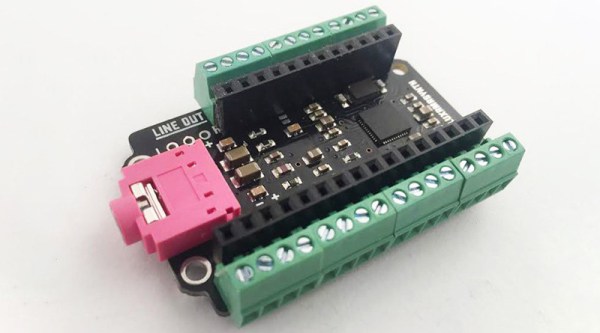
Of course, with any popular platform, there’s a need for an Open Source copy. That’s where [Chris]’ Teensy Beats Shield comes in. It’s a ‘shield’ of sorts for a Teensy microcontroller that adds buttons, knobs, and a display, turning this into a platform that uses the Teensy’s incredible audio system designer.

When it comes to the world of microcontrollers and audio processing, the Teensy is a champ. The Teensy Audio Library has polyphonic playback, recording, synthesis, analysis, and effects, along with multiple simultaneous inputs and outputs. If you’re building a tiny synth that can fit in your pocket, the Teensy is the way to go, and [Chris]’ Teensy Beats Shield does it all, with a minimal and useful user interface. You can check out a video of the Teensy Beats Shield below.

Continue reading “Can You Build An Open Source Pocket Operator?”

Hacking Nature’s Musicians

We just wrapped up the Musical Instrument Challenge in the Hackaday Prize, and for most projects that meant replicating sounds made by humans, or otherwise making musicians for humans. There’s more to music than just what can be made in a DAW, though; the world is surrounded by a soundscape, and you only need to take a walk in the country to hear it.

For her Hackaday Prize entry, [Kelly] is hacking nature’s musicians. She’s replicating the sounds of the rural countryside in transistors and PCBs. It’s an astonishing work of analog electronics, and it sounds awesome, too.

The most impressive board [Kelly] has been working on is the Mother Nature Board, a sort of natural electronic chorus of different animal circuits. It’s all completely random, based on a Really, Really Random Number Generator, and uses a collection of transistors and 555 timers to create pulses sent to a piezo. This circuit is very much sensitive to noise, and while building it [Kelly] found that not all of her 2N3904 transistors were the same; some of them worked for the noise generator, some didn’t. This is a tricky circuit to design, but the results are delightful.

So, can analog electronics sound like a forest full of crickets? Surprisingly, yes. This demonstration shows what’s possible with a few breadboards full of transistors, caps, resistors, and LEDs. It’s an electronic sculpture of the sounds inspired by the nocturnal soundscape of rural Virginia. You’ve got crickets, cicadas, katydids, frogs, birds, and all the other non-human musicians in the world. Beautiful.

An Open Controller For Woodwind Instruments

Engineers, hackers, and makers can most certainly build a musical gadget of some kind. They’ll build synths, they’ll build aerophones, and they’ll take the idea of mercury delay line memory, two hydrophones, and a really long tube filled with water to build the most absurd delay in existence. One thing they can’t seem to do is build a woodwind MIDI controller. That’s where [J.M.] comes in. He’s created the Open Woodwind Project as an open and extensible interface that can play sax and clarinet while connected to a computer.

Early prototype to test out variable resistive pressure pads

If you want to play MIDI, there are plenty of options for keyboards, drum sets, matrix pads, and even strings. If you want to play a MIDI saxophone, there aren’t many options. Keytars, for example, are more popular than MIDI woodwind controllers. [J.M.] is changing this with a MIDI controller that recreates electronic aerophones electronically.

The controller itself uses a Teensy 3.2 loaded up with an ARM Cortex M4, two MPR121 touch controllers for 24 channels of capacititve touch capability, and a pressure sensor to tell the computer how strong the user is blowing. All of this works, and [J.M.] has a few videos showing off the capabilities of his homemade controller. It’s a great piece of work, and there are a few extentions that make this really interesting: there’s the possibility of adding CV out so it can be connected to modular synths, and the addition of accelerometers to the build makes for some very interesting effects.

Check out the video below.

Continue reading “An Open Controller For Woodwind Instruments”

Sonic Robots Don’t Play Instruments, They Are The Instruments

[Moritz Simon Geist]’s experiences as both a classically trained musician and a robotics engineer is clearly what makes his Techno Music Robots project so stunningly executed. The robotic electronic music he has created involves no traditional instruments of any kind. Instead, the robots themselves are the instruments, and every sound comes from some kind of physical element.

A motor might smack a bit of metal, a hard drive arm might tap out a rhythm, and odder sounds come from stranger devices. If it’s technological and can make a sound, [Moritz Simon Geist] has probably carefully explored whether it can be turned into one of his Sonic Robots. The video embedded below is an excellent example of his results, which is electronic music without a synthesizer in sight.

We’ve seen robot bands before, and they’re always the product of some amazing work. The Toa Mata Lego Band are small Lego units and Compressorhead play full-sized instruments on stage, but robots that are the instruments is a different direction that still keeps the same physical element to the music.

Continue reading “Sonic Robots Don’t Play Instruments, They Are The Instruments”

Modular Violin Takes A Bow

They say the only difference between a violin and a fiddle is the way you play it. If that’s so, this modular violin will need a new name, since it can be broken apart and changed in ways that make it sound completely different, all within a few minutes.

The fiddle is the work of [David Perry] and has 3D printed body, neck, pegbox, and bridge. While it might seem useful on the surface as a way to get less expensive instruments out in the world where virtually anyone has access to them, the real interesting qualities are shown when [David] starts playing all of the different versions he’s created. The sound changes in noticeable ways depending on the style of print, type of plastic used, and many other qualities.

Of course you will need a bow, strings, pegs, and a fingerboard, but the rest is all available if you have a 3D printer around. If you’re already a skilled violinist this could be a very affordable way to experiment with new sounds. It’s not the first time we’ve seen 3D printed violins, but it is the first time we’ve seen them designed specifically to alter the way they sound rather than their physical characteristics. If you want to make your own, all of the .stl files are available on the project’s site.

Continue reading “Modular Violin Takes A Bow”