Hackaday Links Column Banner

Hackaday Links: December 16, 2018

Microsoft is really leaning into vaporwave these days. Microsoft is giving away knit Windows sweaters to social media influencers. Is it for an ugly sweater contest? Maybe, or maybe Microsoft is capitalizing on the mid-90s AESTHETIC. Recently, Apple got back in their 90s logo game with the release of a few ‘rainbow Apple’ t-shirts. The spirit of the 90s lives on in tech culture.

Have a Hackerspace? Frack is organizing the great Inter-hackerspaces Xmas goodies swap! Since your hackerspace is filled with weird ephemera and random crap, why not box it up and send it out to another hackerspace? You’ll probably get another random box of crap in return!

Just an observation looking for commentary, but is Thingiverse slow these days? It seems really, really, really slow these days.

The Blockchain makes it to the Apple II! By far, the most interesting thing in tech right now is the blockchain, with AI, at the edge. This will get your Merkle trees tinglin’ with some AI, and 5G is where it’s at. We’re back with cylinder computing this time, and this is the greatest achievement that will synthesize brand new paradigms. Of course, if it weren’t for millennials, we’d have it already.

There’s a new portable console out there, and it’s at the top of everyone’s Christmas lists. The SouljaGame Handheld is a rebrand of what’s available on AliExpress. What makes this one different? It has Soulja Boy’s name on it. If you couldn’t get your hands on the SouljaGame Handheld, don’t worry: Post Malone Crocs are available on eBay for about $300.

RISC-V Will Stop Hackers Dead From Getting Into Your Computer

The greatest hardware hacks of all time were simply the result of finding software keys in memory. The AACS encryption debacle — the 09 F9 key that allowed us to decrypt HD DVDs — was the result of encryption keys just sitting in main memory, where it could be read by any other program. DeCSS, the hack that gave us all access to DVDs was again the result of encryption keys sitting out in the open.

Because encryption doesn’t work if your keys are just sitting out in the open, system designers have come up with ingenious solutions to prevent evil hackers form accessing these keys. One of the best solutions is the hardware enclave, a tiny bit of silicon that protects keys and other bits of information. Apple has an entire line of chips, Intel has hardware extensions, and all of these are black box solutions. They do work, but we have no idea if there are any vulnerabilities. If you can’t study it, it’s just an article of faith that these hardware enclaves will keep working.

Now, there might be another option. RISC-V researchers are busy creating an Open Source hardware enclave. This is an Open Source project to build secure hardware enclaves to store cryptographic keys and other secret information, and they’re doing it in a way that can be accessed and studied. Trust but verify, yes, and that’s why this is the most innovative hardware development in the last decade.

Continue reading “RISC-V Will Stop Hackers Dead From Getting Into Your Computer”

Intel Announces Faster Processor Patched For Meltdown And Spectre

Intel just announced their new Sunny Cove Architecture that comes with a lot of new bells and whistles. The Intel processor line-up has been based off the Skylake architecture since 2015, so the new architecture is a fresh breath for the world’s largest chip maker. They’ve been in the limelight this year with hardware vulnerabilities exposed, known as Spectre and Meltdown. The new designs have of course been patched against those weaknesses.

The new architecture (said to be part of the Ice Lake-U CPU) comes with a lot of new promises such as faster core, 5 allocation units and upgrades to the L1 and L2 caches. There is also support for the AVX-512 or Advanced Vector Extensions instructions set which will improve performance for neural networks and other vector arithmetic.

Another significant change is the support for 52-bits of physical space  and 57 bits of linear address support. Today’s x64 CPUs can only use bit 0 to bit 47 for an address space spanning 256TB. The additional bits mean a bump to a whooping 4 PB of physical memory and 128 PB of virtual address space.

The new offering was demoed under the company’s 10nm process which incidentally is the same as the previously launched Cannon Lake. The new processors are due in the second half of 2019 and are being heavily marketed as a boon for the Cryptography and Artificial Intelligence Industries. The claim is that for AI, memory to CPU distance has been reduced for faster access, and that special cryptography-specific instructions have been added.

Improving Depth Of Field With Only 5 Phones

The hottest new trend in photography is manipulating Depth of Field, or DOF. It’s how you get those wonderful portraits with the subject in focus and the background ever so artfully blurred out. In years past, it was achieved with intelligent use of lenses and settings on an SLR film camera, but now, it’s all in the software.

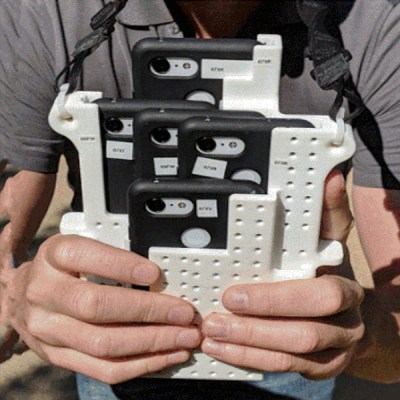
The franken-camera rig, consisting of five Pixel 3 smartphones. The cameras are synchronised over WiFi.

For the Pixel 2 smartphone, Google had used some tricky phase-detection autofocus (PDAF) tricks to compute depth data in images, and used this to decide which parts of images to blur. Distant areas would be blurred more, while the subject in the foreground would be left sharp.

This was good, but for the Pixel 3, further development was in order. A 3D-printed phone case was developed to hold five phones in one giant brick. The idea was to take five photos of the same scene at the same time, from slightly different perspectives. This was then used to generate depth data which was fed into a neural network. This neural network was trained on how the individual photos relate to the real-world depth of the scene.

With a trained neural network, this could then be used to generate more realistic depth data from photos taken with a single camera. Now, machine learning is being used to help your phone decide which parts of an image to blur to make your beautiful subjects pop out from the background.

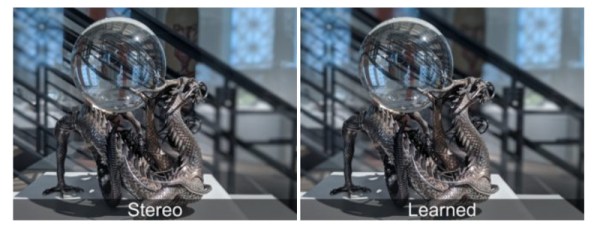
Comparison images show significant improvement of the “learned” depth data versus just the stereo-PDAF generated depth data. It’s yet another shot fired in the smartphone camera arms race, that shows no signs of abating. We just wonder when the Geiger counter mods are going to ship from factory.

[via AndroidPolice]

Off Road Vehicle Has Six Wheels And Fluid Power

What has six wheels and runs on water? Azaris — a new off-road vehicle prototype from Ferox. Azaris has a rocker suspension modeled after the one on the Mars rover. The problem is, linking four drive wheels on a rocker suspension would be a nightmare. The usual solution? Motors directly in the wheels. But Ferrox has a different approach.

The vehicle has a conventional BMW motorcycle engine but instead of driving a wheel, it drives a pump. The pump moves fluid to the wheels where something similar to a water wheel around the diameter of the wheel causes rotation. The fluid is mostly water and the pressure is lower than a conventional hydraulic system. Auto Times has a video of some stills of the prototype and you can see it below. We haven’t actually seen it in motion, unfortunately.

Continue reading “Off Road Vehicle Has Six Wheels And Fluid Power”

Bose Wants You To Listen Up For Augmented Reality

Perhaps it is true that if all you have is a hammer every problem you see looks like a nail. When you think of augmented reality (AR), you usually think of something like the poorly-received Google Glass where your phone or computer overlays imagery in your field of vision. Bose isn’t known for video, though, they are known for audio. So perhaps it isn’t surprising that their upcoming (January 2019) AR sunglasses won’t feature video overlays. Instead, the $200 sunglasses will tell you what you are looking at.

The thing hinges on your device knowing your approximate location and the glasses knowing their orientation due to an inertial measuring system. In other words, the glasses — combined with your smart device — know where you are and what you are looking at. Approximately. So at the museum, if you are looking at a piece of art, the glasses could tell you more information about it. There’s a video showing an early prototype from earlier this year, below.

Continue reading “Bose Wants You To Listen Up For Augmented Reality”

Furby Plus Borges Equals Borgy

What do you get if you cross a Furby with a master of 20th Century literature? The Borgy. Argentinian hacker [Roni Bandini] found an old Furby and decided to hack it by altering its personality. His inspiration was the Argentinian writer Jorge Louis Borges, one of the pioneers of surrealist writing. The idea is that, at random times during the day, the Borgy will share a bit of wisdom from Borges to inspire and enlighten.

[Roni] hacked the Furby to replace the speaker with a more powerful one, and built a base to hold the larger speaker and a switch which can activate Borgy. He also used an Arduino Nano and a Sparkfun MP3 player shield loaded with the samples of Borges.

When the Furby speaks, it shares some wisdom from Borges. It’s a simple, but a surprisingly effective hack that could be very useful for someone seeking inspiration.  Or, as Borges himself once said: “Don’t talk unless you can improve the silence.”

Continue reading “Furby Plus Borges Equals Borgy”