Jumper Cables Block Trains

Standing Rock, North Dakota has been the site of a major protest this year against the Dakota Access Pipeline project. Protesters have sought to delay the pipeline’s progress by a wide variety of means, and both sides in the conflict have been accused of a variety of misdeeds.

An anonymous group supporting the protesters has released a video describing how they stop trains without the use of physical barricades. The video begins with police removing automobiles used to block the tracks and escorting trains through level crossings, showing how these traditional methods have been ineffective.

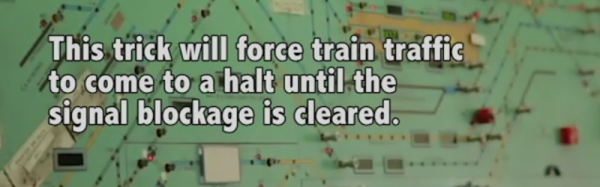
The video then goes on to outline what is described as a “sneaky” way of halting trains. Most railroads use what is known as a track circuit — a current run through the rails of the track detects when a train passes over it by the axles completing an electrical circuit between the two. By using a standard automotive jumper cable to connect the two rails together instead, the circuit is completed and falsely indicates to the railway signalling system that a train is present on the track in question. Due to the safety-critical nature of the railway, no trains can be run on the track until the short circuit is removed, else there is a great risk of collisions between trains on the network.

Intended as a practical guide, strategies to maximize disruption are outlined, such as hiding the cables under snow and painting them in black to evade detection as long as possible. Instructions on how to best make a solid connection to the rails are also shared.

It goes without saying that interfering with major infrastructure is risky, dangerous, and highly illegal. Protesters have already been arrested for physically blocking trains. Perpetrators of this method will surely be arrested if caught, and circumventing the technology could easily result in harsher charges associated with electronic security and safety systems. This is sabotage (deliberately obstructing) and undermines the validity of peaceful protest.

This shows how ingenuity is often spawned by turmoil and frustration. Reflect on human nature, and catch the video below the break.


Continue reading “Jumper Cables Block Trains”

Bluetooth Turns 5

Last week, the latest and greatest member of the Bluetooth family of wireless specifications was announced to the world: Bluetooth 5! What main changes are in store? Read the FAQ (PDF), or dig into the full spec (bigger PDF) at 2,800 pages.

Their big-print selling points include “up to 4x the range, 2x the speed, and 8x the broadcasting message capacity” to power the Internet of Things. Etcetera. [Akiba] pointed out via Twitter that they get the fourfold increase in range by adding an extra zero to the “Maximum Output Power” spec, going from 10 mW maximum power to 100 mW. That would do it.

In less snarky news, they’re also allowing for a lower-bitrate mode that will also increase range without simply boosting the power. The spec is actually being changed to let the user work out their optimal blend of power, range, and bitrate. We’re down with that. But you’re not getting 4x the range and 2x the speed without paying the bandwidth piper. That’s just physics.

If you use the beacon mode in Bluetooth Low Energy (BLE), you’ll be happy to hear that they’re lengthening the beacon packet from 31 bytes to 255, so you can send a bunch more data without consuming too much power. That’s the “8x”. Bluetooth 5.0 is also backwards compatible with Bluetooth 4.2, so you don’t have to redo anything if you don’t want to take advantage of the newer features. Your current BLE beacons will keep working.

Finally, there’s some contention-detection and other bandwidth optimizing going on, which is welcome in our crowded 2.4 GHz office spectrum. Our guess is that’s where the “2x speed” is largely coming from, but there are about 2,750 pages that we haven’t read yet, so if you’re digging into the spec, let us know what you find in the comments.

Thanks to [Akiba] for tipping us off to this via Twitter. Go check out his great talk on getting hacker stuff in Shenzhen that was presented at the SuperCon.

Florida Man Hates Amateur Radio

Any amateur radio operator who is living under a homeowner’s association, covenant, or has any other deed restriction on their property has a problem: antennas are ugly, and most HOAs outright ban everything from 2-meter whips to unobtrusive J-pole antennas.

Earlier this year, the ARRL got behind a piece of legislation called the Amateur Radio Parity Act. This proposed law would amend FCC’s Part 97 rules for amateur stations and direct, ‘Community associations to… permit the installation and maintenance of effective outdoor Amateur Radio antennas.’ This bill passed the US House without objection last September.

Last week, the Amateur Radio Parity Act died in the US Senate. Sen. Bill Nelson (D-FL), the ranking member of the Senate committee on Commerce, Science, and Transportation, refused to move the bill forward in the Senate. The ARRL has been in near constant contact with Senator Nelson’s office, but time simply ran out before the end of the 114th Congress. The legislation will be reintroduced into the 115th Congress next year.

That NASA EM Drive Paper: An Expert Opinion

A week or two ago we featured a research paper from NASA scientists that reported a tiny but measurable thrust from an electromagnetic drive mounted on a torsion balance in a vacuum chamber. This was interesting news because electromagnetic drives do not eject mass in the way that a traditional rocket engine does, so any thrust they may produce would violate Newton’s Third Law. Either the Laws Of Physics are not as inviolate as we have been led to believe, or some other factor has evaded the attempts of the team to exclude or explain everything that might otherwise produce a force.

As you might imagine, opinion has entrenched itself on both sides of this issue. Those who believe that EM drives have allowed us to stumble upon some hitherto undiscovered branch of physics seized upon the fact that the NASA paper was peer-reviewed to support their case, while those who believe the mechanism through which the force is generated will eventually be explained by conventional means stuck to their guns. The rest of us who sit on the fence await further developments from either side with interest.

Over at Phys.org they have an interview from the University of Connecticut with [Brice Cassenti], a propulsion expert, which brings his specialist knowledge to the issue. He believes that eventually the results will be explained by conventional means, but explains why the paper made it through peer review and addresses some of the speculation about the device being tested in space. If you are firmly in one of the opposing camps the interview may not persuade you to change your mind, but it nevertheless makes for an interesting read.

If EM drives are of interest, you might find our overview from last year to be an illuminating read. Meanwhile our coverage of the NASA paper should give you some background to this story, and we’ve even had one entered in the Hackaday Prize.

Official: Pebble Ceases Hardware Production

Today Pebble has announced that it will cease all hardware production. Their outstanding Kickstarter deliveries will not be fulfilled but refunds will be issued. Warranties on all existing hardware will no longer be honored. However, the existing smartwatch service will continue… for now.

This isn’t unexpected, we ran an article yesterday about the all-but-certain rumors FitBit had acquired Pebble (and what led to that). Today’s news has turned speculation about Pebble 2 and Pebble Core Kickstarter campaigns into reality. You won’t get your hands on that fancy new hardware, but at least backers will have the money returned.

Perhaps the most interesting part of today’s blog post from the founder of Pebble, Eric Migicovsky, is about how this impacts more than a million watches already in the wild. Service will continue but (wait for it) “Pebble functionality or service quality may be reduced in the future.”

It’s not like this is a unique problem. Devices purchased by consumers that are dependent on phoning home to a server to function is a mounting issue. Earlier this year [Elliot Williams] coined this issue “Obsolescence as a Service” which is quite fitting. Anyone who still has a functional first generation iPad has enjoyed reduced quality of service; without available upgrades, you are unable to install most apps. It’s zombie hardware; electrons still flow but there’s no brain activity.

One of the perks associated with FitBit acquiring Pebble is that they have decided to keep those servers running for watches in the field. A cynic might look at the acquisition as FitBit reducing competition in the market — they wouldn’t have let hardware production cease if they were interested in acquiring the user base. At some point, those servers will stop working and the watches won’t be so smart after all. FitBit owns the IP which means they could open source everything needed for the community to build their own server infrastructure. When service quality “reduced in the future” that’s exactly what we want to see happen.

Talking Neural Nets

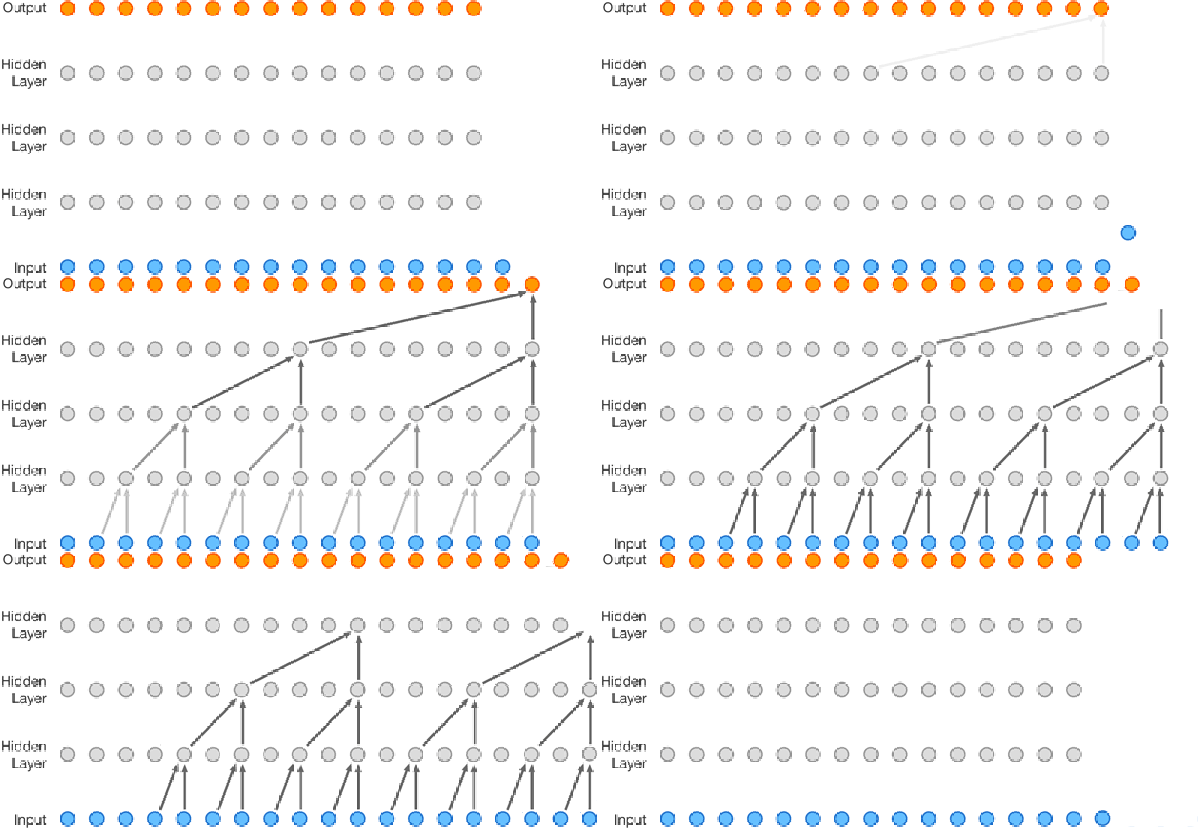
Speech synthesis is nothing new, but it has gotten better lately. It is about to get even better thanks to DeepMind’s WaveNet project. The Alphabet (or is it Google?) project uses neural networks to analyze audio data and it learns to speak by example. Unlike other text-to-speech systems, WaveNet creates sound one sample at a time and affords surprisingly human-sounding results.

Before you rush to comment “Not a hack!” you should know we are seeing projects pop up on GitHub that use the technology. For example, there is a concrete implementation by [ibab]. [Tomlepaine] has an optimized version. In addition to learning English, they successfully trained it for Mandarin and even to generate music. If you don’t want to build a system out yourself, the original paper has audio files (about midway down) comparing traditional parametric and concatenative voices with the WaveNet voices.

Another interesting project is the reverse path — teaching WaveNet to convert speech to text. Before you get too excited, though, you might want to note this quote from the read me file:

“We’ve trained this model on a single Titan X GPU during 30 hours until 20 epochs and the model stopped at 13.4 ctc loss. If you don’t have a Titan X GPU, reduce batch_size in the train.py file from 16 to 4.”

Last time we checked, you could get a Titan X for a little less than $2,000.

There is a multi-part lecture series on reinforced learning (the foundation for DeepMind). If you wanted to tackle a project yourself, that might be a good starting point (the first part appears below).

Continue reading “Talking Neural Nets”

Geohot’s Comma.ai Self-Driving Code On GitHub

First there was [Geohot]’s lofty goal to build a hacker’s version of the self-driving car. Then came comma.ai and a whole bunch of venture capital. After that, a letter from the Feds and a hasty retreat from the business end of things. The latest development? comma.ai’s openpilot project shows up on GitHub!

If you’ve got either an Acura ILX or Honda Civic 2016 Touring addition, you can start to play around with this technology on your own. Is this a good idea? Are you willing to buy some time on a closed track?

A quick browse through the code gives some clues as to what’s going on here. The board files show just how easy it is to interface with these cars’ driving controls: there’s a bunch of CAN commands and that’s it. There’s some unintentional black comedy, like a (software) crash-handler routine named crash.py.

What’s shocking is that there’s nothing shocking going on. It’s all pretty much straightforward Python with sprinklings of C. Honestly, it looks like something you could get into and start hacking away at pretty quickly. Anyone want to send us an Acura ILX for testing purposes? No promises you’ll get it back in one piece.

If you missed it, read up on our coverage of the rapid rise and faster retreat of comma.ai. But we don’t think the game is over yet: comma.ai is still hiring. Are open source self-driving cars in our future? That would be fantastic!

Via Endagadget. Thanks for the tip, [FaultyWarrior]!