Software Update Destroys $286 Million Japanese Satellite

The Japanese X-ray telescope Hitomi has been declared lost after it disintegrated in orbit, torn apart when spinning out of control. The cause is still under investigation but early analysis points to bad data in a software package pushed shortly after an instrument probe was extended from the rear of the satellite. JAXA, the Japanese space agency, lost $286 million, three years of planned observations, and a possible additional 10 years of science research.

Hitomi, also known as ASTRO-H, successfully launched on February 17, 2016 but on March 26th catastrophe struck, leaving only pieces floating in space. JAXA, desperately worked to recover the satellite not knowing the extent of the failure. On April 28th they discontinued their efforts and are now working to determine the reasons for the failure, although a few weeks ago they did provide an analysis of the failure sequence at a press conference.

Continue reading “Software Update Destroys $286 Million Japanese Satellite”

Shor’s Algorithm In Five Atoms

If you want to factor a number, one way to do it is Shor’s algorithm. That’s a quantum algorithm and finds prime factors of integers. That’s interesting because prime factorization is a big deal of creating or breaking most modern encryption techniques.

Back in 2001, a group at IBM factored 15 (the smallest number that the algorithm can factor) using a 7 qubit system that uses nuclear magnetic resonance. Later, other groups duplicated the feat using photonic qubits. Typical implementations take 12 qubits. However, recent work at MIT and the University of Innsbruck can do the same trick with 5 atoms caught in an ion trap. The researchers believe their implementation will easily scale to larger numbers.

Each qubit is an atom and LASER pulses perform the logic operations. By removing an electron to make each atom positively charged, an electric field can exactly hold the positively charged ions in position only microns apart.

We’ve covered quantum computing before. We’ve even talked about the effect of practical quantum computing on encryption. You might also want to read more about the algorithm involved.

Photo credit: Jose-Luis Olivares/MIT

WISP Needs No Battery Or Cable

One of the problems with the Internet of Things, or any embedded device, is how to get power. Batteries are better than ever and circuits are low power. But you still have to eventually replace or recharge a battery. Not everything can plug into a wall, and fuel cells need consumables.

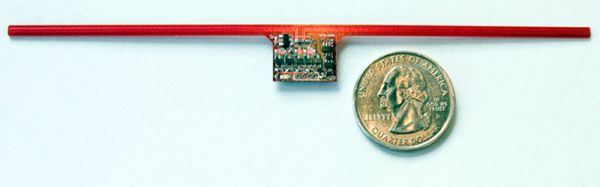
University of Washington researchers are turning to a harvesting approach. Their open source WISP board has a sensor and a CPU that draws power from an RFID reader. To save power during communication, the device backscatters incoming radio waves, which means it doesn’t consume a lot of its own power during transmissions.

The big  news is that TU Delft has contributed code to allow WISP to reprogram wirelessly. You can see a video about the innovation below. The source code is on GitHub. Previously, a WISP had to connect to a PC to receive a new software load.

Continue reading “WISP Needs No Battery Or Cable”

The MakerBot Obituary

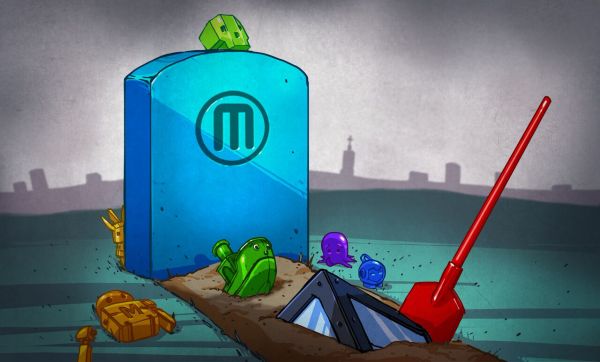
MakerBot is not dead, but it is connected to life support waiting for a merciful soul to pull the plug.

This week, MakerBot announced it would lay off its entire manufacturing force, outsourcing the manufacturing of all MakerBot printers to China. A few weeks ago, Stratasys, MakerBot’s parent company, released their 2015 financial reports, noting MakerBot sales revenues have fallen precipitously. The MakerBot brand is now worth far less than the $400 Million Stratasys spent to acquire it. MakerBot is a dead company walking, and it is very doubtful MakerBot will ever be held in the same regard as the heady days of 2010.

How did this happen? The most common explanation of MakerBot’s fall from grace is that Stratasys gutted the engineering and goodwill of the company after acquiring it. While it is true MakerBot saw its biggest problems after the acquisition from Stratasys, the problems started much earlier.

Continue reading “The MakerBot Obituary”

This Teddy Bear Steals Your Ubuntu Secrets

Ubuntu just came out with the new long-term support version of their desktop Linux operating system. It’s got a few newish features, including incorporating the “snap” package management format. One of the claims about “snaps” is that they’re more secure — being installed read-only and essentially self-contained makes them harder to hack across applications. In principle.

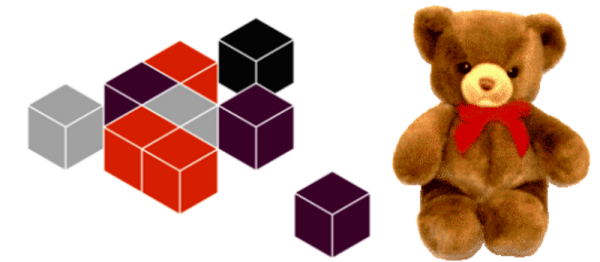
[mjg59] took issue with their claims of increased cross-application security. And rather than just moan, he patched together an exploit that’s disguised as a lovable teddy bear. The central flaw is something like twenty years old now; X11 has no sense of permissions and any X11 application can listen in on the keyboard and mouse at any time, regardless of which application the user thinks they’re providing input to. This makes writing keylogging and command-insertion trojans effortless, which is just what [mjg59] did. You can download a harmless version of the demo at [mjg59]’s GitHub.

This flaw in X11 is well-known. In some sense, there’s nothing new here. It’s only in light of Ubuntu’s claim of cross-application security that it’s interesting to bring this up again.

xeyes

And the teddy bear in question? Xteddy dates back from when it was cool to display a static image in a window on a workstation computer. It’s like a warmer, cuddlier version of Xeyes. Except it just sits there. Or, in [mjg59]’s version, it records your keystrokes and uploads your passwords to shady underground characters or TLAs.

We discussed Snappy Core for IoT devices previously, and we think it’s a step in the right direction towards building a system where all the moving parts are only loosely connected to each other, which makes upgrading part of your system possible without upgrading (or downgrading) the whole thing. It probably does enhance security when coupled with a newer display manager like Mir or Wayland. But as [mjg59] pointed out, “snaps” alone don’t patch up X11’s security holes.

All Prior Art

Disclosed herein is a device for gauging medication dosage. The method may include displaying first, second and third navigation controls. A switch is connected in parallel to the relay contacts and is configured for providing a portion of the input power as supplemental load power to the output as a function of back EMF energy.

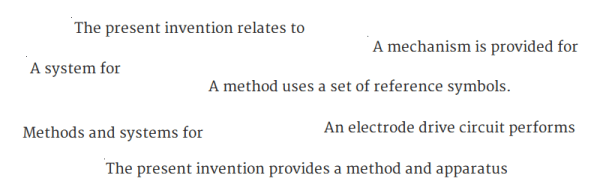
We’ve had patents on the mind lately, and have been reading a fair few of them. If you read patent language long enough, though, it all starts to turn into word-salad. But with his All Prior Art and All the Claims websites, [Alexander Reben] tosses this salad for real. He’s got computers parsing existing patents and randomly reassembling them.

Rather than hoping that his algorithm comes up with the next great idea, [Alexander] is hoping to nip the truly trivial ones in the bud. Because prior art — the sum of all pre-existing ideas — is enough to disqualify a patent, if an idea is so trivial that his algorithm could have come up with it, it’s sooner or later going to be off the table.

Most of the results are insane, of course. And it seems to be producing a patent at a rate of about one per 10-15 seconds, so we’re guessing that it’ll take quite a few years for these cyber-monkeys to come up with the works of Shakespeare. But with bogus and over-broad patents filtering through the system every day, it’s not implausible that some day it’ll prove useful.

[Via New Scientist, thanks Frank!]

Super Thin Display Makes Your Skin Your Screen

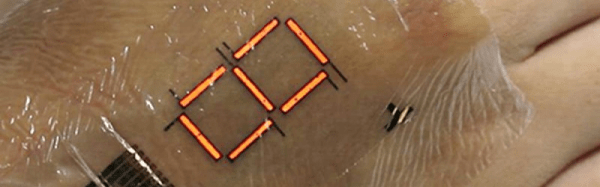
Researchers in Japan have created a 3-micrometer display that looks like plastic wrap and can make any part of your skin into an electronic display. The idea isn’t new, but this display is far thinner and more durable than previous devices. It also lasts longer (several days) and has increased brightness.

The display uses polymer LEDs to form a seven-segment digit, so you aren’t going to stream Netflix to the back of your hand anytime soon.  However, the team wants to build more advanced displays that could one day replace smartwatch or smartphone screens.

Continue reading “Super Thin Display Makes Your Skin Your Screen”