Science Fiction, Help Or Hindrance?

[Annalee Newitz] from io9 has written a piece about how science fiction can impact the public’s perception of scientific research. She’s covered stories ranging from Frankenstein, for showing the negatives of humans “playing god”, to The Diamond Age, for showing an inspiring use of nanotechnology.

We wonder what direct impact science fiction has had on research. Depictions of a 3D metaverse have always been compelling, but is pouring effort into half measures like Second Life a waste of time compared to serious computer interaction research?

We discussed this for a little while and concluded that whether inspiring or hindering, the very act of critically thinking about technology was beneficial. What books have inspired you in the past? Was it because they showed a better world or were they a stern warning?
Radiohead Releases Laser Music Video With Data


Radiohead has released their music video for “House Of Cards.” We’ve already covered some of the tech involved. If making an entire video without cameras wasn’t edgy enough, they’ve released all the point data for people to play with and remix. The band is encouraging people to post their creations to their YouTube group.

Head over to their Google Code page to watch a making of video as well as view some of the datasets in 3D. There is a link to the entire dataset for download as well.

Will It Blend? Tests The IPhone 3G

[youtube=http://www.youtube.com/watch?v=DLxq90xmYUs&hl=en&fs=1]
The Will It Blend? host, [Tom Dickson], is at it again. This time, he blends the new Apple iPhone 3G. We’re completely in awe of how efficient the blender is at the destruction of electronics, and this time, it’s no different. Watch in fascination (or horror) as [Dickson] turns the latest iPhone into ashes.

[via Neatorama]

Music And Visual Arts At The Last HOPE

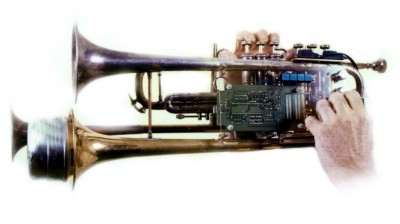
[Peter Kirn] from Create Digital Music has an article up highlighting many of the great music and visual performance pieces planned for The Last HOPE on Friday night. If you are around New York and not accustomed to hacking conferences, this could be a great excuse to go check it out. Here are some of our favorite projects.

Continue reading “Music And Visual Arts At The Last HOPE”

Epilog Zing Personal Laser Etching

The new Epilog Zing is designed to bring laser engraving to the home for personal use. It’s got 25 watts of power, a small enough footprint to fit neatly on your desk, and the video above shows it has a pretty high resolution. But compared to the mini18, the Zing has less Z movement, a lower wattage, a smaller engraving area, and about half the speed. Also, with a price set around $8,000, we don’t think many people will be buying them for personal use just yet. However, if you have a small home business that requires these services, the Zing could be perfect. If you are looking for more information on laser engraving, see [ladyada’s] laser information page.

[via Engadget]

Microfluidic Art


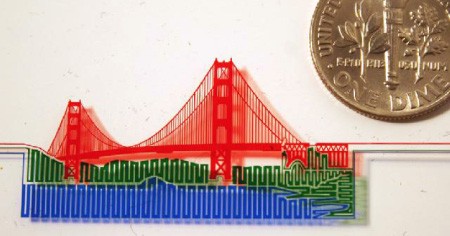
Microfluidics expert [J. Tanner Neville] decided to turn his work into art. Along with his student, [Austin Day], they turned lab chips into miniscule works of art by developing a technique of patterning proteins onto substrates. Each colored line you see is actually a groove full of liquid about 20 microns in width. Another student of [Neville’s], [Albert Mach], is currently working on a method of preserving the liquid for longer amounts of time. As you can probably guess, the dye tends to dry up within a few days. He is also taking submissions for artwork, so we encourage you to submit! We’re certainly looking forward to what else [Neville] and his students come up with next.

[via io9]

Memristor-based Memory Prototype By 2009

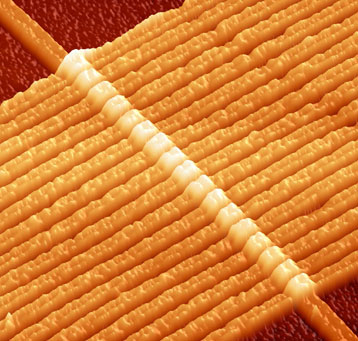
An article in EETimes suggests that we may see a memristor-based memory prototype in development as soon as 2009. The memristor is claimed by many to be the theorized fourth passive circuit element, linking the fundamental circuit variables of charge and flux. This news may not sound that exciting to most computer geeks, but this new component could usher in a new era of computer memory by forming the basis of RRAM (resistive random-access memory).

Scientists at HP labs have finally confirmed that the memristor behaves as their theories predicted. The reason that the component will work so well for memory is that the process is nonvolatile and the bits themselves will only change after the CPU tells them to. The bits in current DRAM systems slowly fade out and require a refreshment every 50 nanoseconds.

[via /.]