ZeroPhone Gives Smartphones The Raspberry (Pi)

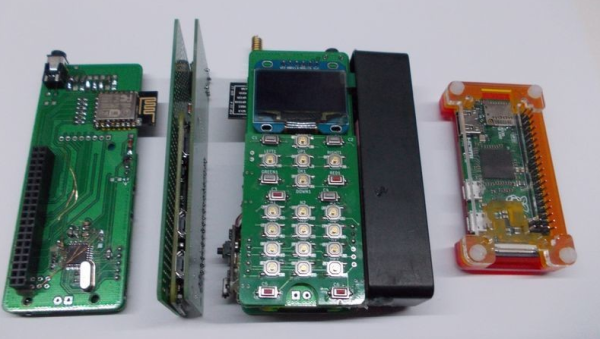
There are several open source phones out there these days, but all of them have a downside. Hard to obtain parts, hard to solder, or difficult programming systems abound. [Arsenijs] is looking to change all that with ZeroPhone. ZeroPhone is based upon the popular Raspberry Pi Zero. The $5 price tag of the CPU module means that you can build this entire phone for around $50 USD.

The radio module in the ZeroPhone is the well known SIM800L 2G module. 2G is going away or gone in many places, so [Arsenijs] is already researching more modern devices. An ESP8266 serves as the WiFi module with an OLED screen and code in python round out this phone. Sure, it’s not a fancy graphical touchscreen, but a full desktop is just a matter of connecting a display, mouse, and keyboard.

For the security conscious, the ZeroPhone provides a unique level of control. Since this is a Raspberry Pi running Linux, you choose which modules are included in the kernel, and which software is loaded in the filesystem. And with news that we may soon have a blobless Pi, the firmware hiding in the radio modules are the only black boxes still remaining.

If a Raspberry Pi is a bit too much for you to bite off, check out this Arduino based phone. Don’t want to do any soldering? Check out what you can do with a cheap Android phone and a bit of hacking.

Smartphone Case For The Retro Gamer

A well-designed phone case will protect your phone from everyday bumps with only as much style flair as you’d like. While protection is usually the only real function of a case, some designs — like [Gabbelago]’s Emucase — add specific utility that you might not have known you needed.

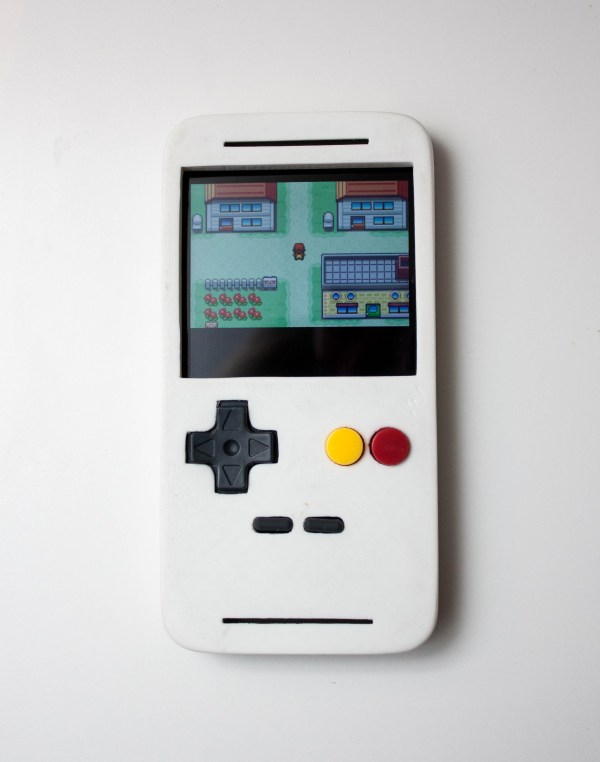
Contrary to most cases, the Emucase fits over your phone’s screen, and the resulting facelift emulates the appearance of a Game Boy for easier — you guessed it — Game Boy emulation play on your smartphone.

Cannibalizing a USB SNES gamepad for its buttons and rubber contact pads, Gabbelago then threaded some wire through the contacts, securing it with copper tape and glue; this provides a measurable level of capacitance to register on the touchscreen. Using heat to bend the sides of the 3D printed case so it can attach to the phone is probably the trickiest part of this cool project. Check out his build instructions for any pointers you need.

Continue reading “Smartphone Case For The Retro Gamer”

Blynk With Joy

Last time, I talked about how my storage situation and my cheap nature led me to build an RC joystick controller with a cell phone app and an ESP8266. The key to making this easy was to use the GUI builder called Blynk to make a user interface for an Android or Apple phone. Blynk can communicate with the ESP8266 and makes the project relatively simple.

ESP8266 and Arduino IDE

The ESP8266 Blynk code is straightforward. You do need to set up the Arduino IDE to build for the ESP8266. That can vary by board, but here’s the instructions for the board I was using (from Adafruit; see below).

adaesp

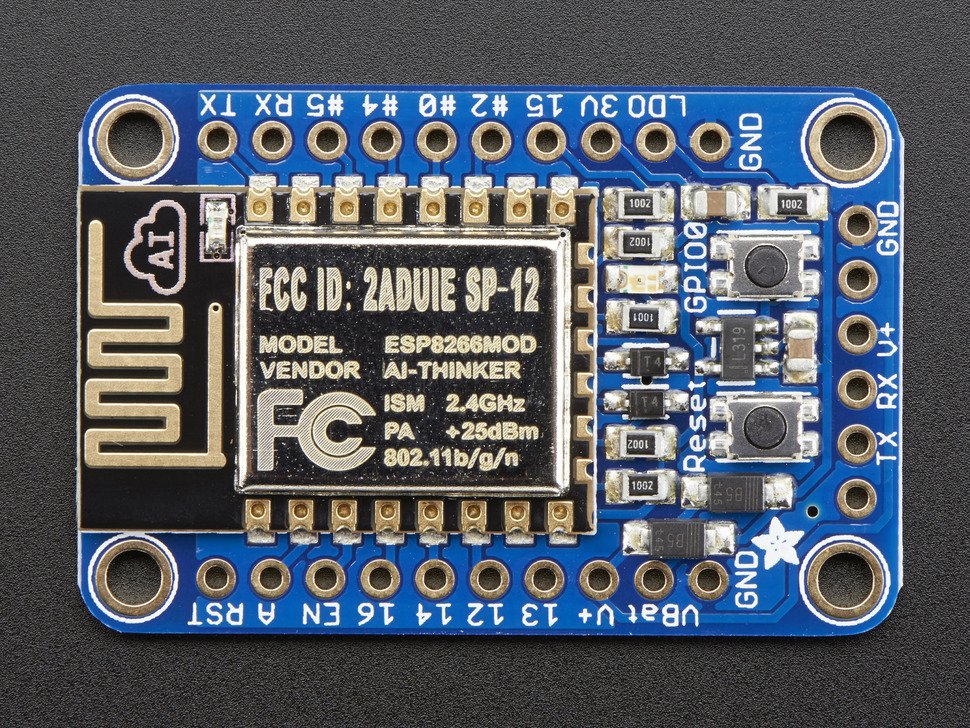
Depending on the type of ESP8266 device you are using, you may need a 3.3 V serial cable or some other means of getting the firmware into the device. For the Adafruit device I had, it has a 5 V-tolerant serial connection so a standard USB to serial dongle plugs right in. There’s also two switches on my device. To get into bootload mode, you have to push the one button down, hold it, and then press the reset button. Once you release the reset button you can release the other button. The red LED half-glows and the device is then waiting for a download.
Continue reading “Blynk With Joy”

Payphone Boombox Straight Out Of The 1990’s.

Due largely to the overwhelming dominance of mobile phones, payphones are a sometimes overlooked relic from the 90’s and earlier eras. While seldom seen out in the wild these days, they can however still be acquired for a moderate fee — how many of you knew that? Setting out to prove the lasting usefulness of the payphone, Instructables user [Fuzzy-Wobble] has dialed the retro spirit way past eleven to his ’90 from the ’90s’ payphone boombox.

Conspicuously mounted in the corner of his office, a rangefinder sets the phone to ringing when somebody walks by — a fantastic trap for luring the curious into a nostalgia trip. Anyone who picks up will be prompted to punch in a code from the attached mini-phone book and those who do will be treated to one of ninety hits from — well —  the 1990’s. All of the songs have been specifically downgraded to 128kbps for that authentic 90’s sound — complete with audio artifacts. There’s even a little easter egg wherein hitting the coin-return lever triggers the payphone to shout “Get a job!”

Continue reading “Payphone Boombox Straight Out Of The 1990’s.”

The Joy Of The ESP8266 And Blynk

I’ll admit it. I can be a little cheap. I also find it hard to pass up a bargain. So when I saw a robot kit at the local store that had been originally $125 marked down to $20, I had to bite. There was only one problem. After I got the thing home, I found they expected you to supply your own radio control transmitter and receiver.

Normally, that wouldn’t be a problem but lately… let’s just say a lot of my stuff is in storage and I didn’t have anything handy. I certainly didn’t want to go buy something that would double the cost of this robot that I really didn’t need to begin with.

However, I did have a few ESP8266 modules handy. Good ones, too, from Adafruit with selected 5 V I/O compatibility and an onboard regulator. I started thinking about writing something for the ESP8266 to pick up data from, say, a UDP packet and converting it into RC servo commands.

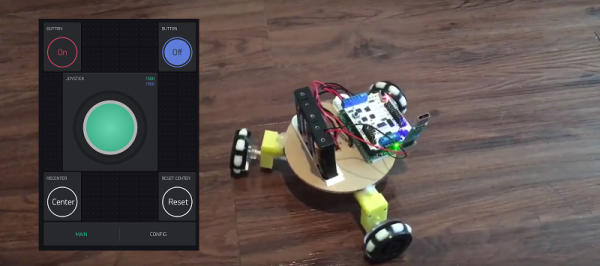
joymainSeemed like a fair amount of work and then I remembered that I wanted to try Blynk. If you haven’t heard of Blynk, it is a user interface for Android and Apple phones that can send commands to an embedded system over the Internet. You usually think of using Blynk with an Arduino, but you can also program the embedded part directly on an ESP8266. I quickly threw together a little prototype joystick.
Continue reading “The Joy Of The ESP8266 And Blynk”

Star Trek Phone Dock Might As Well Be From Picard’s Night Stand

Star Trek is often credited with helping spur the development of technologies we have today — the go-to example being cell phones. When a Star Trek April Fool’s product inspires a maker to build the real thing? Well, that seems par for the course. [MS3FGX] decided to make it so. The 3D printed Star Trek-themed phone dock acts as a Bluetooth speaker and white noise generator. The result is shown off in the video below and equals the special effects you expect to find on the silver screen.

Taking a few liberties from the product it’s based on — which was much larger and had embedded screens — makes [MS3FGX]’s version a little more practical. Two industrial toggle switches control a tech cube nightlight and the internal Bluetooth speaker. An NFC tag behind the phone dock launches the pre-installed LCARS UI app and turns on the phone’s Bluetooth. Despite being a challenge for [MS3FGX] to design, the end product seems to work exactly as intended.

Continue reading “Star Trek Phone Dock Might As Well Be From Picard’s Night Stand”

Retrotechtacular: The Modern Telephone

We take recorded telephone messages for granted in these days of smartphones and VOIP. Our voicemail lives on an anonymous server in a data centre in the cloud somewhere, in a flash memory chip on our DECT base station, or if we’re of a retro persuasion, on a micro-cassette. Wherever we go, we now know our calls will not go unanswered.

Today’s subject takes us back to a time when automatically recording a phone call was the last word in high technology, with British Pathé newsreel piece from 1959 entitled “Modern Telephone”. Its subject is the Ansafone J10, one of the first telephone answering machines available on the British market. After featuring a fantastic home-made Meccano answering machine with turntable recording created by a doctor, it takes us to the Ansafone factory where the twin tape mechanisms of the commercial model are assembled and tested. Finally we get to see it in use on the desk of a bona fide Captain of Industry, probably about the only sort of person who could afford an Ansafone in 1959.

Part of the film’s charm comes not from the technology but from the glimpse it gives us of 1950s Britain sanitised for the newsreel. The clipped tones, leather armchairs and bookshelves, the coal fire and the engineer in a three-piece suit. The past is a foreign country; they do things differently there.

Take a look at the film below after the break, and never take your recorded calls for granted again.

Continue reading “Retrotechtacular: The Modern Telephone”