Impedance Matching Revisited

If you are an old hand at RF design, you probably have a good handle on matching impedance. However, if you are just getting started with RF, [FesZ Electronic]’s latest video series on lossless impedance matching is well worth watching.

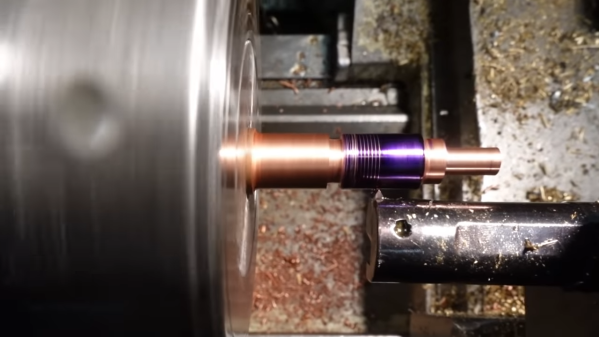
Matching is important for several reasons. Maximum power transfer occurs when the source and load impedance match. Also, at RF, mismatched impedance can cause reflections which, again, robs you of useful power. The video covers some math and then moves on to LTSpice to simulate a test circuit. But the part you are really waiting for — the practical circuits — is about 15 minutes in. Since the values you need are often oddball, [FesZ] makes his own adjustable inductors and uses a trimmer capacitor to adjust the actual capacitance value.

This is a big topic, but the first video is a great introduction blending theory, simulation, and hands-on. A great way to get started with a very fundamental RF design skill.

We’ve worked on explaining all this before if you want a second take on it. If you want to understand why mismatched impedance leads to less power delivery, we’ve done that, too.

Continue reading “Impedance Matching Revisited”

Work The World On A 555

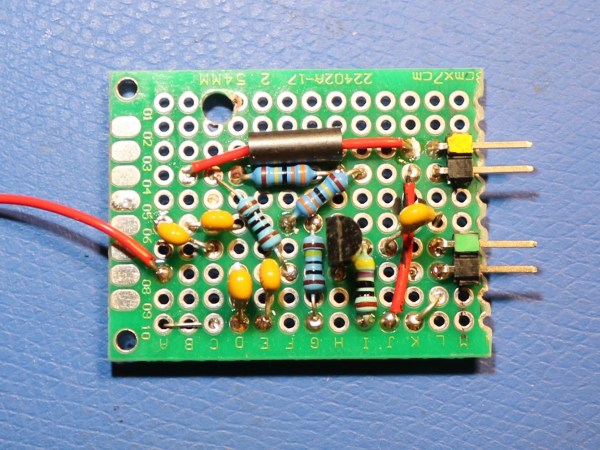
Over the years the humble 555 timer has been used in so many unexpected places, but there’s a project from [Frank Latos] which we think may be a first. On a piece of stripboard sit a pair of 555s, and instead of the usual passives there are a set of LC circuits. This is no timer, instead it’s a CW (Morse) transmitter for the 80 metre amateur radio band.

One 555 is configured as a feedback oscillator through a toroidal transformer with a tuned circuit to set the frequency of oscillation. The other takes an inverted input from the oscillator to produce complimentary push-pull outputs from both 555s, which are fed to another transformer that in turn feeds a low-pass filter and thus the antenna.

Free-running squarewave oscillators of this type are not unusual for the lower HF bands, but we think this is the first 555 design we’ve seen. As shown it doesn’t produce much in the way of RF power, but remembering half-decent motor drivers using a 556 dual timer we think that selection of one of the more powerful 555 variants might deliver some more punch. We commend his creativity though, and hope he can get that all-important entry in the log to prove it works.

If you’re curious about low-power radio operation, it’s something we’ve explored before.

Ham Antenna Fits Almost Anywhere

[G3OJV] knows the pain of trying to operate a ham radio transmitter on a small lot. His recent video shows how to put up a workable basic HF antenna in a small backyard. The center of the system is a 49:1 unun. An unun is like a balun, but while a balun goes from balanced line to an unbalanced antenna, the unun has both sides unbalanced. You can see his explanation in the video below.

The tiny hand-size box costs well under $40 or $50 and covers the whole HF band at up to 200 W. The video shows the inside of the box which, as you’d expect, is a toroid with a few turns of wire.

Continue reading “Ham Antenna Fits Almost Anywhere”

Frame Antenna Works The Low Bands

The lower the frequency of radio transmission, the more antenna that will be needed in general. [OM0ET] wanted to work the 80M to 20M ham bands and decided to turn to a frame antenna. You can see the project in the video below.

The antenna looks a lot like a magnetic loop antenna. The one in the video has seven loops forming a 520mm square. The loop is, of course, an inductor and by removing some insulation, the operator can clip a lead at different points to control the inductance. A variable capacitor resonates the antenna, so there is definitely tuning required.

Continue reading “Frame Antenna Works The Low Bands”

SDR Toolkit Bends Weather Station To Hacker’s Whims

We probably don’t have to tell most Hackaday readers why the current wave of low-cost software defined radios (SDRs) are such a big deal for hackers looking to explore the wide world of wireless signals. But if you do need a refresher as to what kind of SDR hardware and software should be in your bag of tricks, then this fantastically detailed account from [RK] about how he hacked his La Crosse WS-9611U-IT weather station is a perfect example.

Looking to brush up his radio hacking skills, [RK] set out to use the ADALM-PLUTO software defined radio from Analog Devices to intercept signals between the La Crosse base station and its assorted wireless sensors. He notes that a $20 USD RTL-SDR dongle could do just as well if you only wanted to receive, but since his ultimate goal was to spoof a temperature sensor and introduce spurious data into the system, he needed an SDR that had transmit capabilities.

No matter your hardware, Universal Radio Hacker (URH) is the software that’s going to be doing the heavy lifting. In his write-up, [RK] walks the reader through every step required to find, capture, and eventually decode the transmissions coming from a TX29U wireless temperature sensor. While the specifics will naturally change a bit depending on the device you’re personally looking to listen in on, the general workflow is going to be more or less the same.

In the end, [RK] is not only able to receive the data coming from the wireless sensors, but he can transmit his own spoofed data that the weather station accepts as legitimate. Getting there took some extra effort, as he had to figure out the proper CRC algorithm being used. But as luck would have it, he found a Hackaday article from a couple years back that talked about doing exactly that, which help put him on the right path. Now he can make the little animated guy on the weather station’s screen don a winter coat in the middle of July. Check out the video below for a demonstration of this particular piece of radio prestidigitation.

Continue reading “SDR Toolkit Bends Weather Station To Hacker’s Whims”

An NFC Antenna Ring With A Chip As Its Jewel

Contactless payment by means of NFC-enabled bank cards has made our everyday transactions far more convenient over the last decade, but there still remains the tedious task of finding the card and waving it over the reader. Maybe embedded chips are a step too far for many of us, but how about a bank card in a wearable such as a ring? [Jonathan Limén] shows us how, by taking the NFC chip module from a bank card and mounting it on a ring with a wire coil antenna embedded within it.

The chip in a bank card comes mounted on a small thin PCB with contacts on one side and a coil on the other that serves as its antenna. It’s not sensitive enough to work reliably with most card readers, so the card incorporates a separate printed circuit layer that forms a large-sized tuned circuit which couples to the chip antenna. After taking us through the removal of the chip from the card with some acetone, he proceeds to create a replacement for the card antenna by winding a wire coil round the ring. This becomes a trial-and-error process, but in the end, the result is a working NFC payment ring.

We quite like this idea, but would be tempted to both take away some of the trial and error with a vector network analyzer, and run a couple of turns of the wire as a closer coupling coil for the chip. This is a subject we’ve looked at before here at Hackaday, and we wouldn’t mind having another go at it.

Ham Radio SSB Transceiver Fits In Pocket

Talking about this Chinese ham radio transceiver requires a veritable flurry of acronyms: HF, SSB, QRP, and SDR to start with. [Paul] does a nice job of unboxing the rig and checking it out. The radio is a clone of a German project and provides a low-power radio with a rechargeable battery. You can see his video about the gear below.

SSB is an odd choice for low power operation, although we wonder if you couldn’t feed digital data in using a mode like PSK31 that has good performance at low power. There are several variations of the radio available and they cost generally less than $200 — sometimes quite a bit less.

There isn’t much on the front of the radio. There are a few buttons, a rotary encoder, and an LCD along with a speaker and microphone built-in. There are ports for power to run the radio if you want to not use the battery and a separate port for battery charging. There are also ports for a key, external microphone and speakers, and audio connections that look like they’d work for digital modes. According to commenters, the radio doesn’t have an internal charging circuit, so you have to be careful what you plug into the charging port.

Looking inside, the radio looks surprisingly well made. Towards the end of the video, you can see the radio make some contacts, too. Looks like fun. This is a bit pricey for [Dan Maloney’s] $50 Ham series, but not by much. You might borrow an antenna idea from him, at least. If you prefer something more analog, grab seven transistors and build this SSB transceiver.

Continue reading “Ham Radio SSB Transceiver Fits In Pocket”